Putin vs Petrov: Is House of Cards Close to the Truth?

1. No, Putin is not tall, charming, handsome, and linguistically gifted. He is 5’5, ugly, socially awkward, speaks very little English, and his Russian vocabulary is that of a lower-level small-time gang member.

2. No, there is no evidence that Putin killed a mujahid in Afghanistan with his bare hands. He wasn’t even in Afghanistan.

3. Yes, Putin is divorced and it is also rumored that he secretly married his long-time mistress and the mother of his two children Alina Kabaeva. 

4. Yes, there is heavy persecution of gay people in Russia but they are fighting for their rights on their own, without any noticeable help from American activists.

5. Yes, Putin has been accused (by some quite reliable people) of blowing up apartment buildings in Russia as a pretext to starting the second war against Chechnya.

6. Yes, it is true that an opera house in Moscow was taken over by Chechen terrorists and Putin gave orders to gas everybody in the building, including hundreds of civilian hostages.

Book Notes: El pensionado de Neuwelke by José C. Vales

Author: José C. Vales

Title: El pensionado de Neuwelke

Year of publication: 2013

My rating: 2 out of 10

This is the book I thought was fantasy but it turned out not to be. This didn’t make the book a whole lot better, though. In this novel, a governess in a boarding school in Livonia (this is an area in the Baltic states) during the 1840s suffers from an affliction that makes some sort of a ghost-like substance come out of her every once in a while, freaking everybody out. So for 460 pages, the ghost-like substance comes out of the governess and everybody freaks. Then it comes out some more, and everybody freaks. And then the book mercifully ends. And that’s it. There is no explanation of the ghost-like substance and no real resolution to anything. The novel is some sort of a weird pseudo-Gothic thing that just goes on and on and on pointlessly.

After finishing this painfully long and wordy novel, I did some research to find out what the hell it was all supposed to mean and discovered that people who believe in all kind of paranormal crap do think there was a real governess in Livonia in 1840s who had this ghost-like substance come out of her. So El pensionado de Neuwelke was directed towards this weird audience. 

I knew things were bad in Spain but I had no idea they were so bad that 460-page novels on ghost-like substances were sorely needed. I have no idea if the book will be translated into English and I don’t care to find out because I didn’t like it. The book gets 2 stars instead of zero because there was an endearing character called Augusta Dehmel who suffered from insane jealousy and that character was finely done. Spanish authors have not lost their skill of writing about jealousy in a convincing way. Other than that, the novel was a major disappointment.

Superfluous People

A very interesting article on “superfluous people” and why no social unrest is possible:

My best guess at present is a combination

of drugs and computer games as a solution for most … it’s already happening. Under different titles, different headings, you see more and more people spending more and more time, or solving their inner problems with drugs and computer games

And that’s precisely why mass unemployment will not lead even to a shadow of a protest in post-industrial societies.

Of course, there’s still time to wake up and turn in a different direction. There’s still time.

American vs Russian Exceptionalism

A myth of exceptionalism lies at the basis of every nation-building process. As we know, a nation is an invented community, and everybody prefers to imagine their community as the best at something or maybe even at everything. If the purpose of nation-building is to create an emotional attachment strong enough to convince people to lay down their lives for the imagined community, then nothing is more reasonable than to imagine the nation as exceptional.

Everybody’s exceptionalism is different, however. The American version is what I call “a triumphant exceptionalism.” Its narrative is celebratory and goes as follows: 

We have the greatest freedoms, we are proud of our constitution, we are a land of opportunity, anybody who comes here can advance on his or her own merits, American Dream, Civil Rights movement, life, liberty and happiness for all, only here you can achieve everything you want if only you try.

It is completely beyond the point to which extent the myths of nation-building are grounded in reality. They don’t have to come from reality but they do end up shaping it.

Now, the Russian version of exceptionalism is what I call “aggrieved exceptionalism.” Its narrative is sulky and self-pitying:

We have the most spiritual of all cultures, the most beautiful of all languages, the richest of all literatures, the most glorious of all histories but nobody recognizes our achievements, everybody steals our inventions and appropriates our victories, we are surrounded by enemies, we keep saving the world but the world is ungrateful and persecutes us.

Imagine repeating “there are enemies everywhere and everybody hates me” to yourself for ten days in a row. How will that make you feel? Will that have an impact on your life? And what if you were to repeat it for 100 years? All day, every day, nothing but this. 

Yes, these narrative are manufactured, constructed but they, in turn, manufacture reality.

Pointless Dumbassery

dumbass

Because living in a state of bitter anger is an enormously heavy burden to bear, you insensitive dimwit. These are people, not props for you to exercise your idiotic wit on Twitter.

Concordia librarians to help Muslim students cull ‘inappropriate’ books

Montréal ‘ s Concordia University is often a weird place. And not in a good, heart-warming way.

The Talk on Ukraine

Yesterday, I had an Instagram evening. I didn’t open an Instagram account and didn’t go on Instagram. But – in an extremely rare development – I lost my speaking capacity. All that remained from me was a pretty picture but no words.

The reason this happened was that I had overextended myself speaking throughout the day. First, there was my talk on Ukraine that went longer than I thought because there were so many questions. Then I had to retell the whole thing to people who couldn’t attend. Then I had to retell it on the phone. And so by the time N got home, I could barely mumble a few words. And no, he wasn’t happy because he likes it when I talk. Which is normally all the time.

But I’m happy about how the talk went. I almost cried 3 times and one of these instances it was hard to conceal it. The questions were smart. The Chair said that I give people a charge of energy when I speak. So I probably have a career in motivational speaking.

If there are any questions on Ukraine on the blog, I welcome them.

Russia Celebrates the GULAG

I know people hate long quotes but this is really important:

Russia’s only Gulag memorial is redesigned to celebrate the Gulag

Perm-36, Russia’s only Gulag memorial, has announced its first exhibit since the state seized it from a local nonprofit. What was a museum of Soviet political repression will now showcase the technical means used to keep prisoners detained, focusing more on the guards than the inmates.

Viktor Shmyrov, the director of the nonprofit that until recently managed Perm-36, told the BBC that the museum is being maintained, but its public presentation is getting a complete overhaul. “Now it’s a museum about the camp system, but not about political prisoners. There’s nothing said about the repressions or about Stalin,” Shmyrov said.

The white-washing of Stalinism has been going on in Russia for years. School textbooks were modified back in 2005-6 to refer to Stalin as “an effective manager” who industrialized the country and defeated Nazism. Stalin’s purges were presented as unfortunate but necessary for the great task of building a strong and powerful country.

Back in the late 1980s and very early 1990s, there had been a short spike of interest in Russia towards history and towards bringing to light the crimes of Stalin’s regime. But that interest soon fizzled out. For Russia, discussing Stalin is dangerous because it leads to the unwelcome issue of ethnic and racial genocide that lies at the basis of Stalin’s empire. Much of Russia’s nationalistic discourse today comes straight from Stalin’s era. It is not surprising that Putin insists so often that the early years of the Cold War were the best time in the history of humanity. 

The GULAG (which cannot possibly be used in the plural, like many people inexplicably keep doing) was an uncomfortable and inconvenient thorn in the side of Putin’s extremely nationalistic regime. Doing research on the subject, commemorating it or discussing it in public in any way was not welcome. 

As we all know, the past that we refuse to acknowledge and process always comes back. 

This is what the museum looked like before being taken over by the government.

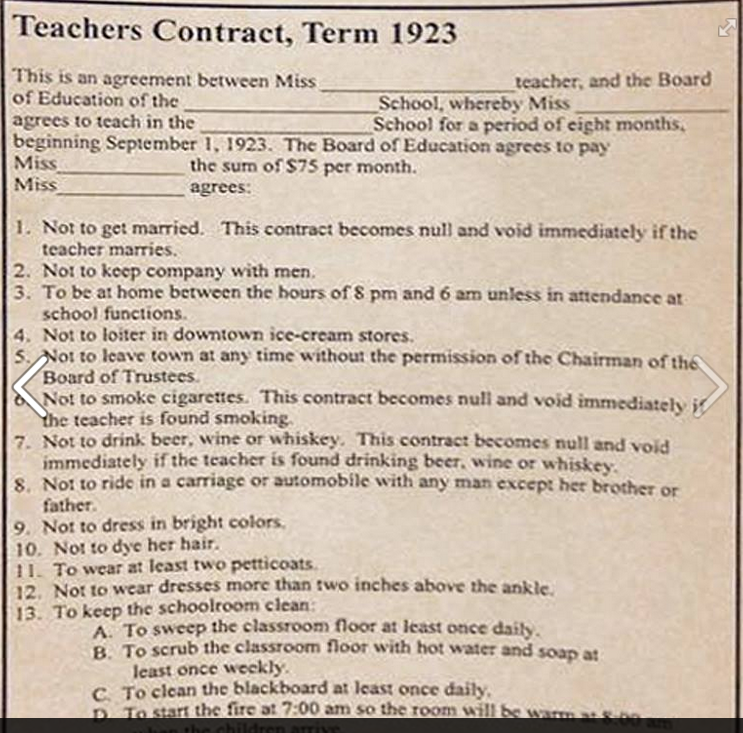
Teacher Contract: Ohio Education Association

teacher contract

Well, I don’t loiter at ice-cream stores, so that’s one point in my favor. The rest, however, I bomb at.