Saturday Link Encyclopedia

Who knew that Joyce Carol Oates was this dumb?

And so is CofE: “The Church of England has appointed as Bishop of Sherborne a leading advocate of Christian nudism.”

Why are issues of identity dominating the 2016 campaign?

The famous videos exchanged by Ukraine and Turkey in support of each other’s armed forces.

A review of Ta-Nehisi Coates’s book. It has some questionable stuff but also some good points. An interesting, valuable review.

In recognition of their complicity in ‘structural racism and oppression’ atOccidental College, the faculty will vote on a resolution that mandates diversity training, requires all academic departments to make racial sensitivity a component of in-class instruction, and allows students to “report microaggressions” between students and professors.” I don’t know where this crazy college is and I hope never to find out. Because faculty members that use the word “microaggressions” in official documents are dumb as doorknobs.

Oklahoma Wesleyan University, on the other hand, has at least one intelligent person on campus: “Oklahoma Wesleyan is not a “safe place”, but rather, a place to learn: to learn that life isn’t about you, but about others; that the bad feeling you have while listening to a sermon is called guilt; that the way to address it is to repent of everything that’s wrong with you rather than blame others for everything that’s wrong with them. This is a place where you will quickly learn that you need to grow up! This is not a day care. This is a university!

Caitlyn Jenner is voting Republican. And what did anybody expect given that this is a person who thinks that being a woman is about buying nail polish and choosing outfits?

Negative father complex makes you a prime target for this particular kind of scammer.

The U of Ottawa cancelled a free yoga class because. . . it’s cultural appropriation. Let’s now cancel all of my courses because I’m not Hispanic, which means I’m obviously appropriating.

The really shocking thing about the crazy Momma and the gay teacher is how illiterate both are. They probably attended U of Ottawa.

Fun International News

And now for some fun international news.

Erdogan is trolling Putin in a really hilarious way. To Putin’s complaint that Turkey didn’t even contact him after taking down the Russian fighter jet Erdogan responded that he tried getting in touch but the connection wouldn’t go through. This reply is so similar to the crap Putin himself loves to dish out that the whole thing is beyond funny.

In a show of gratitude, Ukrainians made a video extolling the armed forces of Turkey that made Turkish people feel so touched and happy that they made a video extolling the armed forces of Ukraine. Peace, love, bubble gum.

Hollande, in the meanwhile, arrived in Russia on a visit that lost all meaning since the escalation between Russia and Turkey. The poor fellow who goes from one embarrassment to another found himself in the unenviable position of having to listen to a litany of Putin’s complaints about the evil Turkey and the even more evil Americans who caused the entire debacle.

Prayerful in Chechnya

From now on, police officers in Chechnya will have to write reports on the number of prayers they say on a weekly basis. All the prayers in each precinct will be summed up and sent to the police headquarters. The Ministry of the Interior will keep track of the number of prayers performed at every precinct and take measures if the praying policemen fall behind the quota.

Nothing is funnier than post-Soviet people who discover religion.

Michel Houellebecq’s Submission: A Review, Part II

There was so much idiotic hype and so many stupid, superficial reviews of Houellebecq’s novel Submission, that I almost decided not to read it. Houellebecq did the unthinkable and mentioned that which shall not be named – Muslims – which immediately unleashed a tsunami of “Islamophobia!” on the one side and “Scary Muslims!” on the other. Besides, most people have a very low readerly culture and can’t distinguish between a book’s author and its first-person narrator. If the character is not “likeable” and people can’t “identify” with him, the author must be an evildoer deserving of nothing but supercilious dismissal. As a result, reviews of anything more complex than Hunger Games are massively useless.

Houellebecq’s novel is about the terrifying ease with which all gains of civilization can be lost almost instantly and imperceptibly. The culture of consumerism creates crowds of spoiled, infantile people who are incapable of dealing with any discomfort. And preserving civilization presupposes complexity, struggle, and difficulty.

Women’s rights, the welfare state, scholarship, literary criticism, the traditions of intellectual inquiry – all these earth – shattering, incredible gains of the Western civilization can be easily lost to religious fanaticism with its cocooning, imbecilic certainties, to empty blabber about free markets and family values that are supposed to cure all ills, to intellectual sloth, to meaningless pseudo-liberalism of brain-dead multiculturalists.

This is a very angry novel. Houellebecq goes to enormous lengths to provoke and enrage his readers. Most of all, I believe, he banks on provoking women by reminding us how crucial the achievements of the Western civilization are for women who want to have a life of a human being and not an insect.

The great paradox of the Western civilization, points out Houellebecq, is that its greatest achievements – women’s liberation, the rights of individuals to pursue happiness on their own terms – make the civilization more vulnerable. There is no freedom possible without the greatest form of liberty of all: an individual’s right to control what comes in and goes out of her or his body. Bluntly put, a civilization where an individual matters will always be less numerous than a civilization where the concept of an individual has no currency. Producing mindless, patient ants who toil stupidly without a single thought of their own is easy. Creating individuals who find their own meaning and construct their own lives is hard. And mass production tends to overwhelm creative artisanship.

[To be continued. . .]

Black Friday

And now, for the first time ever, we are participating in the all-American Thanksgiving pastime called Black Friday! And to make things even more stereotypical, we are getting a huge flat screen TV.

I’ve never been as much as out of the house on Thanksgiving, so this is a great new experience.

Michel Houellebecq’s Submission: A Review, Part I

Sorry, the review will be long because the novel is profound and offers a lot to think about. 

When my students pout that I “hurt their feelings” or “made them feel stupid” by correcting their Spanish grammar in class or in their papers, they exhibit the typical consumerist philosophy of life. A consumer believes that if s/he paid for education (with money or the fact of enrollment), this purchase, just like any other object of consumption, should bring nothing but uniform, unbroken pleasure. When a purchase results in anything other than pleasure, consumers revolt. 

Consumers bring the same approach to interpersonal relationships. It’s impossible to create a profound, meaningful bond with another human being without exposing oneself to a certain amount of unpleasantness, conflict, incomprehension, compromise, anger, pain, etc. Profound relationships can’t be built with objects, only with human beings whose full humanity you are willing to accept and accommodate. 

Consumers, however, can’t tolerate compromise or conflict with their purchases. They flit from one lover, friend, boss, co-worker, etc. to another in search of a uniformly pleasing, ego-stroking relationship. All they manage to encounter is a series of superficial, disappointing contacts that never manage to provide them with the Hallmark tableau of endless bliss that they seek.

François, the protagonist of Michel Houellebecq’s best-selling novel Submission is precisely this kind of pouty consumer. At the age of 44, he feels useless, lonely and sad because all he has in his life is a long procession of indifferent, uncaring lovers with whom he fails to establish any sort of a fulfilling bond.

Like a typical consumer, François never conceives of the possibility that the reason for his loneliness might lie inside himself. If the goods – that is, women in his life – fail to satisfy, there must be a design flaw in the goods. François decides that the reason why women can’t provide him with a family, love, a strong emotional bond, great sex and wonderful cooking is that. . . they work and working exhausts them so much that they have no energy left to fulfill all these functions.

François is not an idiot. He is a university professor and a very well-read man. However, he is so overpowered by consumerism that he fails to observe how bizarre his explanations of his own unhappiness are. For instance, François argues that the only truly sexual women are those who live in Saudi Arabia because they really don’t have to work and can save all their energy for sex.

When life doesn’t work out the way commercials promise it should, consumers begin to look for a “happy pill” that they can buy to make themselves feel better. François searches for his “happy pill” everywhere he can: at a Catholic convent, in the apartments of prostitutes he hires, at the house of his polygamous Muslim colleague, in an endless succession of restaurants and bars, etc.  

The real tragedy of the novel is not that the pill which François buys is called “Islam” (as opposed to “Christianity”, “nation-state”, “humanism” or “pink elephants with blue spots”), as many of this book’s reviewers suggested, but that his incapacity to awaken from the consumerist slumber of reason prevents François from abandoning the search for a “happy pill” altogether.

Powerless in the Crimea

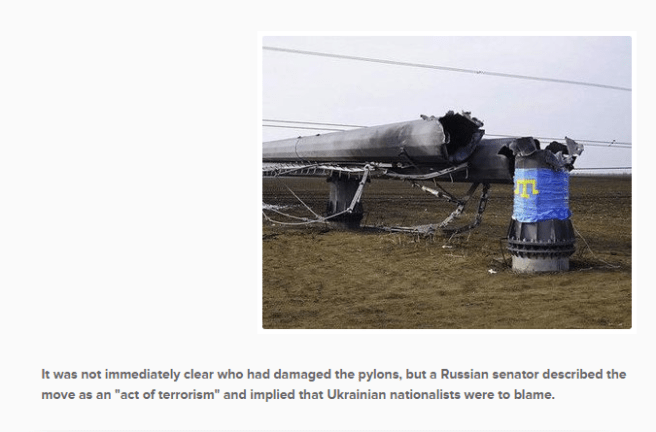
Western journalists are truly something special. The following photo with the caption you can see has been making the rounds on English-speaking websites:

Crimea without power from Ukraine after electricity pylons ‘blown up’|

crimea electricity.PNG

Why a Russian senator’s opinion on the Ukrainian pylons should be valuable is not clear. What is even less clear is what exactly is preventing the journalists reporting the story from noticing something that looks very much like a flag tied around the base of the pylon. One might even expect a responsible journalist to find out which group this flag represents ( a hint: not Ukrainian nationalists) and maybe even discover who and why is most interested in liberating the Crimea from the Russian occupation.

If we allow our imaginations to suggest that some really professional journalists might exist somewhere on the planet, we could even expect such journalists to discover what exactly forced the group represented by this flag to blow up the pylons now and not, say, two months before or after.

But no, that would be too much work. It’s easier to ask a Russian senator, a cow in the field, or a bunch of tea leaves what is happening.

Russia: Funny Factoids

To begin today’s festivities, a couple of entertaining but true factoids about Russia.

1. In Russia, anybody who mentions ISIS in a public context is obligated by law to follow the word “ISIS” with “a terrorist organization that is banned on the territory of the Russian Federation.” In Russian, this sounds even more clunky than in English. Imagine what poor TV journalists and commentators have to go through when they do news segments on ISIS. The endless repetition of this formula has a hypnotic effect and, at this point, nobody hears anything but the formula.

2. The Russian Parliament (called “The Duma”) has a committee dedicated to the defense of Christian values. Yes, seriously. But wait. It gets better. The committee is chaired by an MP who belongs to the Communist Party. Yes, seriously. But wait. It gets better. This Communist / defender of Christian values suggested that Russia take Hagia Sophia away from Turkey. Since Hagia Sophia is located in Istanbul, this must mean an invasion of Turkey by Russia, but hey, when Christian-Communist values demand an invasion, an honest MP cannot resist.