Klara can write her name:
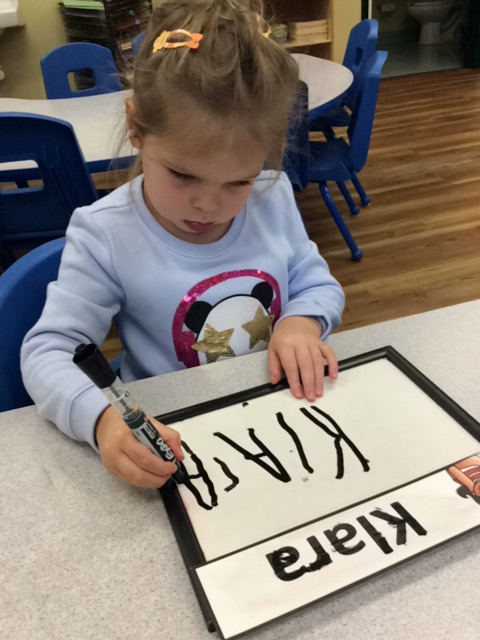
The last name is going to be trickier because it’s long. I heard that kids need to be able to write their name to go to kindergarten, so she’s all ready. Not that I’d ever agree to earlier schooling or skipping grades.
Opinions, art, debate
Klara can write her name:
The last name is going to be trickier because it’s long. I heard that kids need to be able to write their name to go to kindergarten, so she’s all ready. Not that I’d ever agree to earlier schooling or skipping grades.
Remember how Zuboff insisted that surveillance capitalism wasn’t ideological?
She was completely wrong.
An author I’m reading (full review will be available once I finish the book) conducted a curious experiment.
He entered the words “European art” into Google images. And a strange thing happened. The search returned a large number of paintings depicting black people. European art depicting black people did exist historically. But it was nowhere near half of all European paintings, like the search shows.
Then he entered the words “white couples.” Most of the images showed interracial or black couples. Try it yourself. It’s definitely an experience.
Then he searched for “straight couples.” The author is gay, so he was curious. You can guess what came up. Hint: not only or even mostly straight couples.
He decided to try this experiment in different languages. And a curious thing happened. The answers were the most skewed in English-language searches. They were better in Western European languages. But when he tried the same searches in Turkish, the results were suddenly normal. White couples were white. Straight people were straight. European art was exactly what we think it is. I tried the experiment in Russian, and European art came up as not nearly as… erm, diverse as in the English search. Actually, it wasn’t diverse at all. The Spanish search returned more diversity than the Russian but a lot LOT less than the English search.
It’s very obvious that the search results are manipulated before you can see them. Or maybe there’s a totally benign explanation for why these searches look like a fantasy of the Chief Diversity officer at Reed College. It might be a total coincidence that “the political atmosphere in Silicon Valley is several degrees to the left of a liberal arts college. Social justice activism is assumed – correctly – to be the default setting for all employees in the major companies and most of them, including Google, put applicants through tests to weed out anyone with the wrong ideological inclinations. Those who have gone through these tests recount that there are multiple questions on issues to do with diversity – sexual, racial and cultural – and that answering these questions ‘correctly’ is a prerequisite for getting a job.”
There might be no connection at all and it’s all an innocent glitch.
Or maybe it isn’t.
Gypsy Bride is a bestselling police procedural by a mysterious Spanish author who writes under a pseudonym.
To those who love the genre (which is about zero people on this blog, it seems) I can explain exactly what Carmen Mola is like. She’s a Spanish Tess Gerritsen.
Gerritsen is the author of extremely gruesome novels about serial killers and eccentric, damaged women detectives who hunt them down. Gerritsen’s blood-curdling novels were turned into a comedic TV series Rizzoli and Isles but that’s not the author’s fault. She’s still the most lurid mystery writer I know.
Mola is clearly a great fan and is imitating Gerritsen for the Spanish public. It isn’t plagiarism. Mola is inventing her own gore. But she’s following Gerritsen’s model pretty faithfully. Gerritsen’s been neutered by the constraints of writing for the stupid show, so now the lovers of extreme ickiness in police procedurals can go to Mola instead.
By the way, Gypsy Bride is the only mystery/police procedural in Spanish that I read of my own free will and actually finished. I detest Hispanic mystery as much as I love the English-language version of the genre. But again, I only read it because it’s like reading Gerritsen in translation.
Bullet-journaling works because, as the creator of the method says, knowing that there is a place you can dump all of your mental clutter frees up a lot of brain space.
Also, carrying it around means that whenever there’s some unexpected free time you can work on one of your projects. A lot can get done in that way.
I’m chairing a committee with a very complicated, multi-stage task, and it’s 5 times easier now that I bullet-journal than when I did it last time.
Academics who were never forced to interrupt their teaching and research to go sort rotting cabbage for two weeks should shut the ef up about the beauties of socialism.
The full title of the book is Affect and American Literature in the Age of Neoliberalism, and the author is Rachel Greenwald Smith. I’m sure everybody can guess from the title that I’m wildly enthusiastic about the book. Smith is a very good writer and a talented literary critic. She writes about the way making, reading and thinking about literature changes in the age of neoliberalism. The theoretical part is spot-on. And the evisceration of the deeply obnoxious “affective turn” in literary criticism is priceless.
The actual analysis of the novels, however, is… Let’s say it’s different from what we do in the Hispanic literary criticism. Smith contrasts novels that she decided are bad (or neoliberal) with the ones she thinks are good (or not-so-neoliberal). Problem is, I can argue that the ones she says are neoliberal are actually not and vice versa. We don’t pass this kind of value judgments in my field. We see our job as completely different from what a NYTimes book reviewer does.
But that’s not even the worst part. What really troubles me is that after reading Smith’s very good book I am most certain that I have absolutely no interest in reading any of the novels she analyzes. There’s something wrong in that. Grab any 10 novels in a bookstore completely at random, and I can guarantee I’ll want to read at least a couple. And if you remove any romance or sci-fi books from the mix and only leave what Amazon calls “literary fiction,” chances are, I’d want to read 8 out of 10.
I don’t think Smith chose a bunch of particularly horrid novels to analyze. But there’s something in the way she writes about them that makes me want to do everything to avoid reading them. And that even goes for the ones I already read and enjoyed.
To me, there’s no bigger compliment than somebody telling me they are desperate to read the books I analyze in my scholarship. But that’s how we are trained in my field. We are very strongly discouraged from writing about works of literature we don’t particularly like. And since we are in a non-hegemonic language and literature field in the US (especially in what concerns peninsularists), we are always trying to convince everybody that our field merits interest. I can’t dedicate half a book discussing novels I think are crap. Maybe that’s a bad thing because it comes from a culture of scarcity in my field. Be that as it may, I leave the discussions of the books I hate for my blog.
Smith wrote a really wonderful book. It’s probably the most enjoyable volume of literary criticism I have read in a while. But it’s in a different field, and things are different in it. I’m writing about the neoliberal subjectivity in the Hispanic novel, so Smith’s book is helpful in that regard.
 Clarissa's Blog