This boy made a portrait of Leonardo Di Caprio out of 400 Rubik’s Cubes:
I find this unbelievably cool.
Opinions, art, debate
This boy made a portrait of Leonardo Di Caprio out of 400 Rubik’s Cubes:
I find this unbelievably cool.

I hate to say I’m not going to read something but I don’t think I want to read this book. I don’t believe there’s anything new and interesting in it for me. To the contrary, I suspect it will make me angry.
The greatest harm that a screen does to a child is that the parent is staring at it instead of looking at the child. But nobody is willing to say that because it’s easier to format children than to convince adults to exhibit some self-discipline. Parents are the people who will buy the book, and Haidt can’t afford to antagonize them.
The narrative of “evil companies who hooked kids on purpose” is weak sauce and boring. We’ve heard all this before with Coca Cola, Barbie dolls (before they were rebranded as good for you), junk food, etc. Of course, companies want people hooked on their wares. Their responsibility is to their shareholders. They definitely can’t be expected to have a greater responsibility to children than those children’s parents.
This problem gets solved the moment the parents put the phones away when interacting with their children. That’s it. That’s all that’s needed. Don’t hold the bloody things in your hand – turned on or off, doesn’t matter – around children. These kids are miserable not because somebody said something on Snapchat but because Mom hasn’t had an uninterrupted day with them during their whole lives. Snapchat is horrible, definitely. But it’s not Snapchat that’s doing the damage. It’s the distracted, absent parent who interrupts every conversation with the child to stare at a little plastic rectangle. I’d like to read about that but it doesn’t look like anybody will have the guts. Or the readers if they do.
Today, Russia directed most of its bombing to the Western regions of Ukraine. Because that’s where the Catholics live, and it’s their Easter.
The Ukrainian Orthodox will get particularly harsh bombings on Orthodox Easter, May 5.
Happy Easter to those who celebrate today.
In Canadian literature, people are constantly getting lost amidst snowstorms and have to trudge for miles through deep snow. That already is a great argument in favor of reading these books. Another point in favor of reading more Canadian books is the existence of David Adams Richards.
Nights Below Station Street is one of his early novels. David Adams Richards was only 38 when he wrote it, and he was over a decade away from having the maturity and depth to create his masterpiece Mercy Among the Children. In Spanish, we call the kind of writing one sees in Nights Below Station Street “costumbrismo”, or a depiction of customs and habits of everyday life. David Adams Richards doesn’t make any grand pronouncements or tackle great philosophical issues in the novel but simply writes about life among working-class people in New Brunswick. The novel is extremely peaceful even when it speaks of dysfunction. Everything is ultimately as should be. Everybody is where they are meant.
I’m fascinated by this writer’s trajectory, and I’ll keep reading him. Especially now that it’s hot as the dickens around here, and it’s good to imagine some snow.
N and I especially love all the normal family stuff – picnics, trips to the zoo, dinners, badminton games, and barbecues – because we didn’t have any of it growing up. I mean, we had the barbecues and stuff, obviously, but none of it was happy. In his case, such events usually led to violence. In mine, there was no violence but anger, humiliation, and nastiness. N and I never thought we’d get a chance to enjoy what family life has to offer.
We exist in a state of being shocked and humbled by our extreme good fortune in experiencing a normal family life.
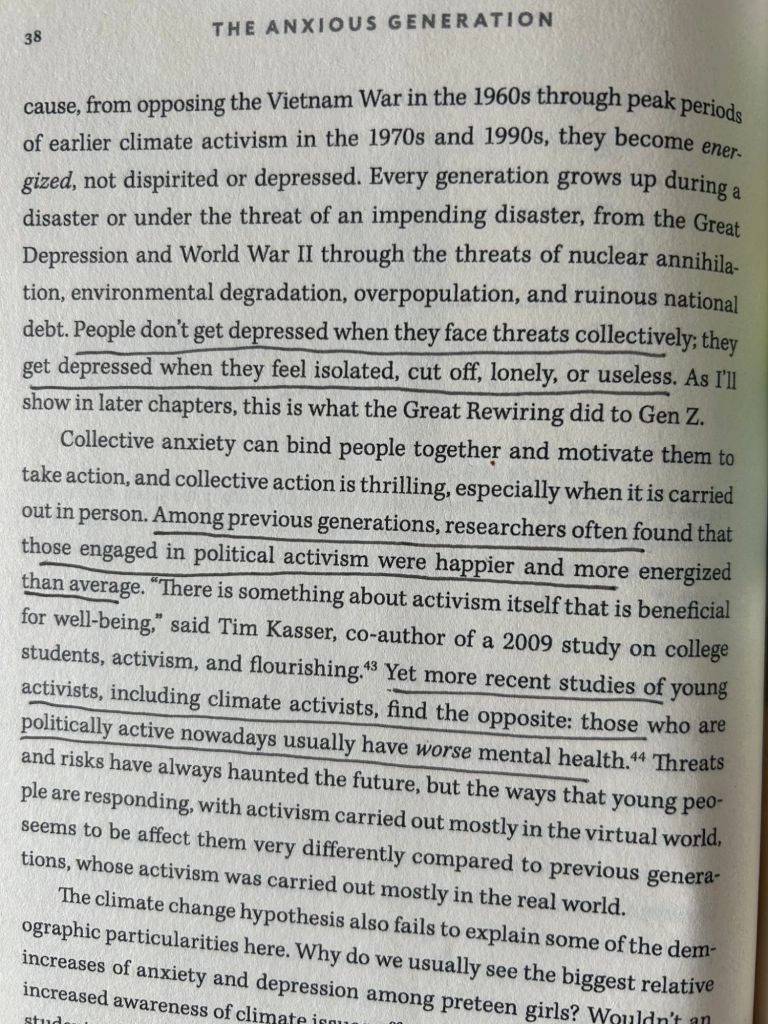
Yes, because “being politically active” now means posting dumb memes online. People are “politically active” by sitting alone and feeling aggrieved.
This is a complete perversion of the initial meaning of “politics” which in its original Greek meant “affairs of the polis”, or “shared life together”. Today, people are most political when most alone. Everybody is too sensitive to discuss politics with others, so it’s only when they are alone with their phone that they let themselves express their political beliefs. And those beliefs are limited to vague, directionless pouting because that’s the only thing one can produce in solitude.
I don’t put my trips and family vacations on social media because the kids at Klara’s school have different lives, and it would be horrible, embarrassing showing off. Of course, Klara tells her friends but children have a way of processing such things through play that renders them normal.
As a result, my only outlet is here, and I’m happy to report that N and Klara are coming with me to Spain for the first time this summer. N is already learning Spanish on Duolingo. This was 100% his idea because I have given up on teaching languages to husbands since the first effort ended up in a divorce.
The opportunity to bring together such central parts of my life is exhilarating.
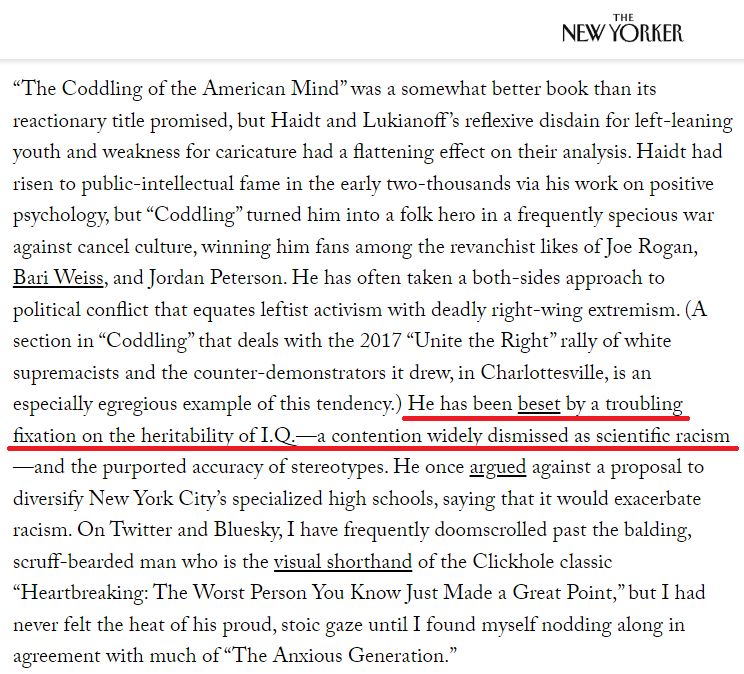
People have gone completely nuts. How can intelligence not be heritable? The rest of the article is partisan, emotional crap, as well, but the underlined sentence is beyond that.
Of course, intelligence is heritable, and the author of the article clearly lost the genetic lottery in this aspect.
That people ascribe moral value to IQ is their problem. They could just as well do it for height and then run around, trying to dispute the glaringly obvious.
I’m glad people are starting to get it.
Instead of cowering in fear of Russian threats, Ukraine destroyed one third of the entire Russian Black Sea fleet and achieved its objectives.
There’s a great lesson for everybody’s life here. Don’t listen to the dire warnings of the professionally senescent and the congenitally subservient. Decide what you need and go after it.
 Clarissa's Blog