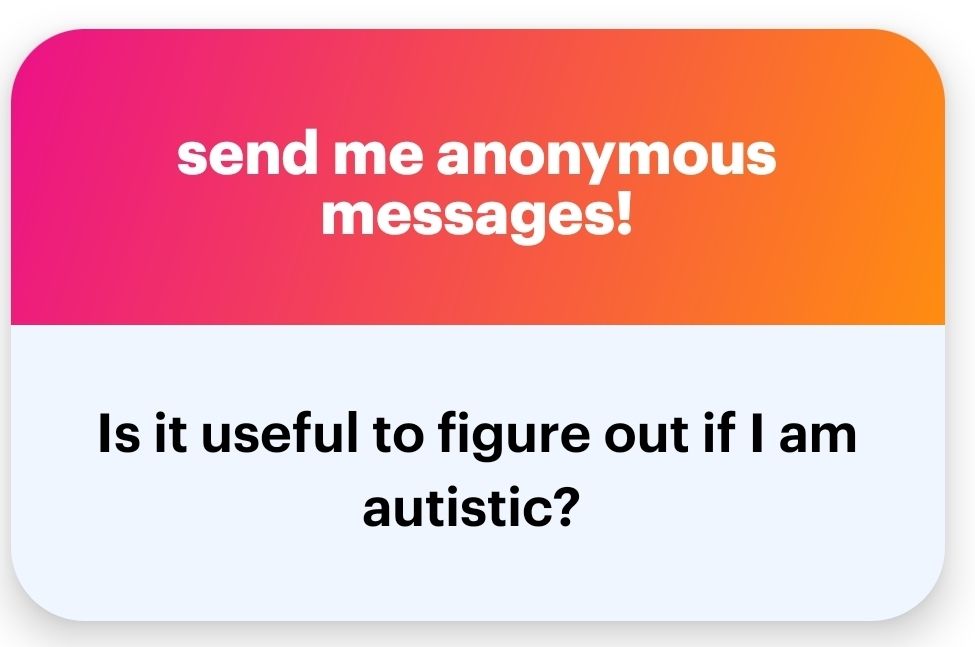
Q&A about Autism

It’s useful if you have spent your whole life knowing that you are weird and experiencing shame and secretiveness because of that weirdness. The knowledge that it is a thing that exists and that many other people have it can relieve the guilt and the anxiety. Once you get rid of the guilt and the anxiety, you can start looking for ways to mitigate certain manifestations and accept the rest of them.

If you’re already in a place where you don’t feel that you need to go to great lengths to conceal your weirdness from others, then I don’t see how it is useful. At a certain point in my life, it gave me enormous relief to find out about autism and realize that I have some form of it. I thought this was a character flaw, but it turned out that it was a neurological condition. Since then, I have mitigated some things and accepted others. I don’t think about the autism label anymore because I no longer need it.

You don’t owe anybody to put a label on yourself. If the label helps you in some way, then that’s fine.

3 responses to “Q&A about Autism”

  1. methylethyl Avatar

    It can be useful for getting lists of things you’re probably doing wrong (without knowing it), and finding ways to do things less wrong. Being normal isn’t really an option, if autism is what you’re dealing with. But very often: we can do better once we have a clearer picture of what, exactly, the problem is. It turns out normal people get kind of creeped out when I stare at a point six feet behind their heads during social interactions 😉 So I try not to do that: I’m never going to get the exact right amount of eye contact, but it turns out… I can at least do better than that, and there are some helpful strategies out there.

    There’s a tremendous amount of writing on the subject, most of it not very helpful. Useful how-to guides are radically overwhelmed volume-wise by highly verbal autistic people writing extremely long rationalizations for why they should be able to keep doing all the things they are already doing, making no adaptations whatever out of courtesy for others who, say, might not enjoy me clicking that clicky pen 800,000 times during an otherwise friendly chat.

    So, uh… beware of the but autism is who I am crowd. Autism as a protected identity to cling to is remarkably maladaptive. We all have to find ways to live in the world God placed us in, not the fantasy world where all our idiosyncracies magically turn out to be superpowers (they are mostly not). Save that for your webfic account.

    If you can filter out the identity and advocacy trash, there is some useful literature looking at specific neurological deficits (usually in medical journals). They don’t give work-arounds or coping strategies for the most part, but often being able to define the problem is a pretty good starting point for finding your own workarounds.

    One other deficiency in the massive amounts of writing on the subject is simply: autism itself is poorly defined. The diagnosis is based on outwardly-observable behaviors, mostly without reference to internal states or causes, and there seem to be multiple ways to get to that set of behaviors. So even if you do have an ASD, not all the stuff talked about in the literature will be useful or applicable to any particular person with ASD.

    Liked by 1 person

    1. Clarissa Avatar

      These are very valuable comments. People make a mistake when they turn autism into an identity. It never leads anywhere positive. Also, if you have children, you owe it to them not to willingly embarrass them in public.

      Liked by 2 people

    2. Demotrash Avatar
      Demotrash

      This guide seems to be popular with sensible autistic people who like to adapt to the world rather than try to force the world to adapt to them:

      https://www.cartoonshateher.com/p/at-28-i-taught-myself-to-be-likable

      Liked by 1 person

Leave a Reply

A conservative literary critic and college professor