In a library book that hasn’t been checked out since 1997, I found this:
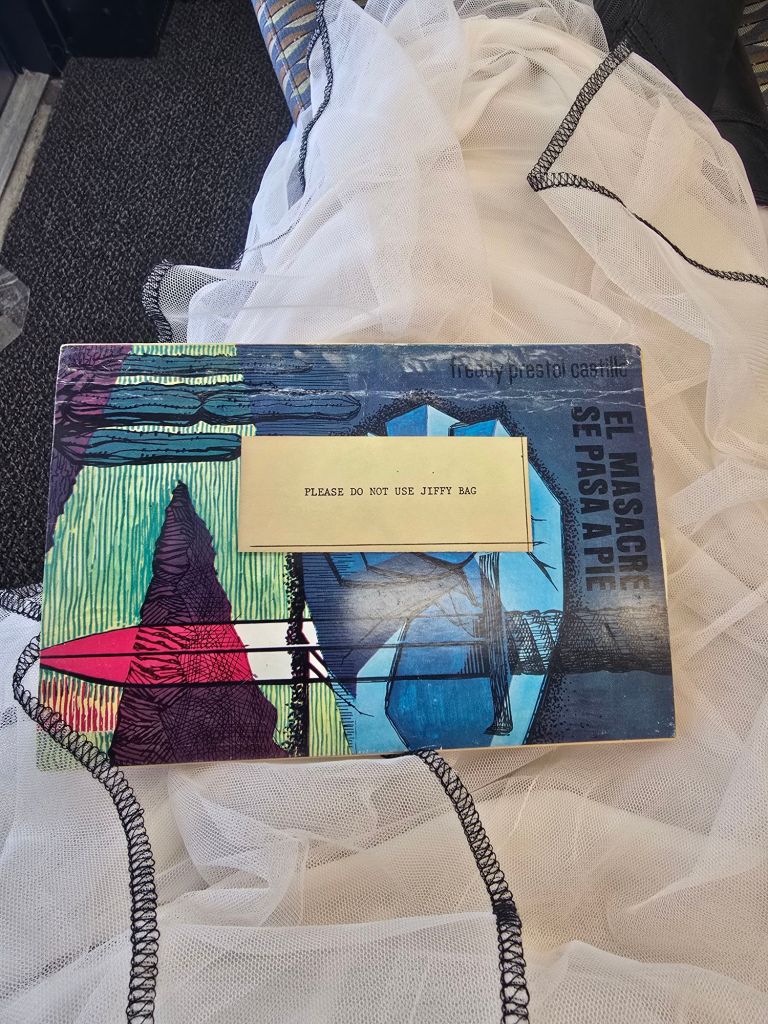
Can anybody decipher this missive?
Opinions, art, debate
In a library book that hasn’t been checked out since 1997, I found this:
Can anybody decipher this missive?
By the way, this stupid, nitpicky thing, Ukrainians do it, too, and it drives me up an absolute wall. For three days now they’ve been bellyaching to Jupiter and back about some dumb Netflix show titled Vladimir. The show is not about Putin. It’s based on a novel about a cheating husband. There’s nothing remotely political there. But no, it’s Russian propaganda, it’s genocidal because the main character happens to share his name with Putin.
But hey, guess what Zelensky’s name was until 15 seconds ago? A Russian-speaking Jew of my age. He was born and spent his whole life as Vladimir. It’s a popular name. My great-grandfather was Vladimir. Am I supposed to not mention him now because Putin? What the fuck?
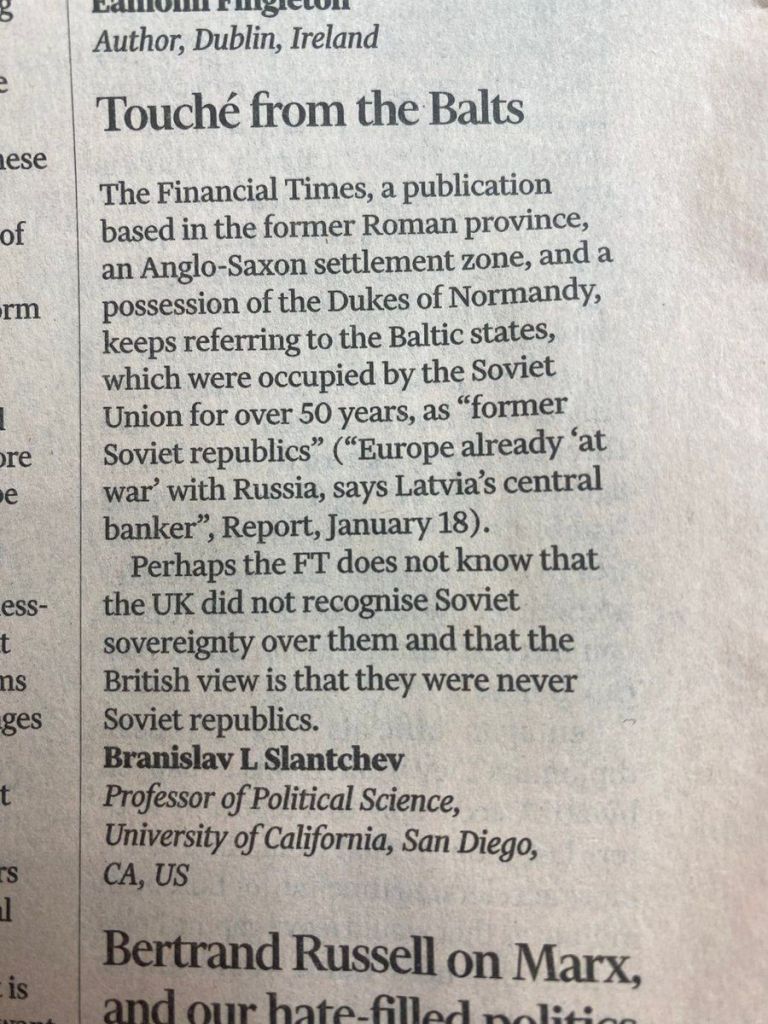
Then there are the Baltics. And this isn’t meant to throw shade on the reader of this blog who is from a Baltic country because he’s solid and not a prima donna. But some people are getting to me. There’s a correct way to say Baltic countries and an incorrect way and somehow I always manage to step into the incorrect one and oh Lordie. And don’t refer to them as former Soviet Republics although that’s literally what they are. Here’s a fresh example from today and I’m so annoyed:
OK, I feel better now. Rant temporarily over unless I remember another victim group that’s getting on my everlasting nerves.
JD Vance Has Made His Choice
By Abe Greenwald
Vice President JD Vance didn’t mention Jews or Nazis in his remarks on Holocaust Remembrance Day. The statement he released yesterday noted instead “the millions of lives lost during the Holocaust,” and “the enduring lessons of one of the darkest chapters in human history.” While these formulations seem vague and empty, they are actually very precise and loaded with meaning. Vance is sending a clear message to Tucker Carlson and his other Jew-hating friends. The message is: Don’t worry, guys. I’m with you.
And he is.
Honestly, the dude can catch no break. If he mentioned Jews, it would be “but why didn’t you mention Slavs?” And the Roma, and gays, and Catholics, and communists, and so on and on.
This nitpicky, pouty, perennially inflamed over being passed over and not having your pet grievance mentioned in every sentence is what I hated on the Left.
But guess what.
A fresh example of saying the thing usually concealed out loud:
After saying for years that illegal don’t vote, Democrats now acknowledge that they not only do but represent a must have. For Democrats.
You’ve got to love the simple-minded dedication of these people.
A frequent criticism of conservatism is that all it does is try to preserve the achievements of yesterday’s radicals. As Ambrose Bierce put it, radicalism is the conservatism of tomorrow injected into today. In 1947, professor of Political Science Bernard Kronick addressed this criticism in an article he published in Southwestern Social Science Quarterly. I love reading Humanities scholarship from before year 1970 because it’s enormously better written than anything you can find today. Kronick, who was born in 1915 and was almost a child in intellectual terms when he published “Conservatism: A Definition”, wrote beautifully. His article is very easy to understand for anybody who is a normal, intelligent and well-read person. There’s zero jargon and a lot of love for the language.
In any case, Kronick says that yes, it’s true that today’s conservatism is yesterday’s radical progressivism. But so what? It still plays the crucial role of slowing the pace of change and making sure that we don’t careen into insane things that will end up destroying us. It is a socially useful task, Kronick says, to modify the manner in which change is introduced while accepting that it will happen eventually.
Conservatives are at a disadvantage, Kronick points out, because their position is by necessity defensive. Their achievement in slowing down change is never recognized because the accolades for introducing the changes always go to the radicals who proposed them, even though these changes could have been terrible without the staying and moderating hand of conservatives. As a result, the conservative movement feels like being nothing but a group of losers. As Kronick says:
The conservative by his very admonitions destroys the likelihood of his fears being realized. He is subsequently ridiculed for what seem to have been foolish fears.
Even when they accomplish little of a positive character, conservatives prevent immeasurable harm. For enormous chaos would result were radicals to have it entirely their own way.
This is why, Kronick reminds us, conservatism is absolutely essential when a society experiences a crisis or undergoes rapid change.
Kronick wrote at a different time and some of his ideas look quaint as one reads them in 2026. This, for example, put a sad smile on my face:
Few desire to live in a state of unceasing change. No people going about its daily business wishes to have its way greatly disturbed for light and transient causes. They desire tranquility above all.
You can hear in Kronick’s words the calm currents of an unhurried time that had not yet witnessed people falling in love with speed, change, and transgression for its own sake.
This tragedy happened during the Biden administration and was directly caused by its insane immigration policies. But the Senate Democrats decided to pretend that this happened recently because they want to use the poor child’s death for political purposes.
You don’t need to “reform detention.” The only solution for this is to stop accepting immigration applications at the border. This solution is being practiced now, preventing many such tragedies.

Wow, this is so great.
On further consideration, no, it’s completely useless. My clutter is exclusively books and clothes, and I love those puppies, and would not give them up even if a herd of elephants visited them for defecation purposes.
By the way, a consumerist personality feels the greatest joy not at the point of buying but at the point of throwing away. Because throwing away frees up space for more buying. Decluttering is the most consumerist activity out there.
A blind diabetic 28-year-old was euthanized in Canada. The horror of this makes my heart stop. Yes, he “wanted it” but he wouldn’t have if he hadn’t been led to want it.
This year I’m working with two blind students. Together (and shh, please keep it a secret) we threw away all the insane requirements of the Disability Office and came up with a system that works for us. These are great young people who will get an education, find jobs, form families and be productive members of society. They have friends, one of them is engaged to be married, and they are both a joy to be around. The idea that we should just get rid of all the blind, diabetic, elderly, infirm and depressed people is deeply immoral.
Yes, the nation-state didn’t exist until the 19th century. Penicillin is even younger. Computers are younger still. Yet we greatly enjoy the benefits of young technology. The newness of something isn’t reason enough to ditch it especially since the post-nation state is even younger than the nation-state. So we aren’t talking about going back to some time-hallowed tradition but embracing something even newer.
I would love to participate in a serious discussion of the nation-state but all I ever get are the same two very vapid objections. One is that the nation-state is an imaginary community, meaning, a recent invention. Which, duh, but so bloody what? As if the post-nation state were a form of government that spontaneously arose in nature thousands of years ago. Whatever comes after the nation will be just as invented and even newer, which in and of itself is neither good nor bad.
The second objection is invariably that the nation-state made the two world wars possible. Again, yes, obvs. The Stating the Painfully Obvious Prize goes to everybody who makes this observation. One would think that if we already paid this humongous price for the nation-state model, then let’s keep it around to reap the benefits. Especially since nobody is advancing an argument that warfare will end once the nation is gone. The nation-state didn’t come into existence because there was no war. To the contrary, it was invented in response to endless warfare that was consuming Europe. War is the natural state of humanity, which sucks bullets (no pun intended), but any fantasy about a complete elimination of warfare is just simply dumb.
No interesting, meaningful objections to the nation-state are being advanced by anybody anywhere. Nobody is trying to list the benefits of the new form of statehood. It’s all childish, inane talk.
In the meantime EU once again shows its great commitment to thwarting Putin’s allies by giving them free reign in Europe.
Please note that the expression “free trade” is now a standard mark of being on the left.
Liberalism is always about exactly what it says. Freedom from limitations, boundaries, traditions, and anything that could place any constraints on it. Of course, it’s only the kind of freedom that pleases capital that it encourages.
 Clarissa's Blog