Canadian Elections

So it looks like the Tories are increasingly likely to win the elections in Canada and even get a lead that is big enough for them to form a majority government.

I can’t say I’m too shocked, either. Based on the policy quiz I took, I disagree with Canada’s Conservatives fiercely on pretty much every subject. And yet, if I were voting in Canada, I’d vote for the Tories.

I’ve been observing Canada (Quebec, especially) all throughout the global economic crisis and I can’t pretend that I didn’t see shockingly great prosperity in the midst of economic woes of planetary dimensions. Whoever made that happen, whoever dragged Canada through the crisis (Americans know it as “the Recession”) so well is very hard to defeat in any election.

Also, the Tories are the only ones standing up for women’s rights (shocking, I know) and denouncing, albeit quite timidly, the degrading habit of dragging around shrouded and animalized women. If you are not a woman, I know you are incapable of comprehending the debilitating effect it has on women to see this kind of thing. Even my husband, a passionate feminist, thinks the issue is funny. Just believe me when I tell you that it is painful, offensive, and deeply humiliating. Whoever manages to squeeze out, “This is not OK” is my hero. (Maybe if you are a Jew you can get what this means to me if you imagine having to see, on a daily basis, Jews who walk off the pavement without raising their eyes and wearing a yellow star on the left side of their chest.)

The opponents of the Tories don’t manage to articulate a convincing set of objections, which is another sign they will not find it easy to win. Their objections are all on the level of “But Benghazi! But the emails! But Bush lied!” And we all know that this kind of childishness loses elections.

>Dr. Antonio Calvo’s Tragedy: Could It Have Been Avoided?

>

What happened to Dr. Calvo who killed himself after being fired in a really nasty way by Princeton University is truly tragic. The question that, of necessity, is on everybody’s mind is what can be done to prevent such tragedies from happening in the future. At-will firing that is the norm in the US is a horrible, inhumane practice. People can be told to clear their work spaces and leave without any warning whatsoever. Often, they are escorted from the premises by security guards and prevented even from saying good-bye to their colleagues of many years. In academia, getting fired between the months of April and September also means that you will not be able to go on the job market until it reopens on September 15. Furthermore, you will not be able to start working until September of the year after that. People who are not US citizens face almost immediate deportation after their work visas are revoked. Obviously, this system implies a lot of pain and suffering for the employees. Workers have to live in a constant fear of dismissal which takes a huge emotional toll.
Unions seem to offer a solution to this issue. They will protect employees from getting kicked out with no warning. However, unions have their problems, too. As important as it is to protect the rights of the employees, it is equally crucial that employers are protected as well. Unions make it extremely hard to dismiss bad employees and reward the good ones. To give an example, the union prevented my department from offering a monetary reward to a stellar instructor on the grounds that every member of the union should be compensated equally. And all my whining about how hard it is to get students to speak Spanish in class? This issue would be easy to solve if it weren’t for the union.
It seems like the only productive solution to balancing the needs of both workers and employees is to have a disinterested third party that will impose a system of regulations to protect everybody. That third party has to be the government. Take Canada, for example. I’m not a complete and utter apologist of Canada, in any way or manner. However, it is evident to me that the way Canadians deal with the issue is quite productive. There is a system of regulations in place that outlines how, when and for what reasons an employee can be fired. People are also provided with a financial cushion that transforms the loss of a job from a tragedy into nothing more than an annoying temporary setback.
Contrary to Libertarian beliefs, this did not hamper Canadian job market in any way. Compared to what we see in the US today, the situation with employment in Canada is quite good.

>Canadian Elections: The Debate

>

Here is the picture of Canadian leaders who debated yesterday as part of their campaign for the upcoming elections in Canada. I saw it and realized that Canada is screwed and will continue to be so while this is what the country’s politics continues to look like.

>Canukistani’s Canadian Style Maple Syrup: A Recipe

>Canukistani, a fellow Canadian and a reader of this blog, noticed that I haven’t posted any recipes in a while, and gave me the gift of the following great post to share with everybody. It is not only useful, it’s funny like hell. I laughed so hard, I’m in actual pain right now. Enjoy! And never say that Canadians don’t have a sense of humor ever again. Thank you, Canukistani!!


Canadian Style Maple Syrup
(Eat your heart out Martha Stewart)
This is my recipe for making Maple syrup from scratch. You might wonder why not just buy it at the store. This stuff is damn expensive! Here’s a graph of the cost in various cities. And you think gas is pricey.

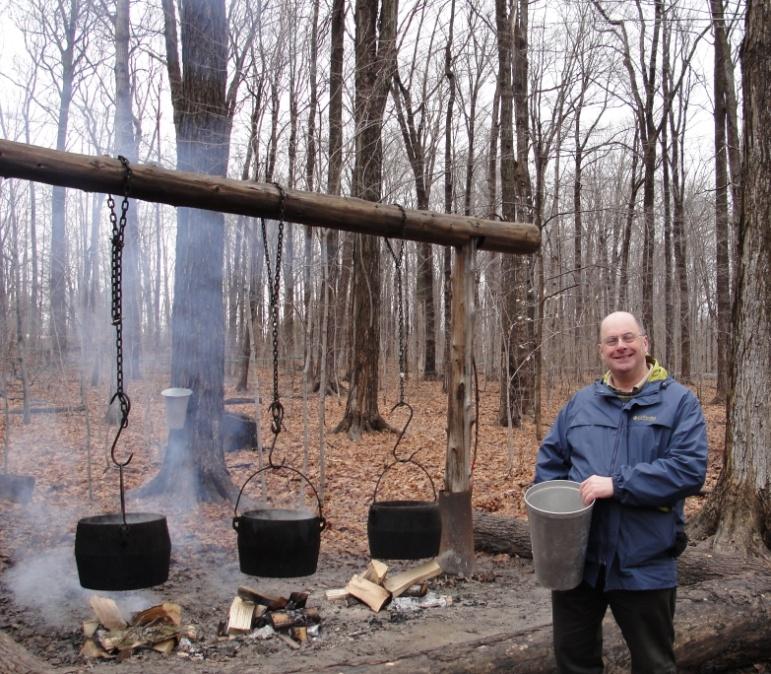
You’ll need: a map, 20 – 40 tree taps (sprules), 20 – 40 metal buckets with lids, drill, 7/16 “drill bit, hammer, 3 foot cloth measuring tape, two helpers, a cord of wood, three large iron kettles, hooks and iron chains, saw, axe, beer, thermometer, brix refractometer, filter sieve, oven mitts, tent, sleeping bags, shotgun, lamps, more beer and a variety of glass bottles with lids. One item which you won’t recognise is a tree tap or sprule.
This can be purchased at a Canadian Tire depot with dollars or Canadian Tire money which is Canada’s real currency.
 
One item which you won’t recognise is a tree tap or sprule.
This can be purchased at a Canadian Tire depot with dollars or Canadian Tire money which is Canada’s real currency. 
You may have not come across a brix refractometer either. Ditto Canadian Tire.
The first item on the agenda is to travel to an area which actually has sugar bush. 

Good weather for sap production is night temperatures in the 20s F and sunny days with temperatures in the 40s F. This alternate freezing and thawing temperature cycle (which can also cause potholes on roads) causes the pressure changes inside the tree that makes the sap flow. If the night time temperatures are too cold, it takes a longer time for the sap to warm up and ‘run’ in the daytime. If the temperatures are very cold, the sap may not run at all.

WARNING! You might run into bears which have just wakened up from hibernation and are HUNGRY. Safety first. Bring at least one person who can’t run as fast as you. If you’re particularly Machiavellian buy insurance with yourself as the beneficiary. Alternatively do a Sarah Palin and arm yourself with a short barreled SxS 12 gauge with Remington Buckhammer slugs – don’t retreat. Reload!
Learn to recognize the right trees. Tapping an elm tree is pointless and embarrassing. The main maple producing tree is known as the Sugar Maple, or Hard Maple ( acer saccarum) which is the best provider of the highest quality sap. It grows as tall as 100 feet. A few of the other main types of maple trees are The Red Maple (acer rubrum), The Silver Maple (or Soft Maple) and The Ash Leafed Maple (or Box Elder) You may need to enlist the help of the indigenous people. They are friendly and will trade for Canadian Tire money.

Local and two specimens of H. Canukistanus (two of my daughters)
 Depending on the tree’s diameter and strength, it may be fitted with as many as three (3) taps. Use the cloth tape to measure the diameter. Trees with trunks less than 25 cm in diameter should not be tapped at all. Prudent tapping is harmless to the maple. Each tap will produce 10 gallons over a six week period.
Drill 1 cm (7/16″) holes about 5 cm (2-2 1/2″) into the trunk of the tree. Use the hammer to place the sprules into the tree. The sap will deteriorate if not attended to. The sap must be boiled the same day it is gathered, so a hot and steady fire is kept going at all times.

The “boiling down” process is slow – sometimes continuing far into the night. Bring lots of beer. Evaporation that is too slow or too fast will affect the color, flavour and texture of the syrup. At sea level, the correct temperature for evaporation is 104ºC. However, since the boiling point varies with altitude, a thermometer must be used to adjust the cooking temperature. For example, in a region where the boiling point of water is 98ºC (or 2ºC below normal), the cooking temperature of the sap must also be reduced by 2ºC (to 102ºC

I use the three kettle method where I put the raw sap which has the consistency of water into the first kettle and then transfer the more concentrated sap into the second. Repeat from the second kettle to the third where the final evaporation takes place. It takes about 40 gallons of sap to make one gallon of syrup. If you use maples other than the sugar maple, the syrup will be darker because the other trees have a lower concentration of sugar and the boiling will take longer.

Maple syrup must be filtered to remove the impurities that could affect its appearance and flavour. Orlon or felt make good filters. Filters should be cleaned with hotwater only (no detergent) and dried thoroughly before and after each use. New filters must be washed before use. Bottles or jars used to store syrup should also be cleaned and rinsed prior to bottling. It is important to adjust the density to between 66º and 67º Brix (the Brix unit of measurement indicates the risk of fermentation or crystallization). Use the brix refractometer. The syrup is then bottled or put in galvanized metal cans while still very hot (87ºC or more). The heat sterilizes the containers and prevents the formation of mold.

You can use maple syrup as a replacement for sugar in any recipe.

>Things That Suck in Canada

>

I love Canada, but there are three things that suck something fierce in my country (no, this post will not talk about taxes): banks, cell phone connections, and the Internet. These three areas are monopolized, which is never good because when there is a monopoly, competition dies. And when there is no competition, there is no incentive to provide goods and services that are even marginally decent.
Canadian banks charge you for every breath you take. Depositing, withdrawing, having an account – everything carries a fee. They mess up, steal your money, and charge you for this transaction. (This actually happened to me. National Bank of Canada stole $1,000 from me, and I could do nothing to get it back. They even recognized they messed up, but that money has never been recovered. By me, that is.) 
They also have this weird policy of “freezing” any money you deposit. I deposit some money in cash, and can’t have access to it for days. If you deposit a check, it’s frozen at least for a week. If the check is American, your money is frozen for 30 days. I once deposited a check from the Treasury of the US in the amount of $250. And then I had to wait for 30 days for it to clear. I mean, I know the US Treasury is not in great shape, but you can reasonably expect it to be able to clear a $250 check, right? After I moved to the US, I kept bugging bank tellers, unable to believe how easy banking was in the US: “So you are saying that I can deposit this check and have access to my money immediately? Like, right now? Like, this very moment? For real?” 
Canadian Internet banking is a story that I’ll keep for another day because it’s too bizarre. And if you dare to lose your bank card, woe betide you. You will be tortured and abused by the condescending bank tellers to the degree where you will start considering how great life was before the banking system came into existence.
The cell phone services in Canada are equally nasty. The quality of the connection sucks. Canadians know that there are specific places in their houses, apartments, offices, streets, where cell phone connection just dies. Every conversation I have with my sister who lives in Montreal is punctured by her saying “OK, I’m gonna get disconnected now. OK, the connection is about to drop again. Don’t hang up if the sound disappears, it might get back up in a minute.” And the cost of having a cell phone has always been sky-high. When I moved back to Canada for a year in 2007-8, I could never understand my cell phone bill. I kept thinking that somebody put the wrong number of zeros on the amount I owed. My happy-go-lucky American habit of blabbing on the cell phone all day long had to be abandoned.
The Internet connection is also expensive, slow and bad. In the US, you can always catch some free Wi-Fi somewhere, but in Canada it’s all password protected. Even in Starbucks, you can’t get free Wi-Fi. Every time I go back to Canada, I prepare to struggle with the Internet connection. As a blogger in the US, I’m used to being able to blog from pretty much anywhere. In Canada, though, I always feel disconnected from the world. Every trip to Canada is spent in a frantic search for a connection. And even if you are fortunate enough to find one, prepare for it to drop for no apparent reason at the worst moment possible.

As if things weren’t bad enough as it is, Canadian monopolists are now trying to make the Internet connection even harder to get and even more expensive:

The CRTC has decided to allow Bell and other big telecom companies to change the way Canadians are billed for Internet access. Metering, or usage-based billing (UBB), will mean that service providers can charge per byte in addition to their basic access charges. The move is sure to stifle digital creativity in Canada while the rest of the world looks on and snickers.

 This is so wrong, people.

>Degrassi

>I love Degrassi: The Next Generation. Not only is it a great show, it also reminds me of the differences between Canada and the US, the differences that I love and celebrate.

Degrassi addresses the problems teenagers encounter in real life with a lot of common sense and with a profound understanding of today’s realities. The show is supported by the government of Ontario and this tells us a lot about Canada.

Degrassi addresses the issues of teen sexuality with a lot of honesty. There is no attempt to demonize adolescent sexuality or to condemn it outright. The show doesn’t have the boring preachings about the evils of having sex for young women that plague similar US teen dramas. The kids on Degrassi experiment with sex, have numerous partners, and explore their sexuality in a variety of ways. Several characters are openly gay and the show promotes the idea that this is perfectly normal and anybody who fails to accept this is wrong and unenlightened.

Unlike its American counterparts, the show doesn’t condescend to its young viewers. It doesn’t treat teenagers as little idiots who need to be preached to and admonished on a regular basis.

I love watching Degrassi because it shows the teenage experience the way it should be. Everybody in the show is kind, tolerant, and understanding. People make mistakes but always repent and come back to a message of kindness and acceptance of difference.