Q&A about Deportations

The scourge of Central America are juvenile gangs. They attract boys beginning at ages 8 or 9 and engage them in alcoholism, drug taking, gang rape, and murder. These gangs are made up of very young men. Here’s a question, though. Why are so many young men in Central America turning to the gang lifestyle starting in elementary school?

The reason is that their parents are not there.

For 30 years, Central American elites have exported human capital for cash. Governments of these countries ran costly ad campaigns to promote the idea that the best, the most responsible way to be a Salvadoran, Honduran, Guatemalan, etc was by not living in El Salvador, Honduras, or Guatemala but instead becoming an illegal migrant in the US. The definition of “Salvadoran” was rewritten to mean “anybody who sends money to El Salvador from overseas”. Please understand that I have researched this for my scholarship and can provide a lengthy bibliography for what I’m saying here.

An entire culture has formed in Central America and the Caribbean where young women are forced by their families and in-laws to become illegal workers in the US hospitality industry. Many end up in less savory industries, too, of course. These women are separated from their children and often don’t see them for years because families back home need a new TV, a new furniture set, an operation, etc, and these poor women have to provide. A woman is usually pushed out of the country (and her child’s life) when the child is about 2 or 3 years old. These children effectively lose their mothers at a young age and often end up – guess where? Yes, in the gangs. This is a phenomenon that has affected millions of people. In the case El Salvador, for example, which is a nation of 6 million people, there are 2,5 million Salvadorans who have been pushed out of the country.

This is a devastating human tragedy. Supporting this horror is not OK. If you look at the large amount of footage of immigrant groups marching towards the US border, you’ll notice that they always carry their national flags. These are people who love their countries, their language, culture, food, their greasy pupusas, their watered down beer. All we need to do is leave them in peace, stop dragging them over because it pleases us to witness their degradation. That’s all we need to do. That way, they’ll finally have a chance to love the way you and I prefer to live, which is at home with our families.

Life Is So Much Easier When You Are an Immigrant

Reader Nancy P. says:

The American Dream is inherently easier to achieve for the immigrant with an education subsidized by the former country of residence.

It is profoundly painful to me to see how strong anti-immigrant sentiments are even in highly educated, good, progressive people. Easier, eh? Let me tell about how easy my subsidized life has been. My high school education was non-existent. I went to school with children of party apparatchiks. Grades were bought and sold, there was no teaching to speak of. I’m grievously ignorant about the most basic things and am still filling the lacunae in my knowledge.

My university education in Ukraine is irrelevant because I never used it. I started my BA in Canada in an entirely new field from scratch. Besides, the quality of that education was abysmally poor. I blogged about this at length and don’t want to repeat myself.

N. and I both got into debt, of course. He paid his down by wearing the same clothes for 10 years and never going out to a restaurant or a bar (never, not a single time, not once) during his undergrad studies and the first 4 years of his grad studies. I got into debt because I was taking care of my underage sister. I still haven’t paid it down. I don’t know who it is that subsidized us but they didn’t do a very good job, it seems.

Neither of us gets to speak our own language anywhere except at home. That, of course, makes our lives so much easier. We also have noticeable Russian accents; his is more noticeable than mine. We had to learn everything anew after we emigrated, everything. How to take a bus, how and where to buy food, how, when and where to pay rent, what a checkbook is and how it is used. God, I even had to learn how to use a library. I spent several months freezing to death in my apartment in New Haven because I had no flapping idea that the switch on the wall needed to be turned to turn on the heating. I’d never seen anything like that before, so how was I supposed to know? Roads are different, kitchen sinks are different, bath-tubs, beds, windows, everything is different. And you get to learn all of that as an adult. Oh, that is so easy, let me tell you.

Our last names are Slavic, which guarantees that our job applications end up in the trash can 90% of the time. My sister is a professional job recruiter, so I know this for a fact. What do people think when they see a Slavic name on a resume? A whore and a mail order bride. An alcoholic and a gangster. That’s how it works and that makes the lives of immigrants so much easier.

And, of course, as immigrants, we can’t just go and find a job. We have to wait for years and pay through the nose to get residence permits and work permits. Even a stupid job at MacDonald’s to tide you over is closed for an immigrant without a work permit. And that also simplifies things incredibly for immigrants.

I feel the pain of American people who suffered in the current economic crisis. But anybody who wants to have an opinion about the easy lives of immigrants will be well-served to acquire some basic information about the complete economic collapse that we experienced in Russia and Ukraine in the 1990ies. We had the kind of inflation where my mother would bring home her salary for 3 months, and on the next day, the very next day, you could buy 2 loaves of bread and nothing more with that money because of the inflation.

Yes, there is unemployment in the US today, and that sucks. However, in the FSU countries, everybody became unemployed when the state fell apart. The very country that used to give people those low-paying Soviet jobs was not in existence any more. And everybody had to look for employment and compete in the job market for the very first time in their lives. Scholars with decades of experience, teachers, doctors, engineers had to start traveling to Poland and Turkey to buy cheap rubbish and then sell it at the market-place. And this wasn’t something that happened to 9% of people or 16% of people. It happened to everybody. At once. Do I need to mention that there were no unemployment benefits, food stamps, credit cards, food banks, churches to offer assistance, or anything of the kind?

Yes, my students don’t have an easy time finding jobs while they go to school. When I was an undergrad in Ukraine in 1994-8, however, there was a law in place that forbade students to work. Police officers would drag students out of classrooms for the horrible crime of working. This is the environment in which I had to support myself and an unemployed husband when I was 19, 20, 21, 22.

Nancy P’s father benefited from the GI bill, and that’s great. My grandfather, though, was a veteran of World War II and he died in penury. He couldn’t feed his children, and my mother didn’t get a chance to finish high school because there was simply no money to support a non-working 15-year-old girl.

It’s great that people in the US are organizing, protesting, getting politically active. But why, on God’s green Earth, can’t it be done without making these egregiously hurtful statements about the supposedly easy lives of immigrants?

I wouldn’t say it if I weren’t provoked beyond all patience by this insanely offensive statement I quoted above, but now I will say it: if you were born and raised in the US, you have no place talking about hardship, poverty, and economic instability to a person from an FSU country.

I’m so insulted that, for the first time in 11 months, my blood pressure has gone up.

The Purpose of Emigration

People often seem to assume that immigrants leave their countries because they want to improve their lives financially. If we are talking about those who emigrate out of a situation of dire poverty, that assertion is true. However, a person who has a middle class existence in their own country mostly loses out financially as a result of emigration.

I lost a lot in terms of my economic status when I emigrated. I was very aware when I made the decision to emigrate that I would never achieve a comparable level of economic well-being in North America. It didn’t matter to me because I’m not materialistic, so I emigrated anyways.

Anybody who emigrates from a middle-class (or higher) existence in their own country with the express purpose of enriching themselves is very unintelligent.

P.S. If you are an immigrant from an FSU country and you want to make an argument that you are better off financially in North America, please ask yourself the following: Who owns the place where you live? How much do you owe on your mortgage? On your car? On your credit cards? And how much did you owe back in your country?

I rest my case.

By Readers’ Request: More on Why I Emigrated, Part II

The reason why my groupmates were acting this way was that after decades of genocides and repressions, people had become afraid of pretty much everything. This is the kind of fear that gets transmitted on a genetic level. You might not have experienced the genocide yourself, but the genetic memory of your ancestors who conceived you in fear and gave birth to you in mortal terror is always there with you.

So the students started attending one of the courses and ignored the other one. Now, the professor of the ignored course showed up to his scheduled class and discovered that the students weren’t there. He also had the Soviet legacy of inborn terror, so instead of going to the Dean’s office and inquiring as to the whereabouts of his students, he kept coming to class in a futile hope that one day students would appear.

They never did, of course.

At the end of the semester, when the exam period came about, a huge scandal broke out. Students hadn’t taken one of the courses and couldn’t pass the exam. The professor had been getting paid for not delivering his lectures. The future schedules got messed up beyond recognition.

People got into all this trouble for the simple reason that they couldn’t deal with the simple task of going to the administration and saying, “I’m sorry, I think there might be a mistake.”

This was when I realized that I wasn’t only completely different from the older generation. I also had nothing in common with my own. Believe me, I’m not blaming my people for being the way they are. I just understood that I was so different from them that no happiness was possible for me in their midst.

So I came home and said, “You were right, we should leave. I’m now ready to submit an application to the Canadian consulate.”

This was absolutely the best decision of my life. It brought me poverty, divorce, struggle, hardship but it got me to a place where, on the most basic level, people think and act like me.

What I Have Done to Adapt

People have somehow gathered from my recent posts that I defend the right of immigrants not to adapt in any way to their new country. Nothing could be further from my point of view. I emigrated twice, and every time worked hard on figuring out how things worked in my new country and adapting to them. Unless you are willing to engage in such efforts, you have no business emigrating, in my opinion. One of the reasons why emigration can be so helpful to one’s personal development is precisely that one goes through this transformative process and learn new things about oneself. (Zygmunt Bauman talks about it better than I ever could, so I won’t retell his ideas.)

So here are some of the things that I learned to do differently after I emigrated:

– I now pay taxes honestly and in full. What’s more, it makes me feel good to do so.

– I haven’t plagiarized a single assignment when I was a student. (In my country, you had to quote without attributing. It was required.)

– All of my whorish attires have been sacrificed. Oh, I miss them sorely. . .  🙂

– I now say “Hi, how are you?”, “Please” and “Thank you.” Sometimes, I even smile at strangers.

– I don’t steal office supplies from work. I have been tempted, I confess, but I haven’t done it.

– When a stranger politely addresses me in the street with “Excuse me, Ma’am, I’m sorry to bother you”, I don’t bark “What??” in response. I’ve even been known to say, “Yes, how can I help you?” a couple of times.

– I don’t toady to my supervisors at work.

– I don’t humiliate, offend or demean students in any way.

– During departmental meetings, I vote my conscience, even when everybody else’s vote is different.

– I refuse to be afraid of expressing my opinion.

– I have learned to enjoy a hamburger. (That’s one of the most surprising adjustments to me.)

– I don’t call people after 9 pm and don’t arrive unannounced at their doorstep.

– When a bar closes at an ungodly hour of 11 pm, I meekly pack up and go home.

– I don’t scoff at everything any man says the second he says it. I now listen and even engage in a dialogue.

– I have learned to wait in line for a bus, instead of running to the doors like a tornado, sweeping everybody off my path.

There is room for growth, of course, since I am yet to learn to operate a grill, remember what sport St. Louis Cardinals play, and wear jeans.

What did you do to adapt to a country where you emigrated, studied or lived for a while?

Happy Emigration Anniversary to Me!

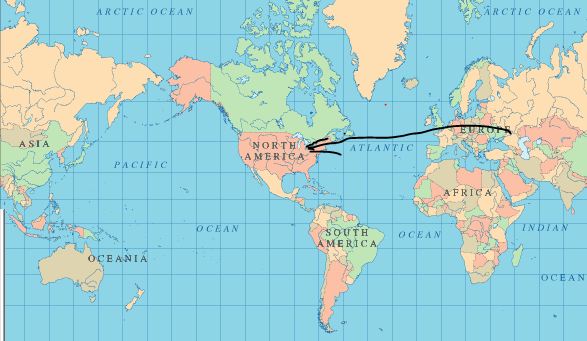
Thirteen years ago I left my country forever and came to this great continent. Since then, I haven’t had a single reason to doubt that decision. This was the best thing I could have possibly done and it has made me very happy on many levels.

This is the journey I made 13 years ago

For reasons I find hard to understand, I never felt at home in my own country. Everything seemed weird, confusing and incomprehensible. When I first got off the airplane in Toronto on July 4th, 1998, though, I immediately knew that I was in a place that suited me perfectly. This is the best continent to be a Hispanist, a feminist, a reader, a scholar, and, obviously, a blogger.

Thank you, North Americans, for making me feel more welcome here than I ever did in the country of my birth!

My Ukrainian Relatives and Friends

On July 4, I will celebrate 13 years since, at the age of 22, I left my country forever. Since then, I never went back for a visit. After my grandfather died five years ago, I haven’t made a single call to Ukraine. Today, I read this fascinating and touching post by Spanish prof (false modesty aside, I actually suggested that it be written) and started thinking about why I have no relationship with any of my Ukrainian relatives and friends (except those who also emigrated.)

Back in the Soviet Union, everybody who tried to leave the country was considered a traitor, was persecuted and abused. Those who managed to leave were not allowed to keep in touch with those who remained. As a result, emigrating was pretty much like dying. You go away, and nobody hears from you ever again. The Soviet Union fell apart, but this attitude towards people who emigrate remained. I discovered it when I received my immigrant visa to Canada and came to my university to share the news with my friends and classmates. The second they saw me, they turned away and pretended I wasn’t there. The experience of being ignored like this by people who, for years, were your bosom buddies is not pleasant.

Then, one of those bosom buddies stole my money and said, “Well, you are leaving anyways” in explanation.

A professor – who used to like me the entire time I was at the university and who used to call me “our department’s star” – yelled that I was a traitor and that she would do everything in her power to destroy my life.

The only friend who did come to say good-bye to me and cried and hugged me was the one who was about to emigrate as well. She now lives in Baltimore and we are still in touch. (Hey, Lenchik!) Other close friends told me they were too busy to meet and say good-bye.

So I never went back. My parents, sister and aunt have visited Ukraine since we emigrated.

My mother went to visit her best friend of many decades. She brought gifts that she had chosen with care and love to suit the preferences of each family member. I saw her run from store to store for weeks trying to find the best gifts possible for the friend she loves so much. The best friend looked at the gifts, put them all back in the bag, handed it to my mother and said, “I’d rather you take your gifts back and give me their value in money.” (In case you think these people are starving or anything like that, you couldn’t be more mistaken.)

My aunt went to meet her nephew whom she babysat and adored when he was a kid. The nephew charged her for the gas he “wasted” on coming to meet her. Her niece stole her money to buy gifts for her boyfriend.

One of my aunts who remained in Ukraine stole the jewelry that had been in my father’s family for over 100 years (my father, mind you, is not related to her except by marriage) and destroyed a suitcase filled with photos of his ancestors, their records, and sentimental souvenirs. This is the aunt whom my parents helped out financially (a lot) for decades.

There are other things but they are too painful to write about at this particular moment. Please don’t think that we somehow managed to end up with a particularly vicious group of relatives and friends. The few times I tried participating in Russian-speaking blogs (run by complete strangers) I always was told that nobody had any interest in talking to a person who’d emigrated.

If I were to go to Ukraine right now, it would be like going to Greece or New Zealand, places where I don’t know anybody and would be completely alone. At least, in Greece and New Zealand I can hope to get in touch with people who read my blog and be welcomed by them. In Ukraine, I’d be completely isolated.

This was supposed to be a post on friendships but it somehow ended up being quite depressive. I will write the second part of the post later and I promise that it will be about my positive experiences with friendship.