My Intellectual Journey, Part I

When I was 20 years old,  all I did was read CosmoElle and Marie Claire. I also believed that studying was useless and stooooopid and that the only worthy pursuit was to make lots of money to help one become a true Cosmo girl.

I didn’t arrive at this worldview by accident. It was a product of my experiences in the Ukraine of late eighties and early nineties. The years between 1986 and 1990 were a moment of a great intellectual awakening in the Soviet Union. This was the era when intellectuals had their long-awaited opportunity to read, think, debate, and feel very appreciated for doing so.

Every day brought new publications of authors that had been censored before perestroika. My parents subscribed to so many magazines and newspapers that it was weary work to drag them all out of the mailbox every day. Earth-shattering revelations about our history awaited us each morning. People gathered in the streets to discuss a new novel, film, or article. I remember many occasions on which I would be walking down the street with either of my parents only to have them stop and start delivering an impassioned speech on politics, literature, economy, etc. to admiring crowds. The Soviet intellectuals finally felt completely relevant and appreciated. They believed that now they would get an opportunity to have a say in where our country – or, hopefully, our many new independent republics – were heading.

And then all that came to an end. The nineties brought us bandit wars, organized crime, violence, fear, hunger, and insecurity. Most of the intellectuals never managed to find ways to inscribe themselves into the new economic reality. The hunger for material goods that everybody (except the Communist party leaders and their lackeys) had experienced during the Soviet era proved stronger than the need for intellectual nourishment. A veritable orgy of materialism overpowered the FSU countries. You either could inscribe yourself onto this really scary version of out-of-control, wild capitalism or you couldn’t.

For most of the intellectuals, this was a truly tragic moment. The new reality had arrived but there was no place for them in it. They had no tools that would enable them to deal with the demands of the free market. Looking for a job, starting a business, competing with others, being rejected when you apply for positions – these were skills that neither they nor their parents and grandparents ever had to develop. And it’s not an easy task to learn to adapt to this way of being from scratch.

(To be continued. . .)
Split Personality and Slacking

Fellow blogger Z published a charming story on her blog. Two grad students are talking:

Parisian: I have spent the whole afternoon reading Shakespeare, and I do not see that it has done me any good!

Londoner: Surely not. That is why I spent the afternoon asleep!

Z asks her readers to guess the gender of these students. I have no idea what their gender might be but I can say that they neatly symbolize 2 aspects of my personality: the obsessively hard-working Jewish persona and the happy-go-lucky, perennially snoozing Ukrainian persona.

I’ll let you guess which side of me wins more often.

A Ukrainian Alternative to a Barbecue

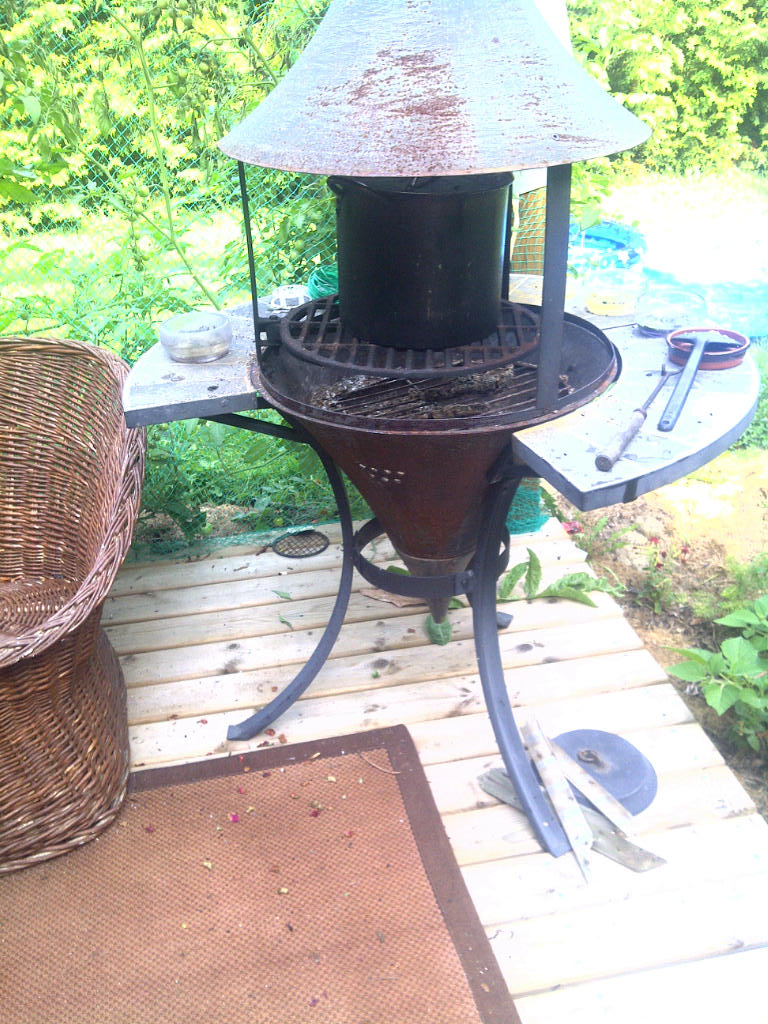
Since I just criticized the American barbecue parties in my previous post, I want to show you what we, the Ukrainians, do instead. We had this kind of garden party in Montreal a couple of weeks ago. Of course, the weather was pretty cool, otherwise we wouldn’t have done it.

The huge black pan you can see on the photo contains my favorite food ever. We call it “a soldier’s pottage” (the clumsy translation is all mine.) As I shared before, my maternal grandfather fought in World War II. He started the war as a teenage kid on the very first day of Hitler’s invasion of Ukraine and ended it in Berlin, on may 9, 1945 when he wrote his (and, eventually, mine) last name on the walls of the defeated Reichstag. This soldier’s pottage is what he and his comrades ate during the war.

The point of the pottage is that you place every kind of foodstuff you have available in the pot, add some water, and let it brew. Obviously, food is much easier to find in Montreal today than in the swamps of Polesie or the forests of Bayern during a war. So our soldier’s pottage ends up being far richer than the original.

This time, we added chicken, potatoes, carrots, millet, and poured in some eggs. In the past, we have used rabbit instead of chicken, canned meat (which made the pottage more like what it was originally), or no meat at all. Barley can be used instead of millet. After the pottage is left brewing for a couple of hours, you can eat it. It isn’t only delicious, it also offers us an opportunity to experience an emotional connection with the history of our family and of the entire world.

Weekend Plans

I have managed to get through the first week of classes and the first two weeks of committee meetings while being sick with the flu and an ear infection. I feel better now, but I still can’t hear anything in my right ear and feel constantly exhausted. So my plans for the weekend are:

  • sleep a lot
  • read for fun
  • take very long baths
  • blog
  • cook
  • drink a lot of tea
  • eat tons of raspberries and peaches
  • watch at least 2 very silly shows on television
  • go for walks with N.
  • do absolutely no work of any kind whatsoever

I’m sure that after 2,5 days on this regimen I will be as good as new on Monday.

The Flu That Stole Christmas

I don’t celebrate Christmas and, for me, the first day of the academic year is its emotional equivalent. I love coming into the classroom, handing out my syllabi, meeting the new students, and reconnecting with colleagues after the summer vacations. After the first day of classes ends, N. and I usually go out to celebrate.

This year, the stupid flu killed all the enjoyment of the first day of teaching I could have had. I dragged myself to  campus today hoping that teaching would magically defeat the disease. That didn’t happen because the flu is too strong. The good news is that I can give the first lecture of the semester in my sleep, so that part of the teaching went well. The bad news is that I’ve lost all hearing in my right ear (and my left ear isn’t good since childhood). So when students ask questions (which they are bound to do on the first day of class), I simply can’t hear.

Another small problem is that my right eye is red and swollen, making me look like a victim of domestic violence. This is not an image I’m trying to project to students, so I initially planned to come to class wearing dark sunglasses. N., however, told me that this would make me look like an alcoholic who is trying to conceal a hangover. A Russian-speaking person is always suspected of being an alcoholic by default, which means that I can’t do anything to make that suspicion even stronger.

But I do feel miles better than I did yesterday and the day before, so there is positive dynamics.

How Buffy Changed My Life

I told this story before on the old version of the blog but now I have many new readers and I like telling it, so I’ll tell it again. Besides, a fellow blogger wrote about Buffy without the veneration due to this fantastic show, which is something I feel I need to address. (Being facetious here.)

When I was 22, I moved to Canada. Three months later I had to leave my husband because of the utter piggishness of his behavior. I was left in a strange country, with no job, no education, no money, and no friends. Worst of all, I was left without an identity of my own. I had been with this guy since I was 16 and had learned to see myself in terms of “we”, not “I.”

Once, I turned on the television and saw this episode of Buffy where Buffy and Angel, who had turned bad at this point, were fighting.

In that scene, Angel knocks the sword out of Buffy’s hands. She bows her head and closes her eyes as she stands against the wall.

“So what do you have left?” Angel asks. “Now that you are without your friends and without your weapons, what do you have?”

[I was 22, so I was weeping so hard I was practically bawling at this point.]

Then, Angel charges at Buffy with a sword. She catches it between her palms, opens her eyes, and says, “Me.”

And then she gives him the thrashing of his life.

This “I have me” was a true revelation. I realized that I could always find new friends, make more money, create a new life in a new country. Because I had me.

Which is why when you criticize Buffy in my presence, you do it at your own peril. 🙂

Being Contentious

I am contentious and contrarian by nature. I was brought up to see this as part of my Jewish identity. In the Soviet Union, Jews were not allowed to practice any aspect of our religion, language, or culture. We had to forget the very word “Jewish” in return for the removal of the pale of settlement. Anti-Semitism was completely absent during the first few decades of the USSR’s existence. After the Soviet Union defeated Nazism, though, it paradoxically (not that paradoxically, of course, but this is a topic for a separate post) became institutionalized. Still, Jewish identity persisted and was transmitted from one generation to another. One part of our identity* consisted in always being a thorn in the side of every reigning ideology.

Once, when I was twelve, I saw a program on television where a famous poet was being interviewed. “I completely agree with what this guy says,” I commented.

My Jewish father was a huge fan of this poet’s writing. Still, he was horrified with my reaction. He gave me a four-hour lecture delivered in an outraged whisper (so as to avoid exposing my mother to the horror of my compliance) on why it was wrong for me to agree with what the famous poet said.

“You are a Jew,” my father told me. “We have survived for thousands of years in alien cultures and have been able to preserve our identity because we have a goal. Our ultimate aim is to be the a thorn in the side of every authority imaginable. Whenever we hear an accepted opinion our first, completely automatic response should be to disagree. When you hear something on television or read it in a book – even one written by your favorite writer, even when expressed by your parents – you first impulse should be to voice disagreement.”

“Well then, Dad, I think you are wrong,” I said just to bug him.

“Now I hear my daughter speak,” he responded. “Whenever some old fart tells you what to do, just say you think he is wrong.”

This lesson was crucial in setting me on the path of becoming a literary critic. It also defines everything I do as a blogger. Often, I say things aimed at shocking people  on purpose and try to get them to think about daily realities in unconventional ways. I like to believe that this is what has helped me become a popular blogger in no amount of time. I keep losing faithful readers because of this strategy. They write me impassioned emails trying to convince me that wording my ideas in a milder way will gain me more followers. However, I don’t  want to gain followers at the cost of diluting my message. I want to preserve my identity of an outspoken, shocking, contrarian Jewish feminist autistic academic who doesn’t mince words and doesn’t care about not hurting anybody’s sensibilities. The Internet is a free space (still) where people can wander in and out of blogs whenever they feel like it. People keep coming back to mine, though, which makes me think that my way of approaching things has some relevance to others.

When I first started blogging, I was convinced that only the four people I forwarded the link to would ever read the blog. (One of them never even checked it out, which tells you a lot about my social life). I was terrified when I first realized that, in spite of the horrible writing skills, people still wanted to read me. I still remember the terror I felt when my blog started getting indexed by Google and I got my first seven unsolicited visitors in one day.

The funny thing, though, is that I regularly participate on conservative, Republican, Libertarian, Chicago School of economy, MRA, PUA, “Sarah Palin For President”, “Sarah Palin Is Evil”, anti-feminist, anti-public education, anti-Ukrainian, “Academics are evil”, and anti-blogging blogs. I love generating controversy and I go to those blogs to voice dissent – always in a very respectful way, of course. And on none of them have I been insulted, excoriated, banned, shut up, accused of really outlandish things and asked to leave as I have been on feminist blogs. At this point – and just two years into blogging – I have been banned or asked to leave from pretty much every feminist blog I tried participating in. I still leave my links at Feministe’s Self-Promotions Sundays from time to time, even though I have been asked by a regular participant why I bother since I “never agree.” (Apparently, there is an agreement every reader is expected to reach before saying anything on the blog.) They haven’t banned me yet, so kudos to them. Other than that, I’m not welcome at any other feminist blog I have been able to discover. That really makes me very sad.

* This was just one part of it, of course. If people are interested, I can blog later about how people preserved their Jewishness in completely non-religious ways.

How Feminism Helped a Bad Student

A reader just wrote in to say that she enjoys my stories about the Soviet Union. (Thank you, kind reader!) So I decided to share yet another story. It is post-Soviet but still fun.

In Ukraine, I was a university student at the Department of Foreign Languages. The way the system worked was that an oral final exam counted for 100% of the final grade. You had to show up a the exam at the end of the semester, choose a random piece of paper among the many on the professor’s desk, take a few minutes to prepare, and speak on the 2 or 3 topics on your paper. In some courses, you needed to write a final essay to be allowed to take the exam.

I worked hard to make a living when I was a student. For this reason, I rarely showed up at the university. Normally, I’d just read the textbook the day before the exam and get a top grade as a result. The quality of education was pathetically low, and I saw no reason to waste my time coming to classes where the professor did nothing but read the same textbook out loud.

One of the courses I had to take was Sociology. I didn’t attend a single lecture or seminar. At that point in time, I was busy finishing a big translation for the Academy of Arts and Sciences of the Russian Federation. There had been an accident a little while before where I had suffered severe burns to my arm. I still had to type up my translation for hours each day, which I did while shrieking in pain from my damaged arm and hand.

So, of course, the Sociology course was the last thing on my mind. I didn’t even find an opportunity to go to the library and take out the textbook before the exam. For my final essay, I went to the British Council, took out several books on feminism, and used them to write my essay. I translated the sources and even quoted them. I was very interested in feminism at that point and cared little that nobody around me had any knowledge about what the word stood for.

When I arrived at the exam and took the paper with my questions, I realized that I had not the slightest idea what the terminology used in the questions even meant. I had no textbook or notes or anything with me. So, of course, I prepared myself to failing the exam very spectacularly.

The professor in the course was a young, nerdy-looking guy. Since I had never come to class, that was the first time I saw him. Now I not only had missed every single day of class and came to the exam unprepared. I had also handed in an essay that passionately defended feminism to a male professor in a rabidly patriarchal society.

As I was sitting there, staring despondently at my questions, the professor suddenly asked,

“Which one of you is called Clarissa?”

“Me,” I answered in a tenuous little voice.

“You are the student who handed in an essay on feminism, right? It was absolutely brilliant! I loved it,” the professor suddenly announced. “You can go now, I will give you an A for the course.”

As I crept out of the room, I mused that feminism was even better than I’d thought before.