Babies, Bathtubs, and Essay Submissions

Every new generation of young parents in my country had to participate in the ideological battle of whether to place a napkin in the bathtub while bathing the baby.

“Why do we need to do that?” new Moms and Dads moaned. “It’s messy, it’s annoying, and it makes absolutely no sense at all.”

“You have to do that!” Grandmas and Great-Grandmas responded. “I always did it, and so did my mother, and her mother. Everybody places a napkin at the bottom of the tub when bathing a baby, so you should do, too.”

The reason behind the napkin tradition is actually very simple. In the XIXth century, children in the country-side were bathed in wooden bathtubs. Those tubs were of low quality, and babies ran the risk of getting splinters into their backsides if no napkin was placed at the bottom of the tub. When the tubs made of metal and later of plastic appeared, people still retained the old tradition, even though it had no practical value any more.

I’ve had my own version of the bathtub fallacy. I’ve never allowed my students to submit their essays by email. I persecuted them with repetitive enjoinders never ever to submit anything to me by email. These enjoinders were delivered in a voice that made email submissions sound like some sort of a crime against humanity.

And you know why I did it? Because as an undergrad and then a grad student I had professors who flatly refused to accept email submissions. So I just imitated them unthinkingly without stopping to consider why I was doing it.

Then, I read on Jonathan’s blog that he accepts email submissions of student essays. Jonathan is an important role model for me, so I decided to conduct an experiment that would allow me to figure out whether I genuinely preferred paper submissions to email ones.

This week, students in both of my courses submitted their essays by email. And you know what? I loved it. This cut the weary work of essay grading at least in half. I can write very long comments, which is important to me because I work hard to improve the way my students write. I didn’t have to try to fit my comments on the small paper margins any more. Also, I think students are now more likely to read my comments because they don’t need to decipher my imperfect handwriting. And, of course, I type faster than I write.

Finally, I have been able to realize that there is no actual need for the napkin in this metaphorical bathtub. Thank you, Jonathan!

Teaching the Art of Email Writing

I hate babying my students or being preachy with them. I also don’t want to come off as condescending. However, I feel that there is an urgent need for me to teach the so-called computer generation how to write an email. I received about a dozen emails in the past three weeks that went as follows:

i need to meet when can i come by your office

And this was the extent of the email. No greeting, no signature. Except one student who signed the email with “XOXO.” Which was not extremely helpful in allowing me to deduce who was writing to me.  No punctuation either.

So this is what I’m planning to say:

Dear students! It is a good idea to begin an email with greeting a person you are writing to. “Hi” is better than no greeting at all. “Hi professor” is even better than that. And “Hi Professor Clarissa” is the best version of all because it demonstrates that you took the trouble of learning the name of the person you are addressing.

Then, it’s a good idea to explain who you are. Example, “I’m your student in the course ABC.” I usually get over a hundred work-related emails per day, and it’s hard for me to place a person immediately.

After that, you say what you need to say and then – and this is very important – sign the email. With your first and last name. 

I can’t even remember the last time I got this kind of an email from a student.

I feel like a nursery teacher right now.

You Want Empathy? I’ll Give You Empathy!

We all remember that I teach at a state university in an economically blighted area of the US, right? And that our students get offered full-time jobs that pay $11,000 per year after they graduate? And that our students work 2 – 3 part-time jobs while going to college, right?

A student of mine writes:

The government of our country is oppressive towards the rich people. It treats them unfailry by asking them to pay more than their fair share in taxes.

And you say empathy is dead in this country.

P.S. I have just been visited by a horrible suspicion. Is it possible that the student thinks I’m rich and is trying to get me to like them in this inventive manner?

Greek

A student comes up to me and says, “I’m sorry, I’m Greek, which means I need you to fill out a form saying how many absences I’ve had.”

“Oh my God,” I think. “This is horrible. I had no idea that Greek students were discriminated against on our campus!”

“Are you sure about this?” I ask the student, preparing to unleash my fury on the haters of Greece at our university.

“Yes,” he says and hands me a paper that bears the name of his fraternity.

During an Exam

When I first saw a student squint at his crotch, touch it and mouth “What?” at it during the midterm exam, I was disturbed.

Then I realized, to my great relief, that his problem was not physiological but, rather, intellectual.

Happy Teaching Experience

My students made me very happy today. For one, they had quite a bit of knowledge about World War I, which was very refreshing.

And then, a student asked me if I could give a few names of Modernist writers who wrote in English. I love questions that allow me to go off on my favorite tangents.

During the entire lecture, students were staring at me with those huge eyes that were starved for knowledge. At least, most of them were. They were just imbibing everything I said with incredible eagerness to learn more. Believe me, after 21 years of teaching, I can really tell when they stare vacantly and when they stare with interest.

Of course, you have to be dead not to wake up when I lecture about Modernism. I’m seriously passionate about the subject. Next week, we will talk about the Mexican revolution, and I know I won’t be able to muster the same level of enthusiasm for it.

Oh, I love my students.

A Story About Teaching a Russian Class

A colleague once asked me to substitute him in his Intermediate Russian class. I don’t teach Russian, and the fact that it’s my first language doesn’t qualify me to teach it. The colleague really needed somebody to substitute for him, though, so I felt like I had to help him out. My colleague was not a native speaker of Russian, so he announced me to this class as “a real Russian person who will answer all of your questions about the Russian culture.”

“So what would you like me to talk to you about?” I asked the class.

“Do you eat bottles after drinking vodka?” a student asked eagerly.

“Yes, can you show us how you do that?” another student suggested.

“That’s like totally the best thing about the Russians!” the rest of the students chimed in.

“I’m sorry, guys, what are you even talking about?” I asked, dumbfounded.

“Well, isn’t it a tradition in your country that after you finish a bottle of vodka you eat the glass bottle? We saw a video here in class where people did that. It was way cool.”

“Yes! It was the best!” all of the students agreed enthusiastically.

“No, we don’t have any such tradition,” I tried to explain, making a mental note to kill my colleague. “The video was probably humorous.”

“Oh, you just say it because you don’t want to show us how you do it,” the students responded. “Of course, it’s what Russian people do all the time.”

Teaching Styles

I found a description of a teaching style that is the exact opposite of mine:

 I’m actually pretty intolerant when it comes to what I expect a class of mine to run like.  What Koshary describes about students waltzing in 20 minutes late and then proceeding to text?  It doesn’t happen in my classes.  I don’t tolerate it.  I ask them to leave.  With a smile on my face, and with a spring in my step, so the rest of the class thinks it’s funny, but I don’t hesitate.  It happens, and they’re out.  Do that a few times, and it stops.  Late papers?  I don’t care about your reasons: you lose a full letter grade a day.  I don’t care if your grandmother died and you were in the hospital – deadlines are deadlines.  You show up unprepared, and you’re out.  You complain about the reading and I’ll tell you, again, with a smile on my face, that this is college and if you’re not prepared to do the work then you really should consider dropping out.  And then I giggle.  In front of the whole class.

Mind you, the goal of my post is not to criticize the educators who teach this way. Everybody has their own teaching style, and whatever works for each teacher is fine. I firmly believe that everybody should run their classroom the way that makes them happy, and nobody should have anything to say about it. I just want to share what my approach is. The blogger I quoted is an admirable educator and scholar, and I’m in no way trying to be critical of her personally.

My approach, however, is different. I believe that my duty to the students consists of arriving in class, delivering the material, grading their work, answering emails with course-related questions, and being available for office hours. And that is where my duty ends. I’m not their Mommy, their life coach, probation officer, boot camp trainer, or nursemaid. I don’t have time or energy to police them.

This is why I don’t care how late, early, or at all they show up for class. I don’t care if they are listening to the lecture or texting furiously to their friends. Students are adults, and it is up to them to decide whether texting is more important to them than the lecture. Who am I to impose my system of priorities on them?

I have a student who always sleeps in class. The moment I come in, he plops his head on the desk and falls asleep. Maybe the sight of me does it to him, I don’t know. Today, we had a mini-quiz in the last 15 minutes of class, so other students had to make significant efforts to wake him for that. I never tried waking him during my lectures, though. He is a grown-up who decided that sleeping is more important to him at this point in life, so good for him. Why do I need to waste time on discussing this with him or waking him?

I also don’t listen to excuses as to why students have to be absent. I just let them go. If this means they need to come to my office later and write the mini-quiz or the exam there, why should I mind? I will be in the office during the office hours anyways.

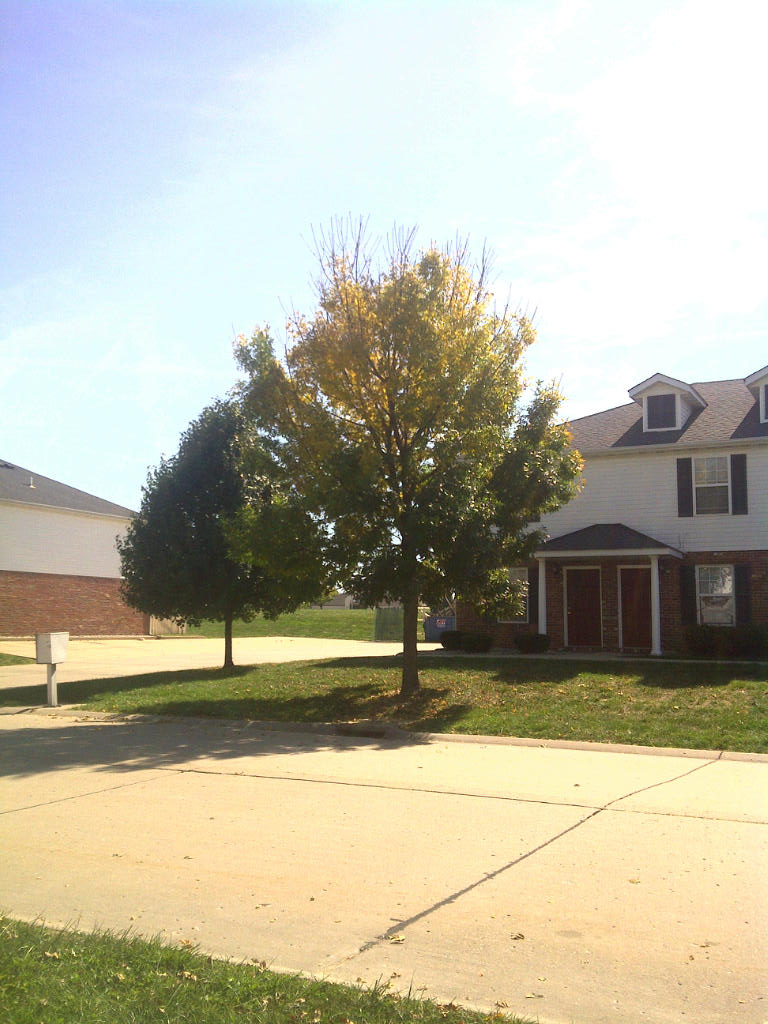
This beautiful tree is half yellow half green. Oh, I love Fall!

As for late assignments, I never lower grades for them. Why should I? I grade the quality of writing. I’m a scholar of literature and that’s the only thing I teach. Personality flaws should be addressed by therapists at a patient’s request. I have never refused to accept late assignments. It’s actually easier to have them all spaced out in time because, honestly, who wants to grade 42 essays in one sitting?

You’d think that as a result of this attitude my classes would be an out of control mess, right? Students arriving late, barely ever showing up for class, asking to rewrite exams weeks after they were given, handing in assignments egregiously late, etc. Actually, this is not nearly the case.

Students see that I respect them and respond with respect. I can’t remember the last time a student was late for class. Nobody interrupts me, nobody talks while I talk.  We have written 3 mini-quizzes and one midterm in one class this semester and 2 mini-quizzes in another class. Out of all these tests, only two students came by my office to do them outside of the class time. One of those students hopped in on crutches, too. Students love me for being so laid back. I love them, too, because I made a decision a long time ago never to be ruffled by other people’s decisions not to do homework, skip class, or snooze during my lectures.

This is why on campus I always walk around with a beatific smile on my lips. Since I don’t allow things that have nothing to do with me to upset or annoy me, I always have a fantastic, stress-free time teaching.

Who Heard of This Buenos Aires Place?

I’m sorry for all these teaching-related stories but I’m always afraid that if I don’t record them, I’ll forget them. On a difficult day, I enjoy reading old posts and chuckling over these funny incidents.

Me: So where are culture and civilization located in Argentina according to Sarmiento?

Student: Oh, he says they are located in this. . . erm. . . whatchamacallit. . . erm. . . Barraba. . .  Bubarra. . . Babarra. . .

Me: Buenos Aires.

Student: Yes, that!

Overdiagnosing Children With ADHD

I just found this map of how often children are diagnosed with ADHD on parents’ request at a very enlightening post published by feMOMhist:

The good news is that I live in a state that is doing better than many others in this country in terms of this diagnosis. We “only” have 6.1% to 7% of kids diagnosed with and medicated for not being subdued little robots all the time. Just across the border in Missouri, things seem to be worse.

Still, the sad reality of teachers not willing to do anything to get their students’ interested in learning and pushing parents to zombify little children with medication instead remains. Read feMOMhist’s post to see how this is done.

Many people have a lot of compassion towards teachers who do such things. It is hard, they say, to keep a large classroom of small kids interested and engaged in learning. I believe, however, that a teacher who solves this issue by requesting (or sometimes even insisting) that a small child be drugged in order not to create any difficulties in the classroom is a profoundly unprofessional person who should be thrown out of the teaching profession as soon as possible.  Small kids fidget when they are bored. This is not a disease or a mental disorder. The only people with a mental disorder are the ones who believe that such behaviors in children should be addressed through medication.