>Things That Suck in Canada

>

I love Canada, but there are three things that suck something fierce in my country (no, this post will not talk about taxes): banks, cell phone connections, and the Internet. These three areas are monopolized, which is never good because when there is a monopoly, competition dies. And when there is no competition, there is no incentive to provide goods and services that are even marginally decent.
Canadian banks charge you for every breath you take. Depositing, withdrawing, having an account – everything carries a fee. They mess up, steal your money, and charge you for this transaction. (This actually happened to me. National Bank of Canada stole $1,000 from me, and I could do nothing to get it back. They even recognized they messed up, but that money has never been recovered. By me, that is.) 
They also have this weird policy of “freezing” any money you deposit. I deposit some money in cash, and can’t have access to it for days. If you deposit a check, it’s frozen at least for a week. If the check is American, your money is frozen for 30 days. I once deposited a check from the Treasury of the US in the amount of $250. And then I had to wait for 30 days for it to clear. I mean, I know the US Treasury is not in great shape, but you can reasonably expect it to be able to clear a $250 check, right? After I moved to the US, I kept bugging bank tellers, unable to believe how easy banking was in the US: “So you are saying that I can deposit this check and have access to my money immediately? Like, right now? Like, this very moment? For real?” 
Canadian Internet banking is a story that I’ll keep for another day because it’s too bizarre. And if you dare to lose your bank card, woe betide you. You will be tortured and abused by the condescending bank tellers to the degree where you will start considering how great life was before the banking system came into existence.
The cell phone services in Canada are equally nasty. The quality of the connection sucks. Canadians know that there are specific places in their houses, apartments, offices, streets, where cell phone connection just dies. Every conversation I have with my sister who lives in Montreal is punctured by her saying “OK, I’m gonna get disconnected now. OK, the connection is about to drop again. Don’t hang up if the sound disappears, it might get back up in a minute.” And the cost of having a cell phone has always been sky-high. When I moved back to Canada for a year in 2007-8, I could never understand my cell phone bill. I kept thinking that somebody put the wrong number of zeros on the amount I owed. My happy-go-lucky American habit of blabbing on the cell phone all day long had to be abandoned.
The Internet connection is also expensive, slow and bad. In the US, you can always catch some free Wi-Fi somewhere, but in Canada it’s all password protected. Even in Starbucks, you can’t get free Wi-Fi. Every time I go back to Canada, I prepare to struggle with the Internet connection. As a blogger in the US, I’m used to being able to blog from pretty much anywhere. In Canada, though, I always feel disconnected from the world. Every trip to Canada is spent in a frantic search for a connection. And even if you are fortunate enough to find one, prepare for it to drop for no apparent reason at the worst moment possible.

As if things weren’t bad enough as it is, Canadian monopolists are now trying to make the Internet connection even harder to get and even more expensive:

The CRTC has decided to allow Bell and other big telecom companies to change the way Canadians are billed for Internet access. Metering, or usage-based billing (UBB), will mean that service providers can charge per byte in addition to their basic access charges. The move is sure to stifle digital creativity in Canada while the rest of the world looks on and snickers.

 This is so wrong, people.

>Internal Candidates

>

Most of the academic job seekers who are preparing for their campus visits right now have no idea how many the jobs they are interviewing for in good faith have already been promised to internal candidates. Often, an internal candidate is somebody’s relative or friend, which makes the entire process smell really bad. In other cases, however, there are legitimate internal candidates who are perfectly qualified for the position.
I understand very well how a department might want to offer a tenure-track position to an adjunct who worked hard for the department for years or who is about to get a PhD. What is really wrong, though, is that even in cases when the department is 100% convinced it has the right internal candidate, it is still forced to declare a national search. Such searches waste university resources that are scarce as it is. They also exploit hopeful candidates who apply for the position in good faith, go through a gruelling 9-month job application process, interview at the MLA, kill themselves to deliver a great campus visit, and have no idea during that entire time that they don’t have a hope in hell of being hired. I’ve seen such fake searches, and they honestly break your heart.
So my question is: why not dispense with fake searches altogether? They waste precious resources, undermine a university’s integrity, and cause damage to job seekers. They are conducted for the sake of keeping up appearances, which is hardly a goal worthy of all this sacrifice and dishonesty.

>A Campus Visit from Hell, Part II

>

Just as I reached the point of utter desperation, a prospective colleague appeared.
“Where have you been?” he asked irritably. “We have all been waiting for you in the classroom.”
We rushed into the classroom, and I started getting the beautiful handouts I’d prepared at home out of my bag.
“Oh, I forgot to tell you,” the person who teaches that course told me. “We actually covered all this yesterday. Today, you should teach pages 98-109.”
The only problem with that plan was that I’d never in my life seen pages 98-109 and had no activities prepared to cover the unknown material contained in those pages. At that point, I had really stopped caring about the job, making a good impression, or the people observing the class. I decided to have a good time. The students in this Elementary Spanish course weren’t prepared for a teacher who only speaks Spanish in class but I didn’t care. I have one huge asset as a teacher: I immediately establish a great rapport with the students even when they don’t understand a word I say. I don’t know how it works, but students like me no matter what I do. So I used that. We played charades, and the walls of the classroom practically shook with laughter.
When it was time for me to leave, I had one of my proudest teaching moments when I heard a student say, “Could she stay? We’d rather have her than our regular teacher.”
The next stage of a campus visit is a talk you deliver on the topic of your current academic research. My talk had been practiced at several other campus visits, so I didn’t expect any surprises from it. That is, until the Chair of the department interrupted my lecture on contemporary Spanish literature to ask:
“So have you read Kafka’s Metamorphosis?”
“Yes,” I answered tentatively, unsure of what to expect.
“So what’s your reading of it?” she continued.
I tried to offer my vision of the book, only to be interrupted by the Chair.
“Your reading of Kafka is very amateurish,” she announced. “It’s what I would expect from somebody who has done no research on Kafka at all.”
I wanted to point out that I had, indeed, done absolutely no research on this writer for the simple reason that I am a Hispanist and have nothing to do with Germanic Studies. Contradicting the Chair, however, was definitely not a way to make a nice impression, so I just smiled impotently. A fellow Hispanist tried to save the situation and asked me about an article I’d published recently. As soon as I started responding, the Chair interrupted me in a voice filled with indignation:

“Well, I have to say, I’m really disappointed with your reading of Kafka!”

After the visit ended, a nice member of the department was driving me to the airport.

“There are still three hours until your flight,” he said. “Let me drive you around the city, show you some landmarks.”

“No, thanks,” I said. “I just want to go home now.”

I knew that these people must have hated me and that I was never going to work at that place.

P.S. It’s my fourth semester teaching at this great department. Campus visits are deceptive. It turns out everybody really liked me. And after the first two weeks of working here, I knew that wild horses wouldn’t be able to drag me away from this campus. And that campus visit I thought had gone so great? They hired somebody else and forgot to inform me that I didn’t need to wait for a reply any longer.

A Campus Visit from Hell, Part I

As many of my colleagues in academia are gearing up for a fresh round of campus visits, I want to share the story of the worst campus visit I ever had. I’m hoping that whatever you have to go through in the coming months, dear colleague, will not be quite as bad. Keep this story in mind and no matter what befalls you on the road to academic employment, tell yourself: it could have been even worse.

The week I came back from what I thought had been an exceptionally successful campus visit, I was contacted by a Chair of one of many departments who had interviewed me at the MLA.

“We want to offer you a campus visit but it has to be right now,” she said. “Can you get on the plane the day after tomorrow?”

I don’t like to say no to any opportunity to get a job in this tough economic climate, so I cancelled my classes and bought an airplane ticket. The department faxed me some pages from the textbook I was asked to cover in the class I had to teach as part of the job interview, and I stayed up all night before the trip preparing some really fun activities for the class.

The flight lasted 6 hours longer than we’d expected. Campus visits are only offered in February and March, which means that the chances of you getting snowed in somewhere along the way are high. The schedule of my 3-day-long campus visit was extremely tight, so every time my flight was delayed I could practically feel the chances of getting anything useful out of the visit slipping out of my reach.

After a sleepless night and a 14-hour flight, I arrived at my destination and was immediately taken to a restaurant for a meal. Only the most naive and inexperienced job seekers expect to eat or drink anything at such gatherings. Every sip you take is scrutinized, and your job is to make a good impression. If you think that academic hiring is about how good your CV is, how rich your research agenda might be, or how great your teaching skills are, then you are in for a huge surprise. It’s all about making a nice impression. That is, if it’s even a good faith search and not one of those sham searches that are only conducted to save face in a situation where the job has already been promised to somebody’s relative or an internal candidate.

From my MLA interviews with the members of this particular department I knew they were a pretty spacey bunch prone to long silences. During that first dinner they seemed even more out of it than at the MLA interview. I summoned all the chirpiness I possess to fill in the long bleak silences. The main topic of conversation at the table was about the high prices of food at that particular restaurant, which made me feel horrible about every bite I tried to take. It might have been my imagination, but it felt like everybody was looking at me with resentment whenever I tried to swallow anything.

Next morning, I was told that because of the delay of my flight several activities had to be taken off the agenda.

“So you aren’t going to get to see the campus. Or the library,” a member of the search committee announced. “But not to worry, you are still going on your excursion with the real estate agent.”

I made a couple of timid attempts to suggest that a real estate agent was of no interest to me but to no avail. The agent arrived, I was packed into her car, and sent off to explore available properties. At that time, I had exactly $112 in my checking account and $32 in savings, so the agent’s spiel about the really cheap properties that were available “just for $325,000, imagine that!” left me cold. I was scheduled to give my trial class right after the real estate excursion. It is very tough to teach a class where there are more people observing and judging you than actual students. All I wanted at that point was to get some alone time to have a cup of coffee, go over my class plan, relax, and get into the teaching mode. I teach in Spanish, so it’s necessary to take a moment to tune into the Spanish-speaking side of my brain. The real estate agent, though, was relentless.

“Oh, there is plenty more time left before your class,” she said as she finally let me out of her minivan 3 minutes before the trial class was scheduled to begin.

I was expecting somebody from the department to be there to take me to the classroom where I was going to teach the class. Imagine my horror when 10 minutes into the class I was supposed to be teaching nobody arrived to lead me to the classroom. The visit had been planned in such a hurry that nobody put the actual classroom number on my visit schedule. I stood outside, in the biting wind, realizing that my hair was getting even more unmanageable and scary-looking than usual.

(To be continued. . .)

>Clarissa’s Real Ukrainian Borscht

>

I seem to be placing recipes in a way that highlights each part of my complex identity. First, there was my Canadian split pea soup with bacon that symbolizes my Canadian identity. Then, I shared the recipe for the Peruvian fish soup that represents the Spanish-speaking part of my identity. Now the time has come for me to offer you a recipe of the most traditional and time-honored Ukrainian dish: the borscht. (Why I seem to be stuck on soups for the moment is a mystery.)
If you only tried borscht in restaurants, then you never tasted real Ukrainian borscht. Every Ukrainian has their own recipe of borscht which can’t be mass produced while preserving the quality. This is why I’m now offering you my own recipe of borscht. Enjoy!
You will need:
  • a piece of meat on a bone (either pork or beef). I have also made borscht using chicken in the past, and it was a great success. Feel free to skip the meat for a vegetarian version of the borscht.
  • dry white beans (1 cup). This is often skipped too but I find it makes borscht much heartier.
  • 1 medium sized onion.
  • 1 bay leaf.
  • 2 medium sized carrots
  • 1 large or 2 small beets
  • 1 small can of tomato paste
  • 2 large potatoes
  • 1/3 of a head of cabbage
  • 1/8 of a bunch of parsley or cilantro
  • sour-cream to serve
1. Wash the meat and place it in a large cooking pan. Pork is normally used for borscht by real Ukrainians but I don’t like pork. For me, it’s a good, beautiful piece of beef. Fill the pan with water and add the onion and the bay leaf. Feel free to add some peppercrons too.
We only just started cooking and
it already looks beautiful. The
visual component is crucial in Ukrainian
cuisine. Food is supposed to look festive and fun.
2. Bring the water to the boil and reduce the fire as soon as it starts boiling. Don’t let it stay boiling! Add some salt to the water and leave the stock simmering on a slow fire until the meat is ready (1,5-2 hours). Every once in a while, remove the foam that gathers on the surface with a slotted spoon. The more foam you manage to remove, the better your stock will be in the end. If you have decided to use the beans, now is the time to add them to the pan. Don’t use canned beans: they will kill the borscht. It’s better to add no beans at all than to use canned ones.
3. While the meat and beans are cooking, peel and cube potatoes. Wash and dice the carrots and the beets.
4. When the meat (and beans if you are using them) is ready, discard the onion and the bay leaf. Remove the meat from the pan. Let it cool. Cut some of the meat into small pieces and add them to the borscht. Reserve the rest of the meat for another recipe. Add peeled, cubed potatoes to the cooking pan.
5. In a small frying pan, heat some olive oil. Add the diced beets and carrots and fry them on medium for 5 minutes.
6. Add some of the prepared beef stock to the frying pan. Pour in 1 can of tomato paste. If you want your borscht to be of a darker color, add some beet juice. If you want it to be sweeter, feel free to add some fresh carrot juice. Leave the pan simmering for 7-10 minutes.
The choice is yours whether to use more beets and less carrots,
vice versa or an equal amount of both
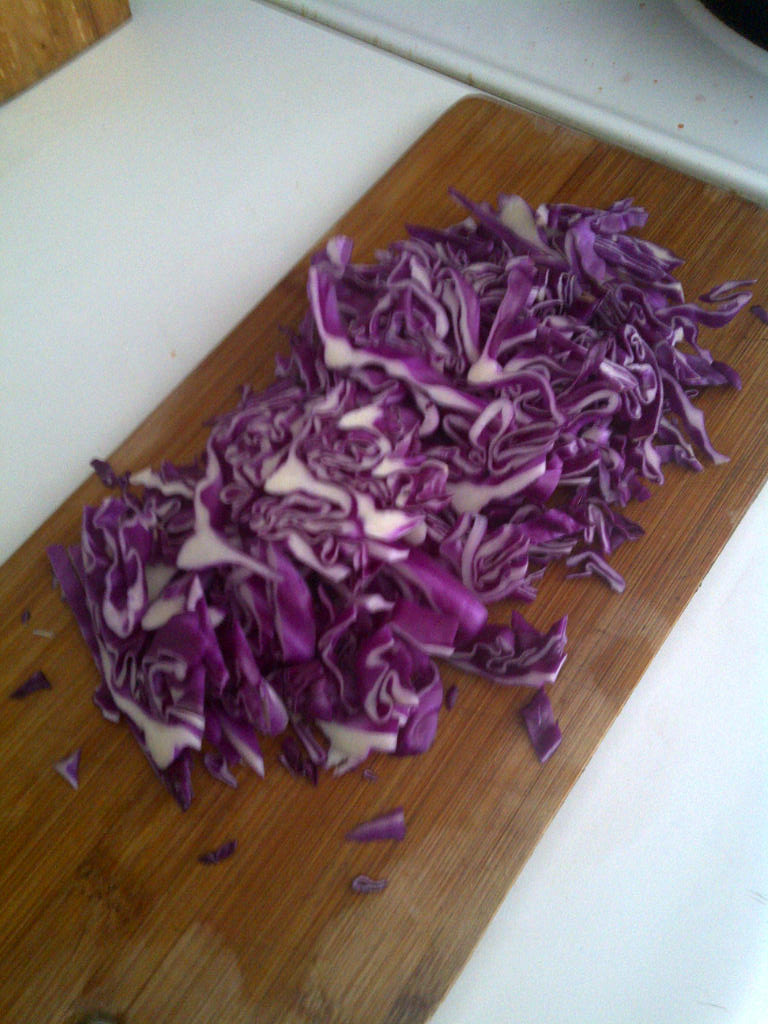
7. In the meantime, shred cabbage. The cabbage should normally be green but it so happened that I only have red cabbage in the house, so I decided to use it instead.
It’s up to you how much cabbage to use based on
how much you like cabbage. Some people who are really
not into cabbage have been known to skip it altogether
8. Add the tomato sauce to the cooking pan with the stock and the potatoes. Then, add shredded cabbage to the pan as well.
 
9. When the cabbage is almost ready, add fresh parsley or cilantro. Keep tasting the cabbage to determine whether it’s ready because it takes different kinds of cabbage a very different amount of time to cook. The cabbage should be “al dente”, so to speak. Make sure it is not mushy. As soon as the cabbage reaches the desired degree of softness, take it off the fire and let it stand for 10-15 minutes.
 
This is how the borscht looks when it’s almost ready
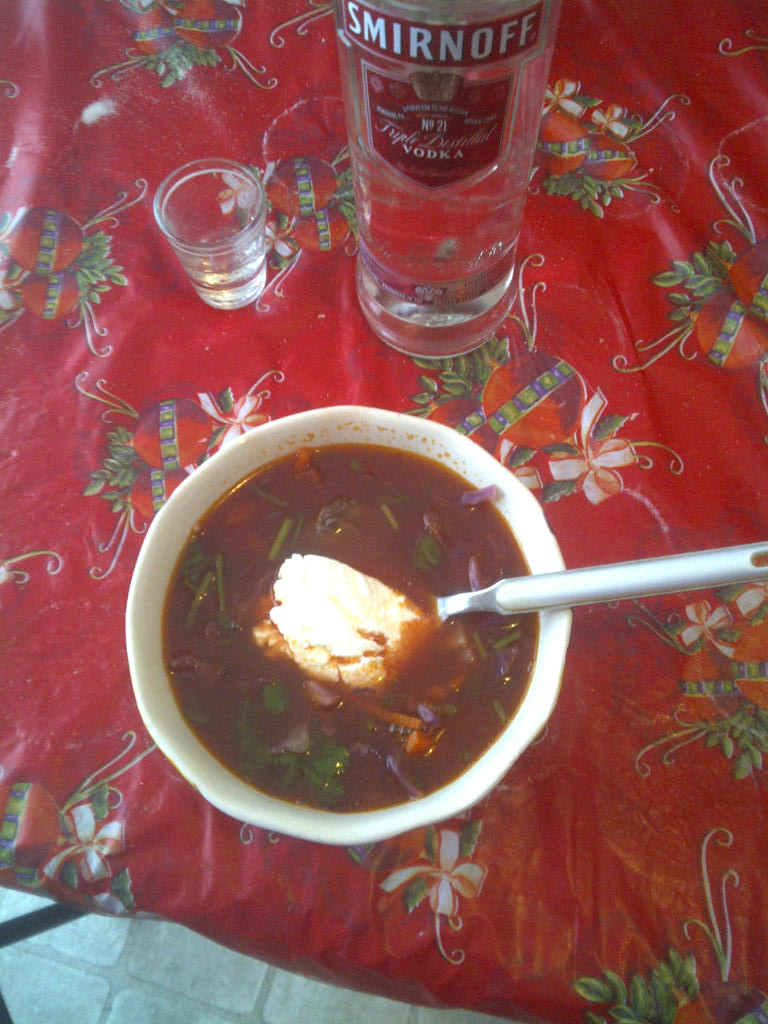
10. Serve borscht with a table spoonful of sour-cream. True Ukrainians stick a really hot red pepper into their borscht and eat it with wooden spoons.
Borscht is served with sour cream.
I don’t drink vodka, but it makes the picture
look more authentic

>Medical Care in the Soviet Union

>

When I tell people I was born in the Soviet Union, more often than not I hear them ask, “The medical care there was amazing, wasn’t it?” Well, let me tell you about just how fantastic it was. God, those fond memories are just rushing in.
Medical care in the USSR was completely free. Of course, if you didn’t offer any gifts or bribes to the doctors and nurses, you could count on nobody paying any attention to you and making you wait forever even for the urgent medical procedures. To give an example, my mother couldn’t convince the nurses she was in labor. They kept telling her to wait in a very rude manner. It wasn’t my mother’s first time giving birth, so she was pretty sure of what was going on. Still, nobody wanted to pay attention to her. It was night-time, and she was being extremely inconsiderate going into labor at that inconvenient time.
When I was five, I had a tonsillectomy. It is a fairly minor procedure that many people undergo with no complications. So it would have been in my case had it not been for the fact that the doctors confused me with some other little girl who was allergic to anaesthetics. So they didn’t anesthetize me. (Something tells me that the other girl was a lot worse off because they must have pumped her full of drugs she was allergic to and that I was supposed to get instead.)
Before the operation, my parents told me that I would be given a medication to make the procedure painless. So when the doctor started tearing my tonsils out with no anaesthetic, I started crying. Not surprising, given that I was five years old. So he hit me in the face with his fist to shut me up. When I walked out of the operation room (which you were supposed to leave the moment the operation ended), my face was covered in blood. Then I was put in a ward with many other little kids. It was December, and the room was freezing cold. It was so cold that I got pneumonia. At least, my mother was there with me, which was very unusual in Soviet hospitals. Normally, little sick kids were denied any contact with their parents during hospitalization. So I was really lucky. The nice, kind doctors wouldn’t let me leave because apparently they weren’t done with me just yet. When matters started looking really grim, my grandfather came and removed me from the hospital. So at least I’m alive.
When my sister was about the same age, she got sick. Kids get sick, it happens. A doctor came to see her. She looked at my sister indifferently and said to my mother, stifling a yawn: “The kid’s gonna die, lady. She’s in a bad way.” Of course, my mother started crying and saying that it wasn’t possible. It didn’t even seem like my sister was feeling all that bad. “I said she’ll die,” said the doctor irritably. “Can’t you hear me?” But at least that nice doctor came to visit us absolutely for free. (My sister grew up to be a beautiful, healthy adult, thanks be to Allah.)
These are just a few of my stories about the beauty of the Soviet healthcare. One day I’ll tell you about the wonders of the Soviet gynecological services which will turn your stomach. So don’t be too surprised if I don’t take all that kindly to any pontifications on how amazing the medical care in the USSR was.

Neil McKenna’s The Secret Life of Oscar Wilde: A Review

After the disappointment of Selina Hastings’s biography of Somerset Maugham, I didn’t expect much from Neil McKenna’s The Secret Life of Oscar Wilde, a book that has served as an inspiration to Hastings. Still, I was too sick to process anything more complex than a biography, so I decided to give it a try. To my surprise, I really liked it.

For one, McKenna doesn’t take on a task that would be excessively hard for him to carry out and never promises anything he will not be able to deliver. He makes it very clear from the start that this book is dedicated exclusively to Wilde’s sexual biography and nothing else. Unlike Hastings, he doesn’t attempt to cover every aspect of his subject’s life or offer inane pronouncements on the subject of his literary work. Wilde’s artistic production is discussed only in terms of its connection to his sexuality.

It is obvious that McKenna has done an incredible amount of research. However, he is different from Hastings in that he doesn’t expose the readers to a barrage of irrelevant minute details of Wilde’s existence. Every new personage he introduces is relevant to the culminating moment of the book: Wilde’s trial. McKenna never forgets to attract the readers’ attention to the information that will become crucial much later in the book. Every fact that the author mentions serves to advance the story, so it’s easy to follow the narrative without getting distracted from the story-line. McKenna makes every effort to remain objective and, unlike Hastings, never tries to offer inane judgements where none are needed. This is quite a feat for a biographer of somebody as controversial as Wilde.

In spite of McKenna’s objectivity, Wilde comes off like a very disgusting individual who bullied underage boys into having sex with him and might have been on the verge of pimping his 9-year-old son to Lord Albert Douglas on the very eve of the scandal that eventually put him in jail. One of the reasons I rarely read writers’ biographies is that I’m fearful of being so disappointed in them that it will prevent me from enjoying their work ever again. Of course, there are artists of such stature that you can forgive them anything. Francisco de Quevedo was an anti-Semite and a hater of women. Dostoyevsky was also a rabid anti-Semite who treated his wife horribly. Juan Goytisolo is a passionate misogynist. Still, they created works of art of such magnitude as to be enough to redeem our entire civilization with all its faults. In my view, Wilde is nowhere near that category.Biographies are often boring, especially if they discuss people whose life journey has been written about and filmed many times. This is not the case with The Secret Life of Oscar Wilde. McKenna offers some very interesting findings. I used to think that my knowledge of the circumstances surrounding Wilde’s trial and incarceration was quite good. This book, however, proved me wrong. After reading it, I realized that the case was a lot more complex than I thought. The book really reads like a mystery novel.

Of course, I wouldn’t be myself if I didn’t find anything in this biography to make fun of. McKenna sometimes creates phrases that are quite heavy-handed. I will give you a few of my favorite examples:
  1. Certain events were enough “to send him rushing towards the bacteriological sanctity and safety of marriage.” You have to agree that the bacteriological safety of marriage sounds perfectly hilarious. Coupled with the general tone of the book that often borders on pompous, this turn of phrase is priceless.
  2. Oscar performed his husbandly duties manfully and to good effect. Just four months after her marriage, Constance found herself pregnant.” It is highly debatable whether the appearance of children in such a loveless and miserable marriage was such a good effect, of course.
  3. The love of Oscar for Constance, and of Constance for Oscar, was a strangely arbitrary, ill-considered, precipitate sort of love.” This sounds like there is love that isn’t arbitrary or precipitate, which is hardly possible. A calculated and well-pondered sort of love is no love at all.
  4. The locus of Oscar’s sexual interest in Constance lay in her virginity, and in robbing her of that virginity.” I don’t know how it’s possible to “rob” anyone of their virginity, as if it were an actual object and not a social construct. It is especially difficult to do so within a fully consensual relationship.
  5. Pierre Louis is usually regarded as a red-blooded heterosexual.” This, of course, immediately made me wonder what other kinds of blood heterosexuals might possess.
  6. The letters were from Oscar, Lucas D’Oyly Carte and others, and were indeed compromising. Wood knew that they were worth their weight in-gold.” Given that letters don’t weigh all that much (and here we are talking about pretty short letters, too), one is left to wonder whether their weight in gold was really that big of an amount. 
  7. Charlie even accepted a preserved cherry from Oscar’s own mouth. `My brother took it into his, and this trick was repeated three or four times.’ It was quite clear to everybody that Oscar wanted Charlie to take more than just a preserved cherry into his mouth.” We cannot possibly know what was clear to everybody who was in the room at that time or what Oscar wanted Charlie to take into his mouth. Thankfully, such heavy-handed attempts at guessing are very few in the book.
McKenna is, however, perfectly capable of creating a very powerful, pithy, incisive sentence. Consider this one, for example: “In the eyes of the Victorians, there was only one thing worse than a sodomite, and that was a proselytising sodomite.” In spite of some minor slips, The Secret Life of Oscar Wilde is a very good book that I enjoyed a lot.

>Random Posts Widget

>

I just added a Random Posts Widget to the blog. It brings up posts from the past on a random basis, showing how many comments they got and allowing to read more from the posts you find interesting. These widget reminded me about some of the posts that I wrote a while ago and forgot about completely since then. I think this widget is cute, but feel free to tell me if you hate it. Also, if you know of other curious widgets supported by Blogger that you’d like to see here, let me know.

P.S. I can see that the new gadget is really popular by the number of visits it got. A tip: if you refresh the home page, the gadget will bring up different posts every time. Enjoy!

>Clarissa’s Chupe de mariscos from Peru (Peruvian Seafood Soup)

>We have Peruvians in the family, so Peru’s wonderful cuisine is very appreciated. Today I will share with you my version of my favorite Peruvian dish – Chupe de mariscos, or a seafood soup. Peruvian food is not only delicious and healthy. It is also aesthetically pleasing, which this particular chupe showcases beautifully.


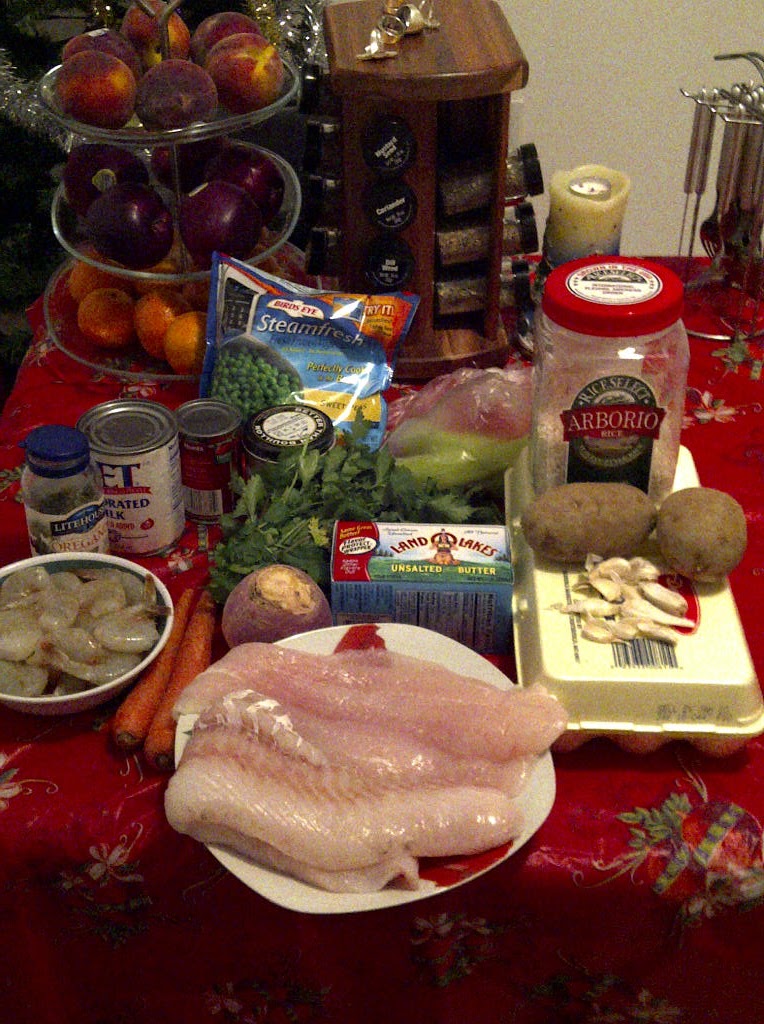
Ingredients for the
chupe de mariscos The fruit obviously are not
part of the dish. They are just there
because it’s their place

 1. First of all, I have to warn you that there are quite a few ingredients in this soup. You can see them gathered in this picture. I am cooking this in a small Midwestern town, so some of the ingredients are not available to me and I have to improvise. It is still absolutely delicious, though. So this is what I will use:

-bouillon (if you don’t have it, just use water);
-raw shrimp;
-a couple of fillets of white swai and cod (you can take the fillet of any fish you like as long as it’s white);
-a small turnip,
-a couple of potatoes;
-frozen green peas (fresh peas are best, if you can get them);
-4-6 eggs;
-a little can of tomato paste;
-1-2 cans of evaporated milk (you decide how much you want to use);
-fresh cilantro and oregano;
-garlic;
-a couple of medium or one big carrot;
-hot yellow peppers;
-unsalted butter;
-some rice (you can skip this ingredient if you like);
-and, of course, salt and pepper.

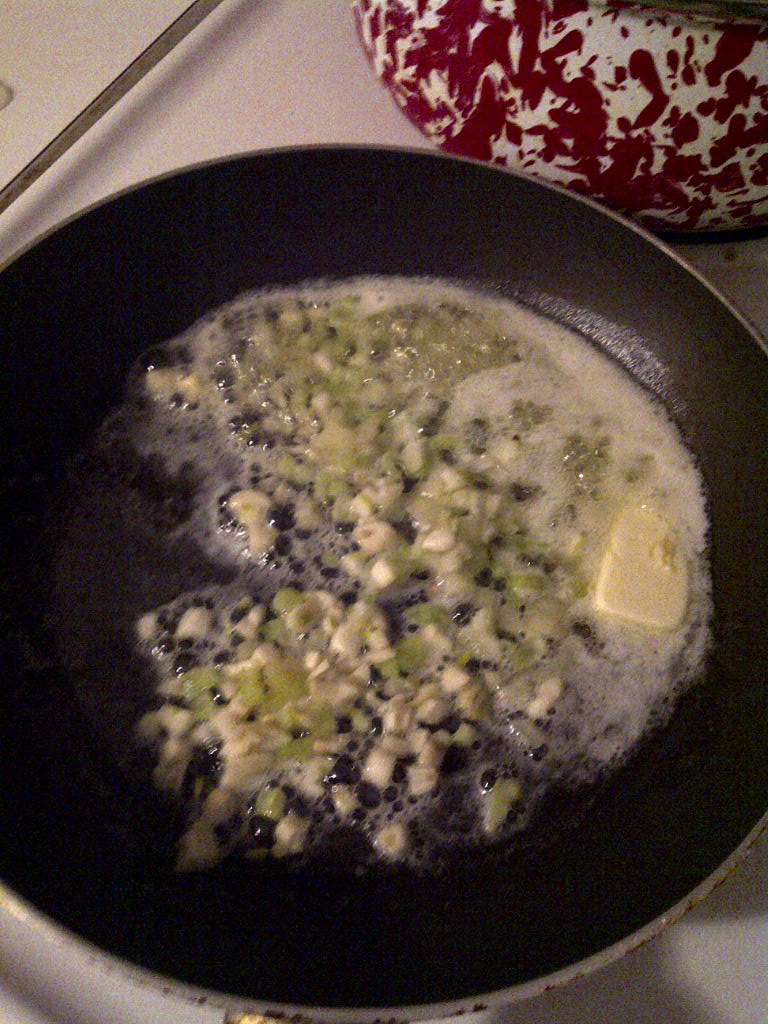
2. Heat up 8-10 cans of bouillon or water in a big pan. Make sure you add salt to taste. In the meanwhile, mince garlic and hot yellow peppers. The quantity of these ingredients is up to you. We prefer more garlic and very little peppers, but some people do the opposite. Take a small frying pan, melt 1/4 of a stick of unsalted butter in it, and fry garlic and peppers on medium heat for under a minute. The garlic should not be allowed to get dark.
3. Peal and cube the carrot, the potatoes and the turnip. Carrot cubes should be smaller than potatoes and turnips. Add the vegetables and garlic + peppers to the boiling bouillon.


Here you can see comparative sizes of
cubed vegetables. Potatoes
are in the front and the turnip is in
the back. Feel free to use any variety of sweet potato.

4. Then add 2 table spoons of tomato paste to the bouillon. Add 1/2 tea spoon of oregano. If you will be using rice, add a handful now. Don’t add too much rice, or it will absorb all the delicious liquid, and you will end up with a stew instead of a soup. 

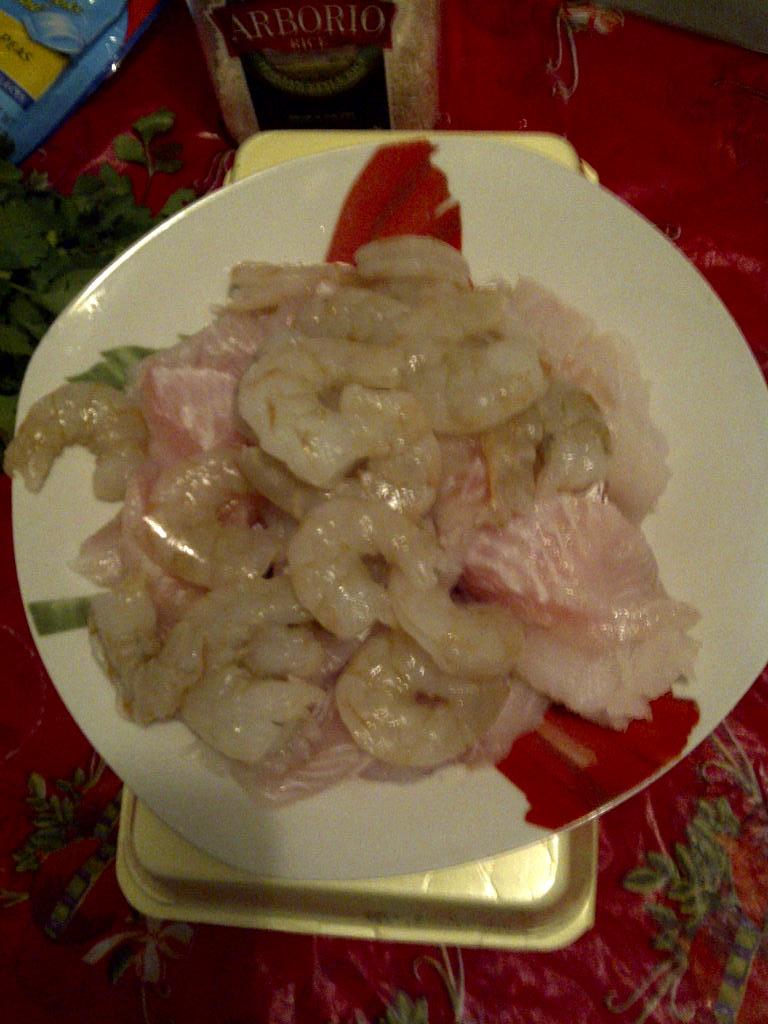
5. When the vegetables are done to the desired degree of softness, add fish fillets cut into pieces and raw, peeled shrimp. Again, it’s up to you to decide how much fish and shrimp respectively you want to add. It’s also a great idea to add fresh calamaris at this point, but I don’t have any today.
Make sure you don’t get the precooked shrimp.
You need raw shrimp, or it won’t be the same at all.
Raw shrimp need to be peeled and deveined.
This can be done for you at the store.

6. When the fish ans shrimp are halfway done, start adding the evaporated milk. Stop adding the milk when the soup reaches a pleasing color. Feel free to add more or less evaporated milk, according to your preferences. Some people use as much as 2 cans, while I normally use just one.

7. Now is the time to add a cup of peas and 4-6 eggs. At the very end, chop some cilantro and add it to the soup. When the eggs are cooked, turn off the heat. Let the soup stand for 10 minutes. And now try it and tell me if it isn’t absolutely delicious.

It even looks beautiful!

 ¡Buen provecho, amigos! Enjoy!

>Why I Don’t Like the Movie The Lives of Others

>http://rcm.amazon.com/e/cm?t=clasblo-20&o=1&p=8&l=bpl&asins=B000OVLBGC&fc1=000000&IS2=1&lt1=_blank&m=amazon&lc1=0000FF&bc1=000000&bg1=FFFFFF&f=ifr

I know that most people adore The Lives of Others and find this movie very touching. I, however, could never get into it because of how wrong it gets many of the most basic details of the characters’ daily existence. I don’t like Cold War rhetoric and imagery because of how reductive and unintelligent they are. It’s always the good versus the evil, and it doesn’t matter which side of the Iron Curtain you are on. The verbiage is the same and the desire to reduce complex realities to a bunch of cheesy stereotypes is omnipresent. Both sides judge each other according to their own, very limited ideology, without ever trying to understand that things might be a little bit more complex.
During the Soviet times, my father always listened to the BBC (secretly, of course) at night. “They are fools, all Westerners are fools,” he would fume in the morning. “Last night they said that there were human rights abuses in the USSR which consisted of people not being allowed to travel freely abroad. They have no idea about who we are and how we live. I have a PhD in linguistics and I have to leave aside my research and spend the entire next week sorting rotten cabbage. But, sure, not being able to travel abroad is my main concern.”
I was reminded of this reductive Cold War mentality as I was watching The Lives of Others. The filmmakers so obviously made their film with the goal of selling it to Americans that it was painful to watch. Take, for example, that scene where the character who works for the Stasi comes to his BARE apartment, where he lives ALONE, eates a plate of spaghetti with KETCHUP and invites a PROSTITUTE over to his apartment. I mean, how much more ridiculous than that can you get? And, of course, if a movie is so careless with the minor details, how can you expect it to deliver anything more reliable in terms of the big picture? The result is this unbearably cheesy Americanized fantasy about what life behind the Berlin Wall was like. A fantasy that has nothing to do with reality.