>Why Didn’t I Discover Michael Connelly Sooner?

>

My brain was about to melt from all the philosophy I had to read in the past two weeks, so I realized that I needed a new mystery series to provide a distraction from the complexities of Badiou and Laclau. Since my fellow Kindle owners are really into Connelly these days, I decided to start reading him, too.

All of my favorite mystery writers are women. There is a single male author whose work I follow (John Lescroart) but the rest are women. I’m over the cozy mystery genre, which is what male writers do best. If you want scary, gritty and bloody, you have to go with female writers every single time. Male mystery authors are squeamish about blood and gore, while their female colleagues pile up horrors in a very cavalier fashion.

Michael Connelly, however, is very good. He has two series that sometimes overlap: the police procedurals whose main character is a policeman called Hyeronimus Bosch (seriously) and courtroom dramas staring a lawyer called Mickey Haller*. The Mickey Haller series are quite crappy. The author based his protagonist on the cliche-ridden legacy of the noir fiction. If you are sick and tired of the characters developed by the supremely boring Raymond Chandler, Mickey Spillane and Dashiel Hammett, then you will be equally bored by this series from Michael Connelly.

There are two big drawbacks to the otherwise great Hyeronimus Bosch series. The first one is that Connelly doesn’t know how to end a mystery novel. His endings tend to be very unimpressive. “Here is the killer, case closed, the end.” This author seems to have no idea that a good mystery doesn’t end when the killer is revealed. At least a few pages need to be dedicated to the explanation of some previously unknown details about the crime, the criminal, or the search for the criminal.

Another huge problem I have with Connelly’s books is that they are set in L.A. Honestly, don’t writers get tired of placing every other series that comes on the market in the same city? I’m sick and tired of L.A. already and I’ve never even been there. And it isn’t just about the same annoying geography. When you place a detective series in L.A., this will define what the books in the series will be about. For example, whenever a novel is set in L.A., it’s bound to be filled with aspiring actors and actresses who don’t manage to make it in the movies and turn to prostitution. (Now that my favorite TV series Law & Order had also moved to L.A., I’m getting annoyed every time I hear this city’s name.)

In spite of these issues, however, Connelly’s Hyeronimus Bosch novels are very good. The writer’s greatest achievement in this series is the protagonist. Connelly has to be commended for reducing the noirish characteristics of the protagonist to a minimum. Writing about an LA police officer who worked in LAPD from the 1990ies on is fraught with danger. Connelly obviated the immediate dislike for a character who is an LA cop by creating a sensitive and tortured policeman. “Taking cases straight to heart is the way of the true detective. The only way,” Bosch announces in Echo Park in a way that would be pompous had it come from someone else. Coming from this particular character, though, the statement is very believable.

* From what I’ve been able to gather, Connelly has some stand alone novels too but I haven’t been able to take a look at those yet.
>Canukistani’s Blog

>

One of the most assiduous readers and participators of this blog who is known to us as “Canukistani” now finally has a blog of his own. The blog is called Northern Gaijin and has kicked off its first week of existence with posts on Žižek, Lori Gottlieb (the author of a manual on how women should settle for whomever wants them lest they be left all alone), American history, Fukushima, and other fascinating topics. There are great videos, pictures, and interesting posts.

>Seafood Risotto

>

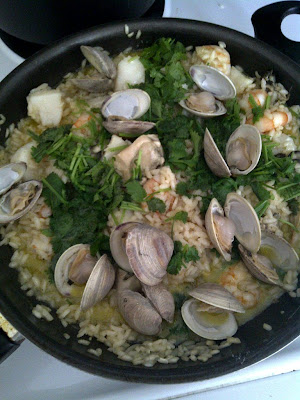
This is the seafood risotto I just made. Making risotto is extremely hard. The first time I made it, it stuck to the plate like cement and, I couldn’t get it to budge in any direction. I still ate it all just to punish myself for wasting great ingredients. Of course, I had to use a steak knife to saw through that sad plate of risotto-based Crazy Glue.

Restaurants almost never know how to make risotto either. More often than not, you just get a plate of rise smothered in cheese. Even expensive, famous restaurants frequently mess it up. There was an absolutely perfect mushroom risotto that was served at a restaurant on McGill College in Montreal. Sadly, that restaurant has closed. Even at The Modern restaurant in New York the risotto was the weakest dish of all.

The good news is that with every risotto I make, I get a little better. This seafood risotto I made today looks great and doesn’t stick to the plate at all. This particular version of risotto contains clams, scallops, shrimp and oysters. Even if the risotto itself were bad, the beautiful seafood would go a long way to redeeming it.

P.S. By huge popular demand of one reader, here is the recipe:

1. Pour some olive oil into a pan. Add some crushed garlic and fry it for not more than a couple of minutes. Add 1 cup of arborio rice. Make sure that every grain of rice is covered in olive oil. 
2. When the rice starts acquiring a slightly golden hue, slowly add one glass of dry white wine to the pan. (Feel free to skip the wine and add fish stock instead.) Keep mixing the rice the entire time. It should be prevented from sticking to the bottom of the pan.
3. When the wine reduces, add some fish stock. Keep adding the stock in little portions as it keeps reducing. Remember that you will need to stop adding liquids when the rice is al dente. Nothing is worse than a risotto whose cook didn’t stop on time.
4. In the meanwhile, peel and devein shrimp. Place clams in a pan of boiling water. In a bout two minutes, the clams will open. When that happens, take them out of the pan. If there are clams that failed to open, throw them out.
5. When the rice is about 5  minutes away from being al dente, add the shrimp, the oysters, and the scallops to the pan. (This seafood can be substituted with any other kind.) Add some grated Parmesan. I also add cilantro because I love it and add it to everything. 
6. When the risotto is about two minutes away from getting done, place the clams strategically all over the surface of the risotto. Make sure you serve it while it’s hot. Leftovers are not bad either but nothing beats freshly made risotto.

>Consulting Services for Fellow Hispanists (And Other Colleagues in Humanities)

>

When you finally get your PhD and find that first professorial position, you feel elated and nearly ecstatic. Finally, you will be able to become a scholar in your own right and transform your field of knowledge. Then you discover that your graduate program taught you how to be a great grad student but left you with no knowledge whatsoever as to how to be an actual scholar. You know how to write a brilliant final essay for a grad course, but have no idea how to transform it into an article that a good journal will want to publish. There are now no course deadlines which used to help you organize your time, so you spend your free hours floundering in the sea of conflicting ideas as to what your next step should be. Articles you submit for publication are rejected with a few lines that give you no clue as to what is wrong with your article. Should it be reworked and submitted to another journal? If so, then how you should rework it? Or is it utterly hopeless and should be abandoned altogether? How do you go about transforming your brilliant doctoral dissertation into a book ready for publication?
So many young academics manage to find no answer to these questions and eventually give up on their dream of becoming research scholars altogether. A distance between being a fantastic grad student and becoming a real scholar is huge and we almost never receive any training on how to bridge that distance while we are in grad school.
Well, my friend, if you are in the field of Hispanic Studies, you are in luck. I have recently discovered that Jonathan Mayhew, a highly esteemed scholar in the field of Peninsular Literature, is starting a consulting business where he will offer a variety of invaluable services that will help young scholars to find out what they are doing wrong and improve. Here are some of the services that Jonathan offers:

Peer Review ($75). I will act as a peer reviewer for your unpublished article, giving you a full report (Humanities fields only). 
Evaluation of the Scholarly Base ($150). I will help you make an inventory of your scholarly base and identify areas of weakness. 
Prose X-Ray ($50). I will read three pages of your prose and tell you what you are doing wrong (Spanish or English). 
Poetry manuscript($200). I will read your book of poetry and give you suggestions for writing less crappy poems. 
Mentoring (variable price). I will design a mentoring plan for you for an agreed-upon price for a minimum of six months. 
Time management ($100). I will show you how to schedule your time so you can get three times more done. 

For the entire list of services and to read Jonathan’s extremely helpful motivational blog go here.

The only reason why I’m promoting Jonathan’s services on my blog is because I have tried them and now want to spread the joy. I asked Jonathan to look at the most recent article of mine. When he read it, he sent me a) a report on the article that he would have written had he been reviewing it for a scholarly journal and b) extremely useful comments on what was wrong with the article and helpful practical advice as to how the article could be improved.
Often, brilliant scholars make really crappy pedagogues and are completely useless as mentors. They word their criticisms of your writing in a way that makes you want to go jump off a cliff instead of making you want to improve. (To give an example, I was told once by an older scholar that the way I write in English puts me on the same level with people who are functionally illiterate. The 1,174 visits I had to this blog just today seem to contradict that statement.) There is another breed of scholars who only tell you how brilliant you are and how amazing everything you write is. Neither of these approaches is extremely helpful. Sadly, scholars who know how to offer incisive criticism of your research in a way that is both useful and respectful are hard to find. 
Jonathan offered some pretty harsh criticisms of my article. However, he did it in a respectful way that didn’t hurt my feelings in the least. It was obvious from the comments that his only goal was to help me improve the piece. I haven’t received such helpful comments on my writing in many years.
So if you are in need of helpful, productive criticism and valuable scholarly advice, consider using Jonathan’s consulting services. Visit his blog for more details.

>Clarissa’s Stewed Rabbit: A Recipe

>

If you never tried rabbit, maybe it’s time you did. Rabbit is good, lean meat and, if cooked right, it is delicious.
What you will need:
1 medium sized rabbit
1 onion
1 bay leaf
2 tablespoons of coarse-grained Dijon mustard
2 tablespoons of sour cream
1 tablespoon of flour
1 teaspoon of rosemary
half a can of green peas
herbs of your choosing
water of bouillion
salt and pepper

1. First, you’ll have to defrost your rabbit because they are usually sold frozen in this country and wash it.

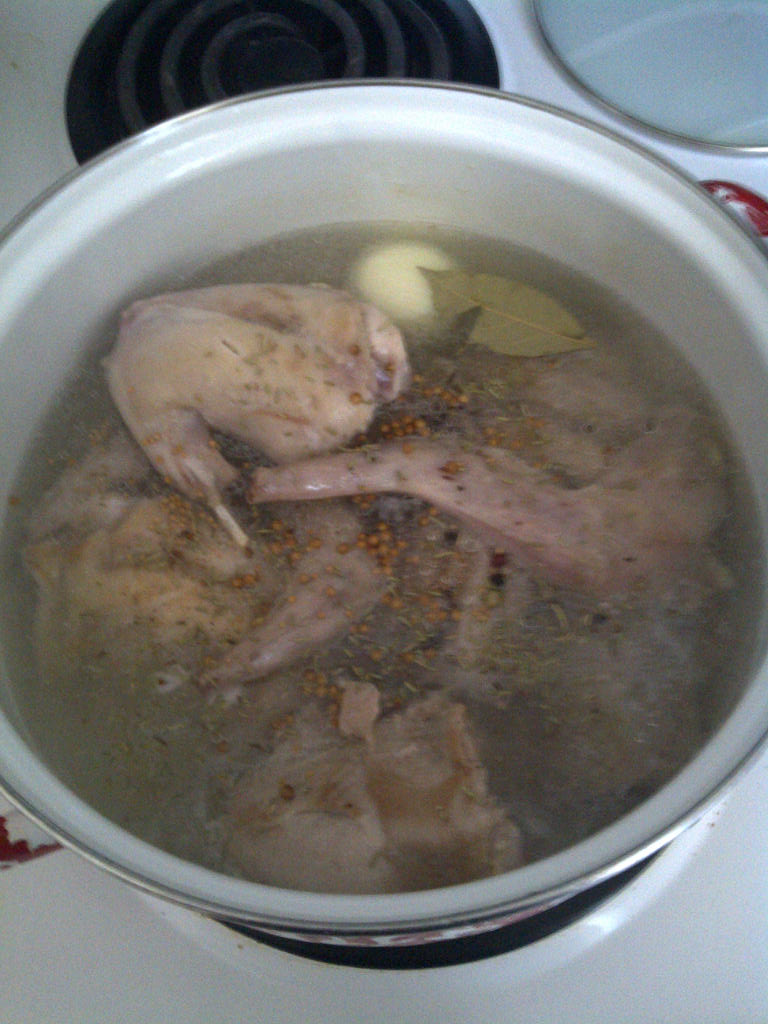
2. Then, you’ll have to butcher it. So if you are at all sentimental about cute, little bunnies, then maybe this is not a recipe for you. The good news is that butchering a rabbit is extremely easy. It usually takes me about five minutes to cut it into pieces like the ones you can see in the picture:

3. Season the pieces of rabbit with salt and pepper. Then, brown them lightly on both sides in olive oil:

4. After the pieces have browned, add them to a large pan, and cover them with bouillion or water. Add an onion, some black pepper and your favorite herbs. I have added a bay leaf, rosemary (which goes really well with rabbit), some mustard seeds (because I love them) and some coriander. Bring the water or stock to a very light boil and put the pan on medium-low heat for about 30 minutes.

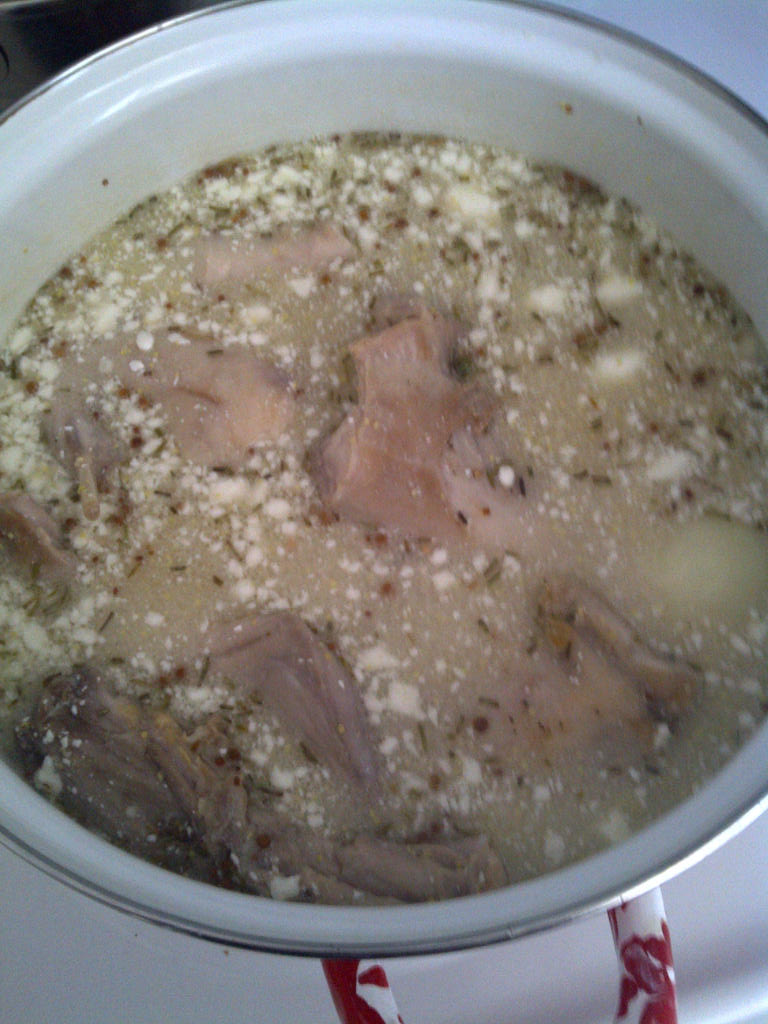
5. Add 1-2 tablespoons of coarse-grained Dijon mustard to the pan. However, if you only have cheap mustard of the kind that people put on hot dogs, it’s better to skip this step altogether. Bad mustard can kill this dish completely. Dissolve two tablespoons of sour cream in cold water and add it to the stew. Then, dissolve a tablespoon of flour in cold water and add it to the pan. This is how your rabbit will look after you do all this:

Add some salt to taste to the stew, cover it and leave it to simmer for another 45-60 minutes, or until the rabbit becomes tender. When the rabbit is almost done, add some green peas.
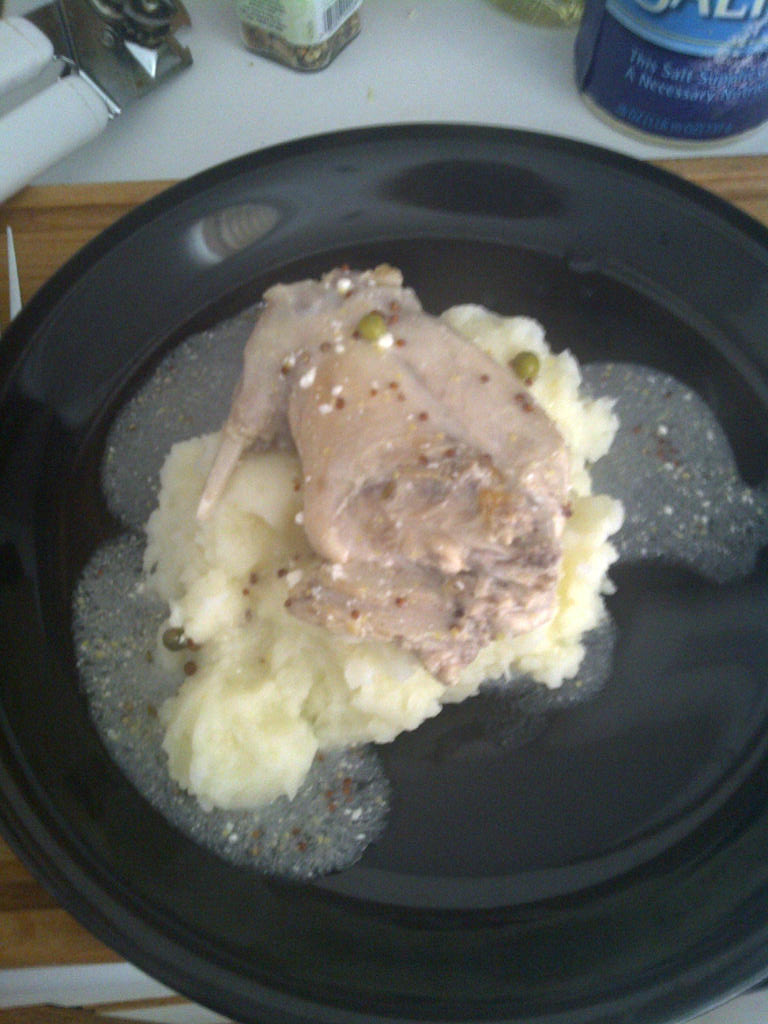
6. I serve the rabbit over mashed potatoes but any other garnish will do, of course:

Enjoy!

Are There Differences Between the Russians and the Ukrainians?

Even though Russians and Ukrainians often speak the same language, there are important differences between us that are the result of our different history, geography, climate and culture. Here are some of these differences:

 1. The most important invasion that was suffered by the  Russians was that of the barbaric, fiercely militaristic and nomadic Golden Horde. The presence of the Mongol invaders (who did nothing but burn, rape, rob, and ravage) throughout the 13th century isolated the Russians from the rest of Europe, putting them behind other European countries in terms of culture, economy, politics, religion, etc. While this was going on in Russia, a part of Ukraine was subjugated by the Lithuanians (who were behind the Ukrainians in terms of their civilization and development and quickly adopted Ukrainian culture and practices). Another part was conquered by the Poles (who were highly civilized ans sophisticated and brought European trends into Ukraine.) The consequences of this can still be felt today when the idea of being European and belonging to Europe is very attractive to most Ukrainians. Russians, however, are a lot more oriented towards Asia and view Europe with suspicion.
2. Most of the Russian lands are infertile and it is very hard to survive on them. For this reason, there were always strong communal tendencies between people who lived on the land. It was a lot easier to survive if you joined your paltry possessions with neighbors and cultivated the land together. The lands in Ukraine, however, are among the most fertile in Europe. Everything grows, blooms, and requires very little effort to become productive. This is why people are a lot more individualistic. It was a lot more difficult for Stalin to enforce collective ownership in the agricultural areas of Ukraine than it was in Russia. Also, the respect for private property is a lot weaker in Russia than in Ukraine.
3. There was a very strong legacy of democracy in Ukraine that was completely absent from Russia. Between the XVth and the XVIIth centuries, Ukrainian cossacks created a democratic government where no distinctions were made between people of “high” or “low” birth. Russians, however, were always governed by extremely autocratic rulers. This is why today, Ukrainians are still trying to establish a democracy in their country, while the Russians seem to be quite content with their authoritarian government. Every Ukrainian is the maximum authority in his or her own life while Russians keep waiting for their good tsar du jour.
4. Women always had much greater freedom in Ukraine than in Russia. Since the Middle Ages, Ukrainian women had an opportunity to choose their partners freely. Unlike in Russia, Ukrainians did not practice arranged marriages where women were not allowed to see their future husbands before the day of the wedding. The practice of having the women’s side of the house where women had to stay was prevalent in Russia, but nobody ever heard of it in Ukraine. Women did not cover their heads in Ukraine (unless they felt like it), while in Russia they had to do so and cover parts of their faces as well.
5. As a result of a greater freedom for women, sexually Ukrainians always enjoyed a much greater freedom and fulfillment. The sexual revolution in Ukraine began at around 1910 (earlier than anywhere else in the countries of our Western Civilization) with the writing of one of our greatest writers (and the future Prime Minister of the independent republic of Ukraine) Volodymyr Vynnychenko.
6. As a result of their climate, the fertility of their lands, the beauty of their landscape and the joyfulness of their culture, Ukrainians became much more open to the world than the perennially gloomy and self-centered Russians.

>Ukrainians and Food

>

Once I invited some friends over to my parents’ place. After a huge meal with many different dishes, the sated friends started getting up. “Where are they going?” asked my mother who doesn’t speak English. “Tell them all to sit back down. These were just the appetizers. I also have hot sandwiches, entrées, and a dessert to serve.” 
At the end of the meal people had to crawl away from the table because they were so full. “Ask them if they want a snack,” my mother said. “I have a lot of snacks to offer. It isn’t like I’d allow your friends to leave the house hungry.”

What You Need to Know About Your Russian-Speaking Friend

Every culture has its own peculiarities. We, the Russian-speakers, are, of course, no exception. In this post, I will share some of the things you should expect if you are planning to spend time with Russian-speaking friends or colleagues.

1. We are joyful people who love to celebrate, spend time with friends, and enjoy existence. A week doesn’t pass by without my parents having at least one group of friends over at their place. A Russian-speaking party is very different from the Anglo-Saxon party, for example. For one, nobody stands while trying to balance the plate and the glass. Everybody sits around a big table. Regardless of the economic situation of your Russian-speaking hosts, food will be abundant and will consist of several courses with many food choices. Nobody will ever ask you eat off a paper plate and drink out of plastic cups. The table will be beautifully and properly laid, there will be beautiful table linens and dinnerware.

There will not necessarily be alcohol. (No, we are not all alcoholics, no matter what you might have heard.) If guests at my parents’ house request alcohol, there is likely to be a lot of confusion followed by a frantic search for that half-finished bottle of wine that somebody brought over last summer. As I was growing up, my parents never bought a single bottle of vodka. There was champagne for New Year’s (one bottle that would be divided among a dozen guests) but vodka never made an appearance. There will never be any drinking of alcohol without plentiful food to accompany it. Asking people to drink wine and only offering them some cheese with it is considered unacceptable.

Your place at the table is usually assigned to you by the hostess. It is rude to rush to a place of your own choosing because it will spoil the hostess’s seating plan. My mother, for example, often leaves cards with the guests’ names (and a little gift inside) next to the plates she assigned them. If you saw how my mother lays a table, you’d think she was brought up in the palace of the Queen of England. The next time I visit my parents, I’ll take a picture and post it on the blog. I promise that you will be stunned. We, however, consider it business as usual.

Parties last a lot longer than in North America. Here in the US, I’m usually disappointed whenever I go to a party by the fact that people begin to leave the moment when the gathering reaches the degree of warmth and mutual contentment after which a party in my culture continues for several more hours.

2. People are very direct. Politeness is not highly valued. I had to learn to say “please,” “thank you,” “how are you?”, etc. after I emigrated. Nobody is afraid of passing judgment on anything or anybody. (Which is something you would have never guessed after reading this blog for a while, right? 🙂 If your Russian-speaking friend thinks you gained weight, got a horrible haircut, are wearing an ugly dress or silly shoes, s/he will inform you of that in no uncertain terms.

3. People require (and expect others to require) a lot less personal space. It is completely normal to show up at a fiend’s place unannounced with your entire family and expect an elaborate meal to be served to you. And, of course, if you show up unannounced, people will leave everything they are doing and will feed and entertain you joyfully.

4. In spite of all the hospitality, this is a very closed culture and it’s extremely difficult to gain access to it. People will be nice and kind to you but it will take a lot of effort for them to see you as somebody who can be trusted.

P.S. If you are asking over somebody who is not just a Russian-speaker but specifically from Russia, make sure you have some tea in the house. Russian people drink tea all the time. After about 15 minutes in your house, your Russian friend is likely to start getting antsy and will send wistful glances in the direction of the tea-kettle. A Russian person’s first response to any trouble you might share with them is to offer to make you a cup of tea. I’m from Ukraine, so for me it was something I had to get used to when I first started living with a Russian person.

>Gender Stereotypes and the Mystery Genre: From Christie to Rendell

>

In the mystery genre, no one can compare with the amazing British authors Agatha Christie and Ruth Rendell. The first of these authors created the genre* while the second one took it to incredible heights in a number of extremely well-crafted novels. Compared with the psychological and literary sophistication of Rendell’s work, Christie’s novels seem primitive. The language is simple, the characters are one-dimensional, and the plots are quite similar.
One thing, however, is shared by the two queens of the detective genre. Both Christie and Rendell know extremely well how to manipulate the gender stereotypes of their times to create a mystery their readers will not be able to solve. Take, for example, Agatha Christie’s The Moving Finger and Ruth Rendell’s A Fatal Inversion**. In The Moving Finger, Christie attempts to prevent the readers from guessing the identity of the criminal by relying on their misogynistic vision of what constitutes “male” and “female” kinds of crime. This particular gender stereotype has lost its currency completely in the decades that elapsed since the novel was published. As a result, The Moving Finger is one of the lesser known of Christie’s novels. A modern-day reader will have no trouble guessing what really happened since the gender stereotype is the only thing standing between the reader and the realization of the criminal’s identity.
Ruth Rendell’s A Fatal Inversion is one of this prolific author’s best mysteries***. Vulnerability is the topic she explores in this novel in a stunningly successful way. Her characters are vulnerable to all kinds of things: sexual obsession, insanity, the desire to fit in at all costs, fear of rejection, the desire to fit in, alcoholism. The question of which one of them will prove to be the only truly resilient one remains unanswered until the stunning ending of the book. However, if it were not for our deeply-ingrained gender stereotypes, that ending would not surprise us in the least.
Hopefully, the gender stereotypes that Rendell based her novel on will pass into oblivion one day, just like the ones that informed Christie’s outdated mystery I have discussed here****.
* Edgar Allan Poe and Arthur Conan Doyle created the genre of the police procedural, not the mystery novel as such. Christie’s Hercule Poirot makes vicious fun of Sherlock Holmsian type of characters. Rendell has written quite a few police procedurals (her Inspector Wexford series), which I consider to be vastly inferior to her mystery novels.

** The novel was published under Rendell’s nom de plume Barbara Vine.

*** A Fatal Inversion, The Bridesmaid and Thirteen Steps Down are Rendell’s best novels, in my opinion. If I weren’t wary of making this list too long, I would add The Chimney Sweeper’s Boy and No Night Is Too Long to the list of her best work. If you like the mystery genre but still have not read anything by Rendell, what are you waiting for? She is absolutely the best. 

**** I have tried to discuss the plots of these novels as little as possible here to avoid spoiling the pleasure of their future readers.

>Clarissa’s Sauerkraut Salad: A Recipe

>

This is a very traditional salad that we make often in my culture. Since good sauerkraut is hard to come around in the area where I live, I make my own. It isn’t difficult at all to make it, and if people are interested, I can share how it’s done. My country isn’t rich in vegetables and vegetarian options do not abound. This is probably the closest we come to a vegetarian and healthy dish. (Here I do need to remind you that Ukrainian cuisine is probably among the most unhealthy in the world. Everything is salted, pickled, and smothered in lard. It is what it is, so I’m just trying to make the best of it.)
What you are going to need:
sauerkraut
potatoes
beets
pickles
scallions
canned green peas
olive oil
Some people also add carrots but I make my sauerkraut with carrots, I don’t add any more to the salad to avoid overpowering it with a carroty taste.
I don’t put any proportions here because it is really a matter of individual taste. Just keep adding ingredients and stop when you reach the taste profile that makes you happy.
1. Boil some potatoes but make sure they are not overdone. Nothing is worse than a mushy potato in a salad. Potatoes should still remain pleasantly firm inside after you boil them. 
2. Many people boil their beets too, but it’s always better to bake them in foil. Beets should also be taken out of the oven before they become mushy inside.

3. While things are boiling and baking, cut up some scallions and pickles and mix them in a big bowl with sauerkraut and green peas. Don’t overdo the pickles. Two medium-sized one are more than enough for the bowl of this size.

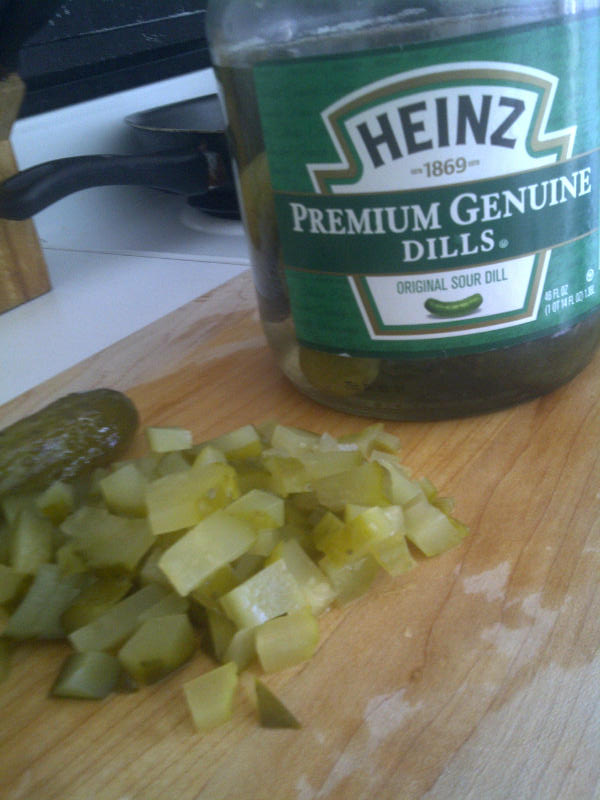
4. In the absence of a Russian food store in a close physical proximity, these are the pickles that I use for all my recipes because they come very close in taste to the real thing. I don’t suggest getting any other brand of pickles because the strong vinegary taste of most North American brands will demolish the taste of all my recipes.

5. Then, when potatoes and beets are ready, dice them and add them to the salad. The smaller you dice them, the better the quality of the salad will be. Then, add a little olive oil (I never add more than a tea spoon, unless the sauerkraut is extremely dry), mix everything, and enjoy.