Please look at the following image:
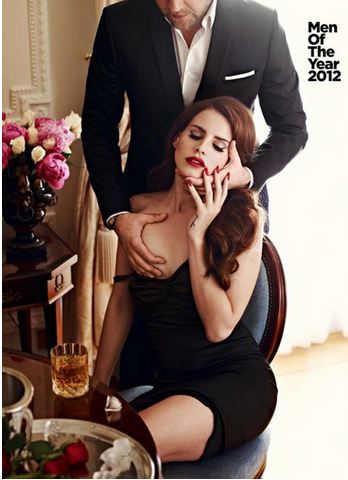
Here is an interpretation of this image provided by Nerdy Feminist:
When I look at this image, I can’t help but feel that the power is squarely with the man. Del Rey is vulnerable, with the placement of his hand over her breast and it is unclear what her feelings are about this or what is actually happening. The man’s other hand near her throat area furthers the sense that she is vulnerable and he is in control. We don’t really even know if he is threatening some level of violence. As he is dressed and she is partially nude, the feeling that she is an object is magnified. And as Miss Representation pointed out, it really is about her looks and body. He is in polished formal wear, and she’s almost a plaything or an accessory to him.
I had a completely different reaction to the photo when I saw it and Nerdy Feminist’s reading was very unexpected for me. In this image, I see a man whose only role is to gratify the woman sexually. He doesn’t even get a right to have a face. He is completely robbed of any individuality. He looks at the woman but she doesn’t look at him. He tries to gratify her but she is completely concentrated on her own feelings and is not willing to reciprocate.
This post doesn’t offer any criticism of Nerdy Feminist who is a talented blogger. Her reading is as valid and valuable as mine. The point I’m making here is that people bring themselves to every text they encounter. There is no single meaning even to a silly magazine cover.
Which reading do you prefer? Or do you have one of your own?

 Clarissa's Blog
Taking into account cultural context, her reading is more valid one, imo.
Seeing half-naked women isn’t rare, and the- intended- and- perceived- by- most idea isn’t of women enjoying themselves for themselves.
LikeLike
What cultural context? This doesn’t look like a scene taking place in Saudi Arabia. In a Western society where this scene seems to be set, many women happen to enjoy sec.
LikeLike
What I find funny in the OP is that when a faceless man pleasures a woman, the woman is an accessory. If a faceless woman pleasures a man, the woman is an accessory. It’s like mo matter what is depicted, tot this blogger the woman can never be anything but an accessory. Even when the activity they are engaged in is likely to give her more pleasure than him
I also find the idea that if a man caresses a woman, he takes control of her to be very interesting. If we saw her give him oral sex, would we decide that she took control of him with this act?
LikeLike
What about her being completely naked on the cover, unlike *any* of the men?
Public nudity is considered humiliating in Western culture too. Here her breast is out, on the cover – her body. The man with women hands is closed and at the picture’s centre, the hands are “nude”. Clothes signal seriousness, status and dignity, which (half) nude photos of a person of any gender (but here exclusively women) don’t have in Western culture.
LikeLike
What’s public in this situation? I don’t see an audience.
And I don’t see any nudity either. 🙂 The parts of the woman’s body that can be seen you can find in many a low-cut dress.
LikeLike
//The man with women hands is closed
CLOTHED, not closed.
LikeLike
Hi Clarissa–
I totally agree with you about the fact that we bring ourselves into analyses. It’s impossible not to. When I get into discussions with friends where we strongly disagree on the feminist merits of a book, character, movie, etc. I like to remind everyone that there’s never a right/wrong in these situations and it’s important to understand that different interpretations can exist simultaneously. And my interpretation can exist without implicating me in some kind of sad worldview.
That said, I would like to defend a few things because I feel my interpretation is being re-interpreted in a way which is not in line with what I’m actually trying to say. Chiefly, I think that these comments cross over into judgement about my view:
“What I find funny in the OP is that when a faceless man pleasures a woman, the woman is an accessory. If a faceless woman pleasures a man, the woman is an accessory. It’s like mo matter what is depicted, tot this blogger the woman can never be anything but an accessory. Even when the activity they are engaged in is likely to give her more pleasure than him”
There are certainly many photos in this world that I do not see as female objectifying. It’s not that I see every instance of a faceless man “pleasuring” a woman as reflective of woman=accessory…it’s that I see that *here* when I take BOTH of the photos of Del Rey into consideration. The theme I am seeing from GQ is of powerful men in tuxes on the 4 other covers (“men of the year”) and the positioning of a tuexed man in the photo here, as another powerful man who is–to me–dominating a woman. This interpretation is not reflective of how I view EVERY faceless man/woman situation. It’s not reflective of how I view all sexual images.
I think the photo is ambiguous…I acknowledge that in the photo description I wrote up in my original blog. I said we don’t know what is really going on, but my take is that there is an implied element of tenseness—from the positioning of his hand at her throat and her face. Where you see pleasure, I see strain.
Also, you say, “I also find the idea that if a man caresses a woman, he takes control of her to be very interesting.”
You are reading the picture as a caress–that’s fine, but I don’t see it like that. I see it as a grope. So I *don’t* think that caresses=control because I don’t see a caress. I, instead, feel that groping can–and has–been used as a way to abuse, humiliate, dehumanize, etc. I don’t know if that’s happening here, and that’s not the point right now, I just want to clear up that I don’t read caresses as control, I read this isolated set of photos as a demonstration of the stereotype that masculinity is power and control.
LikeLike
Interesting, as a man my first reaction was nice looking woman. After a moment I then scanned the pic and saw several things that stuck out. Roses, formal dinner clothes and a drink on the table. Next I saw the expression on her face(cant see his) and I felt like she was aroused by his touch. In fact, the scene is not that far off what my wife and I have done in the past. All in all I see it as a married couple getting ready to go out on a romantic date and the hubby copping a feel from his beautiful wife and her thoroughly enjoying it. 🙂
LikeLike
Every human interpretation is free and therefore depending on interpreter’s background, experience and own perception of the world. And, as such, is susceptible to re-interpretation.
I, for example, disagree with the two expressed in the post. In fact, the “power is squarely” with both the man and the woman, softly engaging her hand with that of the man helping her face to encounter his coming towards hers.
Indeed, he has a right to a face. His mouth and nose are getting ready for the special moment while his eyes are kept invisible in accompanying the woman’s entering their shared world of intimacy. It is a consensual closeness far beyond what their human eyes are able to see. In fact, she doesn’t need her eyes open to visualize the external world since she is already transported into their loved, secluded space.
LikeLike
To me, the caption says something important — “Men of the Year 2012.” Does it mean that men of the year are men who pleasure their women? Or does it mean that men of the year are those who take control of their women? My knee jerk reaction was to think that the picture was offensive, even before reading both analyses of the picture. Now that I’ve read both, I think I’m still offended. To me, it looks like the woman sat down to have a drink, and the man just came up from behind to do what he wanted to do, regardless of what the woman was doing.
LikeLike
I think yours is closer to the mark than Nerdy Feminist’s, but I do not really understand the image as either. It looks contrived and posed and not quite real.
LikeLike
Well, it is a magazine cover, we can’t expect too much.
LikeLike
The point I’m making here is that people bring themselves to every text they encounter.(Clarissa)
After reading some of the different views on this I think this sentence of yours speaks volumes about where some of us are at.
LikeLike
That’s precisely why I love this exercise! It says everything about the people who see the photo and nothing about the photo.
LikeLike
As a gay man, my first reaction was “ewww!” 😛
But now that I’ve calmed down, I think I can say that I see your interpretation more than the Nerdy Feminist’s. While the woman’s pose is somewhat natural and laid-back, the man’s composition is stiff and awkward, as if he’s not enjoying what he’s doing at all. His arms in particular look robotic. What little you can see of his face shows that his expression is blank. This man is not at ease at all.
I don’t think this was a deliberately statement, though. I’d chalk it up to poor posing and composition.
LikeLike
The authorial intention is irrelevant. Only our interpretations matter.
LikeLike
I suspect that the author may learn how to express him or herself better, upon reading divergent interpretations. The authorial intent is irrelevant only if the author is deceased.
LikeLike
” The authorial intent is irrelevant only if the author is deceased.”
– I just read Philip Roth’s open letter (that I will link in tomorrow’s post) where he explains what his brilliant novel The Human Stain was supposed to mean. And. . . bleh. What he was trying to say is so pathetic, boring and plain silly (academia sucks, university sucks, political correctness sucks) in comparison to what the novel actually is. His art is a lot greater than he is. I’m not likely to allow his explanations to dictate my experience of the work of art. Why should I? Should I allow a person who made a mirror tell me what I’m supposed to see in it?
LikeLike
Reading divergent interpretations (David Bellamy) only allows you to understand the lowest common denominator of meaning, as it can be applied to a text. One should never adjust one’s writing on the basis of the reactions of the masses.
LikeLike
I cannot agree with that, musteryou. If I believe I am writing a mathematical proof and large numbers of people think it is a defense of Stalin, I damn well better adjust my writing. And, yes, this is a far-fetched example, but I believe that extreme examples are precisely what shed light on underlying principles.
LikeLike
I see Nerdy Feminist’s reading as being closer to the mark than yours, specifically because of the hand on the throat. That’s a position from which considerable power can be exercised. If, given the absence of his face, he is dehumanized, it is because he is made into a figure of (sexualized) power, rather than because he exists to gratify the woman (who has a face, but doesn’t actually get to look at us or at anything) sexually.
LikeLike
And whose worldview do you think makes life happier for one, mine or hers, given that we are both are women?
In one woman’s worldview, men exist to please women, in another, men are threatening and controlling. Hmmmm. . . 🙂 🙂
“the woman (who has a face, but doesn’t actually get to look at us or at anything) sexually.”
– She looks inside herself which is where her sexual enjoyment occurs. She is the center of both their worlds at this moment.
LikeLike
I’m with Bellamy on this. I also bring to the picture John Berger, Ways of seeing, and my own lack of interest in being photographed, especially during sex or anything like it.
It think this is a picture for straight men to look at. It displays the woman’s body, not the man’s or his face, because that is what will interest the implied viewer. If the man’s face and body are left vague, the viewer can even use the suggestion of a male form as a stand-in for himself.
That is, I think it is set up to elicit Tit for Tat’s reaction, where he finds the woman pleasing and remembers being in a romantic setting somewhat like this himself. I am not saying that is a bad reaction to have.
My own reaction is … ick … she is being put on display for other men. This display aspect of it that seems like a violation, not what the man in the picture is doing.
Going back to Bellamy’s comment, both figures seem sort of stiff, especially their hands. The lack of suggestion of movement or flow is a bit creepy and may contribute to the ick factor … are they alive, or vampires, or wax figures?
LikeLike
“It think this is a picture for straight men to look at. It displays the woman’s body”
– According to this logic, Cosmopolitan, Marie-Claire, Vogue and Elle have straight males as their target audience. 🙂
“That is, I think it is set up to elicit Tit for Tat’s reaction, where he finds the woman pleasing and remembers being in a romantic setting somewhat like this himself.”
– As we can see from this discussion, whatever reaction this was set up to elicit is completely unimportant. People bring themselves and their worldview to any image.
LikeLike
Yes, I actually think they do, and women’s internalized straight male!!! I have evidence, too. The prisoners and oilfield workers, out on the platforms for days on end, love to read Vogue!
If things aren’t set up to elicit reactions, how does advertising work?
LikeLike
I honestly thought that the photos in these women’s magazines were aimed at selling the clothes and makeup women in them are wearing. Something like, “Buy this shit and you will be as pretty as this woman.”
LikeLike
There is that, too, but we know it already. The interesting questions are how thi is produced as pretty, etc. Berger goes into this whole thing comparing advertising, the Dutch masters, the tradition of the nude, etc.
LikeLike
//“Buy this shit and you will be as pretty as this woman.”
Not pretty as a little girl or a pink pony, but sexy, titillating, attractive to men. ( Now I sound creepy to myself, but it’s true. )
Thus, pictures “for straight men to look at”.
LikeLike
“Not pretty as a little girl or a pink pony, but sexy, titillating, attractive to men.”
– Which men? 🙂 The image of a 6 foot 3 extremely skinny woman with a heavy jaw, androgynous features and no chest or butt is mostly attractive just to fashion designers some of whom are not male or not straight. 🙂
LikeLike
// a 6 foot 3 extremely skinny woman with … no chest or butt
The man’s hand cupping her breast visually enlarges it too. May be it was 1 more reason for the position.
LikeLike
We are now talking about women’s magazines, of which this is not one.
LikeLike
That is, I think it is set up to elicit Tit for Tat’s reaction, where he finds the woman pleasing and remembers being in a romantic setting somewhat like this himself. (Z)
Great theory. Now, the question is,am I straight??
LikeLike
Yes!
LikeLike
lol, nice try. Wrong though. 🙂
LikeLike
Definitely vampires. What this picture says to me is that real love is elusive. Don’t expect to have it. It is supernatural and it leads to death.
LikeLike
My husband saw James Bond. I have no idea what this is supposed to tell me. 🙂 🙂
LikeLike
I think that this is a very staged photo. The women is singer, Lana del Ray. The glass of whiskey (?) in the center represents her well known struggle with alcoholism.
The unknown man with his hand around her neck and the formal flower arrangement reminisent of a funeral parlor is referencing her hit single, “Born to die.”
LikeLike
And this is why it is really important to know the context to do a productive reading.
This entire thread could be used as an introductory lecture in literary criticism if only the photo weren’t likely to bug prissy students.
LikeLike
Since we’re on the topic of Lana Del Ray, check out this list of GQ magazine covers and pick out the odd cover. What does this say about GQ’s stance on gender and what is the message?
http://www.newstatesman.com/blogs/media/2012/09/gqs-men-year-covers-spot-odd-one-out
LikeLike
This entire thread was my attempt to demonstrate that the message always comes from us and has little to do with the creators’ original intent.
My students keep insisting that I give them “the correct” reading of the texts we encounter and now I see why they do that.
LikeLike
Well, there is the intentional fallacy but there is also the structure of the piece.
LikeLike
I guess I am a little late to the party, but when I saw the picture, my first thought was that the woman was having a good time. I didn’t think any of the couple was a victim or being objectified in the picture.
LikeLike
I guess you are the healthiest person of all in this thread. 🙂 Congratulations!
LikeLike
Is it a sign of health to see health? If I happen to see some colors of the spectrum more vividly than others, is that a sign that I am those colors?
Or, as I say to Mike, “I have my mask over my eyes for sleeping now, so you can’t see me.”
LikeLike
But T for T, turns out to be quite avant-garde as well.
LikeLike
Ummm, errr, thanks, I think. 😉
LikeLike
Well, married with kids but not straight, that does make you alternative somehow! 🙂
LikeLike
Lol, no it just means we like the buffet. 🙂
LikeLike
@Z
My wife thought the guy seemed a little controlling, even though she did think the woman liked it.
LikeLike
Yes, it seems that way. He’s clenching his fingers a little, a quasi clawlike manner … this is part of where I got my vampire idea! 🙂
LikeLike
From upthread — I thought it was from GQ which is why I didn’t think it was directed to women.
LikeLike