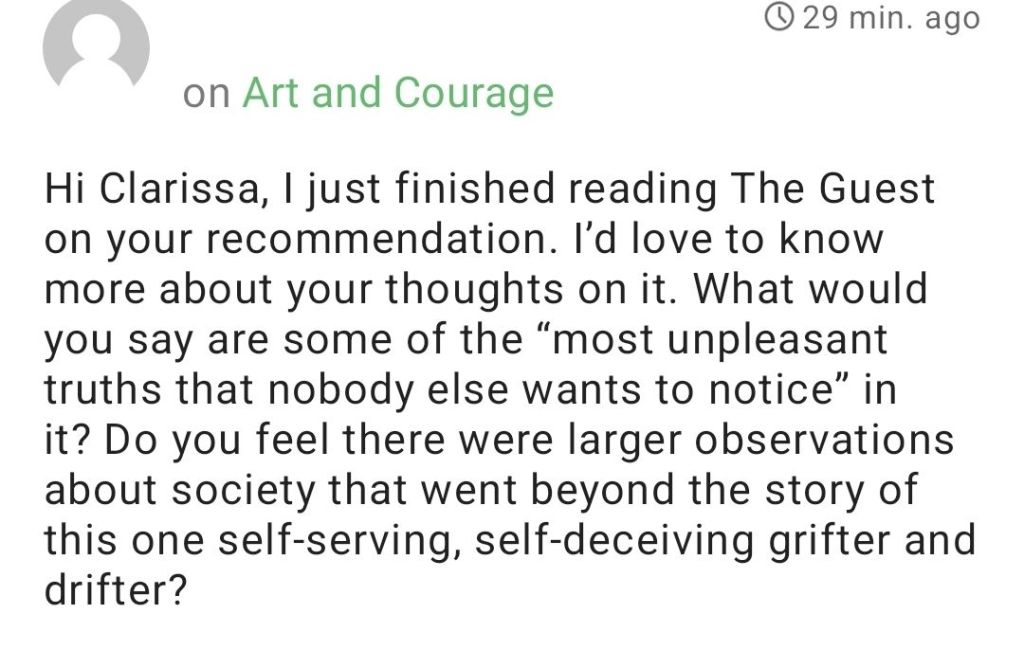
Somebody very smart and kind asked me the following question about Emma Cline’s masterpiece The Guest:
Alex, the main character of The Guest, is a representative of the chthonic chaos that is the enemy of any civilization. Each of us is originally Alex, and our success in life depends completely on how far we manage to travel from our basic self, our inner Alex.
Alex is dumb, primitive desire. She is governed by spontaneously arising whims, and in order to feed them, there’s no destruction she won’t wreak. There was a story on the news recently about a mother who went on vacation, leaving her 16-month-old baby alone. The baby died, but the mother still doesn’t understand why people are upset. She needed a vacation! Don’t you get it? She needed it. This woman is a real-life Alex, and we are horrified by her because we know deep inside that we are all originally her.
When we talk about self-discipline, duty, delayed gratification, and responsibility, we are naming stops on the journey away from our inner Alex. Every society has its bottom layer composed entirely by people who have not found a way to fit their raging desires into a corset of constraining principles. Some societies become overrun by their chthonic bottom, and that’s a terrible thing.
Our society is not like that. But we have a different problem. We keep trying to engineer away the dysfunction of people like Alex. None of the social engineering policies we employ make a dent in the dysfunction. All they do is make life more uncomfortable for the people who are civilized. Cline’s great achievement in the novel is precisely not to provide an explanation for Alex’s dysfunction that would allow us to engage in our favorite pastime of imaginatively engineering away her chaotic nature. “Ah, it’s because she’s poor. Let’s solve poverty. Ah, it’s because she’s a minority. Let’s do DEI. Ah, it’s because she was abused. This won’t happen to me, then. Yay!”
The novel invites us to take measure of our inner Alex and think about what keeps us from sliding into chaos. Take war, for example. Why are there still wars? Why is war a constant accompaniment of humanity? War is an escape valve from the corset of civilization. War is people looking into the face of the chthonic horror that resides inside them. And sometimes realizing that chaos is the default. Civilization isn’t. It’s precious, tenuous, and always at risk.
There’s nothing more useful a person can do than seeing their own reflection in Alex and thinking about what keeps them from being engulfed by the chaos. Also, we need to ask ourselves how much our need to engineer away the chaos in others stems from the fear of not being able fully to contain our own.
I’m not a drug-addled prostitute but I see myself in Alex. No amount of college degrees, publications or accolades contradict that the same chaotic human nature is right there inside both of us. I control mine enormously better but I’d be guilty of the greatest hubris if I were to deny that the chaos is there. It’s always there for individuals and societies, and we need to decide anew to keep it at bay every day.
P.S. If you are a student who needs to write a book report, please don’t copy the above. The teacher will report you as a danger to your classmates if you do. Just use the AI, like everybody else.

 Clarissa's Blog