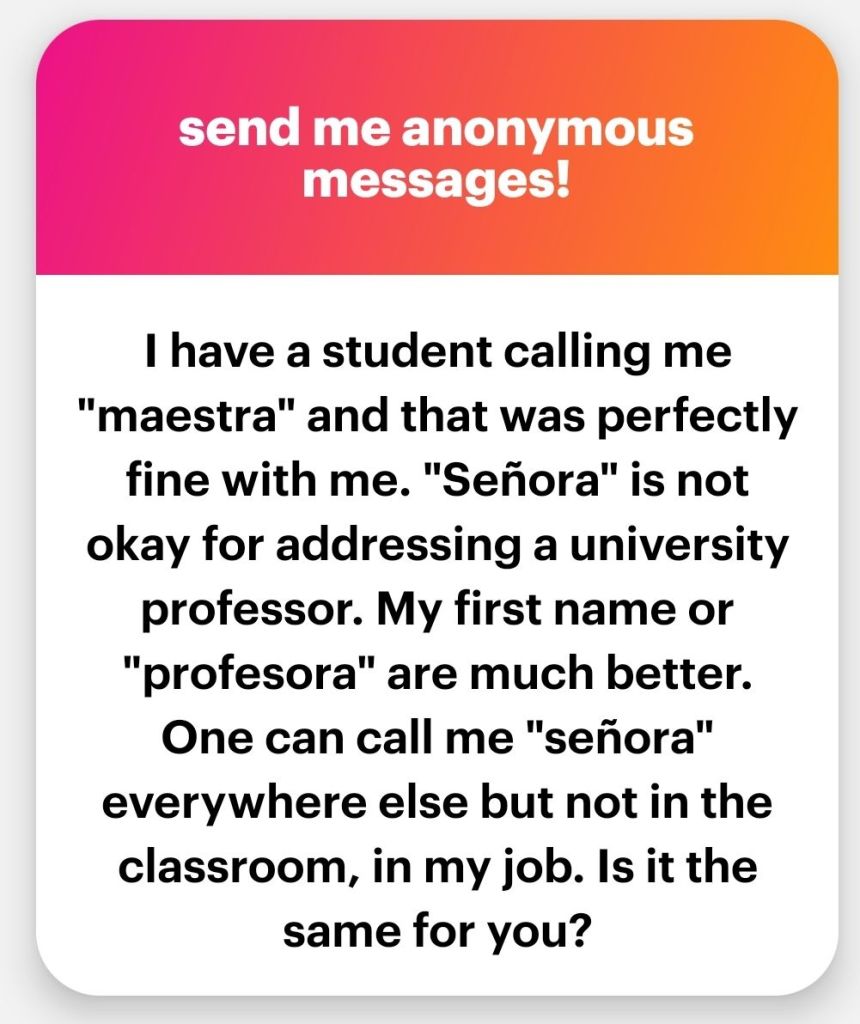
Exactly. I also want to mention that there’s a difference between “Señora + last name” and simply “señora”. While the former is an equivalent of “Mrs Jones”, the latter is, if not rude, then kind of going in that direction. It’s akin to when we addressed strangers as “man” or “woman” in the USSR. There was always a bit of implied disrespect in it. As there was in every Soviet interaction.
One thing I don’t allow (and glare at people unpleasantly when they try it) is addressing me by my first name if I haven’t introduced myself with it. I always disliked the forced American (and Spanish, as it’s very prevalent in Spain) egualitarianism. I cringe at calling the Dean and the Provost by their first names, for example. They encourage it but it’s so fake. We aren’t friends. We don’t want to be friends. We work in a hierarchy, which is excellent. Let’s not pretend otherwise.
Also, I want to correct a popular misconception. People in the USSR didn’t address each other as “Comrade” past the 1930s. On rare occasion they used “Citizen” but that happened either in the context of the criminal justice system or ironically.

 Clarissa's Blog
In Israeli schools, students call teachers by their first name. Teachers call students by their first names too, of course.
In a religious school I previously worked in, students could say “the teacher + first name” or “first name.”
Don’t remember how I talked with professors, which I hardly did. Probably like I do at work with people I work with / under – w/o using any names at all, unless it’s talking with somebody else about them and then mentioning first names becomes necessary.
Hebrew doesn’t have tu / vous either. It’s all “you” like in English, only unlike English “you” for a man is different from “you” for a woman. “You” for a group of men / women differs too.
LikeLike
I think it’s egregious that schoolchildren should address a teacher with this familiarity. In Klara’s school, it’s Mrs Smith. There needs to be respect and an understanding of hierarchy.
LikeLiked by 1 person
I understand how it sounds in Russian, truly horrible.
But in Hebrew in Israeli cultural context it does sound different.
Were f.e. I adress the school principal by Ms. First Name Family Name that would sound both weird and disrespectful. I simply do not use any names because there are no good options imo.
LikeLike
“needs to be respect and an understanding of hierarchy”
Everything I’ve heard about (more secular) Israeli society is that it’s characterized more by flat hierarchies of circumstance (like Scandinavia) rather than the elaborate existential hierarchies of Southern or Eastern Europe.
Using teachers’ first names is a single data point and it’s probable that respect is shown in other ways.
“Hebrew doesn’t have tu / vous either. It’s all “you” like in English”
A non-Polish colleague from a neighboring country (with serviceable but not… impressive English) was under the impression that English speakers can’t show respect in conversation and I tried to explain that, for native speakers at least, while the pronoun stays the same speakers show respect for higher ranking people in other ways (especially in lexical choices) and that no, you don’t talk to a person several rungs above you the same way you do with friends.
It was a tough sell.
I have no idea about Israeli Hebrew but I partially assume as a relatively new language a lot of language protocols haven’t been worked out as thoroughly as in some other languages.
LikeLiked by 1 person
Israel is a Middle Eastern society, so people are rude as a matter of course. They have hierarchies, and pretty severe ones, as to who’s allowed to succeed economically and who’s doomed to eternal poverty. Maybe that’s what the widespread rudeness and familiarity are masking.
LikeLike
“Israel is a Middle Eastern society”
I dunno…. Arabs, Turks (and Persians if you want to include them) are all very polite ime in personal contacts (leaving aside the question of men interacting with outsider women they don’t know….).
On the other hand, I’ve never heard of anyone in any context who describe any kind of Jewish culture as being particularly polite so it may be more a Jewish rather than middle eastern thing.
That’s not criticism, mostly Jews have lived as minorities and minority cultures tend to be…. very direct in personal contacts and tend toward… indelicate humor.
I watched one episode of the Israeli series Shtisel and I’m not sure if I want to watch more… the lead is generally sympathetic if often wrongheaded but almost all the other major characters were major jerks (especially sabotaging the poor grandma’s tv time).
LikeLiked by 1 person
\ They have hierarchies, and pretty severe ones, as to who’s allowed to succeed economically and who’s doomed to eternal poverty.
That’s not true for Israel.
For instance, Ethiopian Jews, who arrived with “no useful training for a developed economy like that of Israel” and with high levels of illiteracy, show great improvement:
Among large groups, Orthodox Jews and Arabs are two poor groups in Israeli society. Haredi society fights to be like that despite increasing demands from the rest of Jews to learn math at schools, work and serve in IDF. Arabs have different problems.
LikeLike
I don’t know about Ethiopian Jews but among all the relatives and friends of ours who moved to Israel nobody achieved anything beyond scratching out a very modest living. It’s nothing like in the US where there are real opportunities for advancement.
LikeLike
\ among all the relatives and friends of ours who moved to Israel nobody achieved anything beyond scratching out a very modest living
It’s not a large sample, and I do not know their ages and professions in FSU.
Would most of them have achieved something great in America? Without good Hebrew or/and lucrative profession like being a good programmer, it’s hard to reach a high standard of living. But it’s also true for America, and there surely are many immigrants who do not succeed there too.
Besides, how do you define “a very modest living”? In Israel having a private house is often a sign of great wealth, unlike in the US.
A son of my aunt decided not to try to become a teacher of English here. Now he works in a good firm sitting near a computer and checking quality of some computer details, w/o connection to his previous education at all, and earns as much as me. He does work longer hours, but still. And he doesn’t know Hebrew either.
I think there are “real opportunities for advancement” for people like you and N, who would’ve been successful in Israel too and pretty much in every other half-normal country.
LikeLike
Forgot to add that at our health clinic (almost?) all family doctors and nurses speak Russian, while secretaries do not. Many teachers speak Russian. I personally know many people who immigrated as adults and joined Israeli middle class. I do know some people who did not, but don’t see them succeeding in America either.
The most important point is that when you talked of people being doomed to eternal poverty because of severe hierarchies, I didn’t think of first generation immigrants but rather of a kind of Indian caste system. Imo, adult immigrants are a separate issue altogether.
I read that the American dream had the element of “it’ll be hard for you, but your children will rise.” Nothing prevents children from rising in Israel.
LikeLike
During apartheid, black people were expected to refer to white people as boss. The whole project was much more about white supremacy than white nationalism or ethnostates.
https://en.m.wikipedia.org/wiki/Baasskap
LikeLike
@el @ cliff arroyo
“Hebrew doesn’t have tu / vous either. It’s all “you” like in English”
It’s a common misconception, especially among non-native speakers whose native language distinguishes between a familiar and a courtesy pronoun, and I can understand Cliff’s frustration, considering the multifarious pronouns in Polish and the wonderful Pan/Pana form which even 45 years of communism were unable to eliminate. Long live Poland!
In English, “Would you like to sit here, Sir?” is a courtesy form, whereas “Hey, you, come sit here!” is familiar bordering on disrespectful, and in Italian, French, German and Spanish the “you + verb part” in each sentence would have to be translated in a different way.
In Danish there is a respect form which is still used, but in ever more restricted situations given the social context. When I lived in Copenhagen pupils would use first names with teachers at primary school, but not in high school or university. That was over 30 years ago, I wonder if it’s still the case today.
Swedish presents an interesting situation. The respect form was abolished by government fiat (yes) in the late 1960s and the du-form was imposed on all levels of society, from schools to factories and offices, shops, government departments and so on. I imagine that they use it even with the King. Coming from Danish, I always used the respect pronoun even when speaking Swedish, which always aroused a puzzled response in my interlocutors.
If you want to see what happens to a society where the benighted political elites can impose their extreme beliefs in egalitarianism and the total autonomy of the individual, there is a wonderful film about it. Alas, there is no English version for poor monolinguals but a Spanish one is available: La teoría sueca del amor, by Erik Gandini.
LikeLike
I went through my entire schooling without knowing the first names of my teachers.
LikeLiked by 2 people