It is, of course, an absolute accident that I ended up with a chronic disease requiring constant, minute attention to food, frequent mealtimes, the carrying of snacks, and the capacity to bring everybody to fearful attention with the words, “I’m getting hungry.”
Month: May 2025
The Joys of Technology
I haven’t worn headphones for 15 years. I never held any or had any dealings with them. This is why I missed important technological advances that happened in this field.
Harsh life circumstances—also known as a lineup of irresistible books on Audible—forced me to get headphones. I spent a miserable half hour trying to locate the “on” button to turn the little bastards on. Their surface was smooth, though, and no button presented itself. Driven by utter desperation, I placed them into my ears with a vague hope that the button would reveal itself that way. To my shock, the moment the headphones popped into my ears, they started working without any need for an “on” button.
I’m like a savage who came from the woods and discovered the joys of polyethylene. (This is a reference to a family that missed half a century of history in the taiga and, after re-establishing contact with civilization, was impressed by nothing as much as single-use plastic bags).
The Female Hoax
Yesterday’s hoax about Macron’s Kleenex was also created by a woman.
Once you see it, you can’t unsee it. These things are always created by women of a certain type. Menopausal, unattractive, gasping, and overheated. This is as entertaining as watching how many men traumatized by menopausal mommies jump up and down, trying to please the symbolic mommy by spreading the crazy story.
Bearers of Culture
It takes at least 3 generations to create a thoroughly cultivated individual, says Renaud Camus. This was always widely known. Even in the USSR we’d say that a member of intelligentsia needs three university degrees – his own, his father’s, and his grandfather’s.
Today, however, it’s radically unfashionable and even dangerous to state this obvious truth.
“We prefer to sacrifice culture out of a horror of heredity,” says Camus. This form of hyperdemocracy destroys actual democracy because it creates de-cultured patchwork societies which are societies in name only. Those who are supposed to be the bearers and the conservationists of the shared culture are terrified even to think of themselves that way.
Mess on the Floor
Mess on the floor, guests are coming.
You tell your five year old to clean up her mess.
She doesn’t.
You threaten and try to persuade.
She doesn’t.
Seems everyone responding to me would just beat her up.
I wouldn’t, but let’s say I do.
She still doesn’t and is now just screaming.https://x.com/NateLF4/status/1921426644671098925?t=Z7cBkCxuZHO4im8By4r8aA&s=19
Poor dude, seriously. My heart goes out.
This “she refuses to do what I say at 5” should not be a thing. It’s downright dangerous because if there’s a need to leave, duck, stop, turn around, etc to avoid physical danger, a child should know to follow commands without starting a debate. Heavy traffic, airport, a vagrant acting erratically, a crush of people at the mall, a sudden tornado warning – there are many situations where it’s crucial for a child to obey immediate directions.
Plus, it’s not good for a child to witness an internally chaotic, anxious dad. Or mom, obviously.
The issue this man describes does not arise from anything he can say to the child or any “parenting technique.” It comes from how he feels inside. If he feels calm and authoritative, this won’t happen.
The girl in the story doesn’t mind cleaning. She minds a weak parent who is not the head of the pack (cf. how cleaning is needed not because it’s necessary for the family but because guests are coming. ) She’s acting up because the lack of a strong, calm parent is causing her anxiety. It’s a survival mechanism.
Threaten, persuade – these are strategies of the weak. The strategy adjusts automatically once you adjust who you are. The father needs to ask himself why “guests are coming” makes him shrink inside. Therein lies the cure.
Of course, different ages demand different things. It’s good for a child to obey immediately at 5 but not great at 15 (and terrible at 20). As with absolutely every physiological function, the parent gradually hands it back to the child. By 15, the child should have her own inner authority to leave a situation with, for example, an aggressive vagrant. Or a sexually demanding boy. By 20, cleaning her own space should be an internal need. None of this happens through exhortations or lectures. It only comes from growing a non-chaotic inner space. A well-ordered lower bulb.
Shamelessness
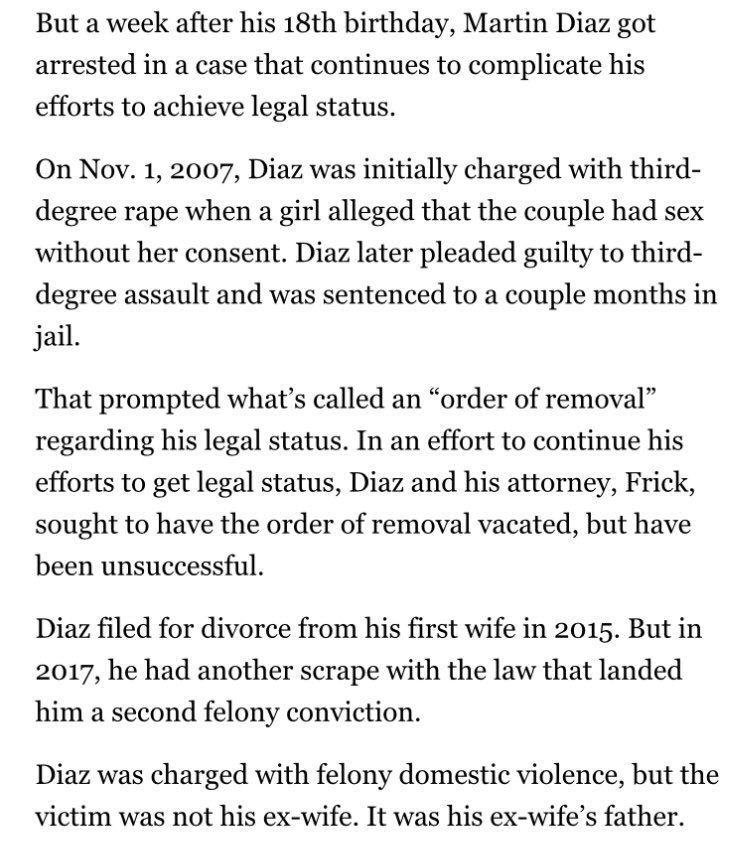
“The couple had sex without her consent.” It’s cute how all the #MeTootery immediately went out of the window when it’s necessary to defend an illegal immigrant rapist.
The shamelessness of these people has no limits.
Solving Homelessness
Do these people realize how incredibly organized and disciplined one has to be to live in this tiny house and not turn it into a garbage dump within days? Individuals with that degree of psychological health don’t end up homeless. They end up living in mansions.
Broken Circuit
Tomorrow is Mother’s Day.
If you want to understand the birth rate decline, I implore you, go on TikTok tomorrow.
It’s become an annual train wreck I absolutely cannot look away from. Women, en masse, log on in tears to record how badly their day went – it usually involves being ignored by their husbands/kids, not being given presents, or having to do things for their MIL instead of the day being solely about them.https://x.com/HannahDCox/status/1921213671386091688?t=4lzTWqIOxX7c3huTlicbqA&s=19
I’m not on TikTok but yes, this is a whole phenomenon on social media. The other day I posted an X example.
This is like people who can’t enjoy food. Their digestive system is broken, and the only way for them to derive any enjoyment from it is to have a special occasion where everybody gathers around and praises them for eating.
Imagine saying, “I’m unappreciated as an eater and people can’t even show up to celebrate that I eat a single time in a year.”
“I’m unappreciated as a person with two legs.”
These are precisely the people who’ll line up to purchase “experiences” because the circuit that communicates their bodies and their brains is broken. They need an artificial one that they are ready to pay for.
Happy Mother’s Day!
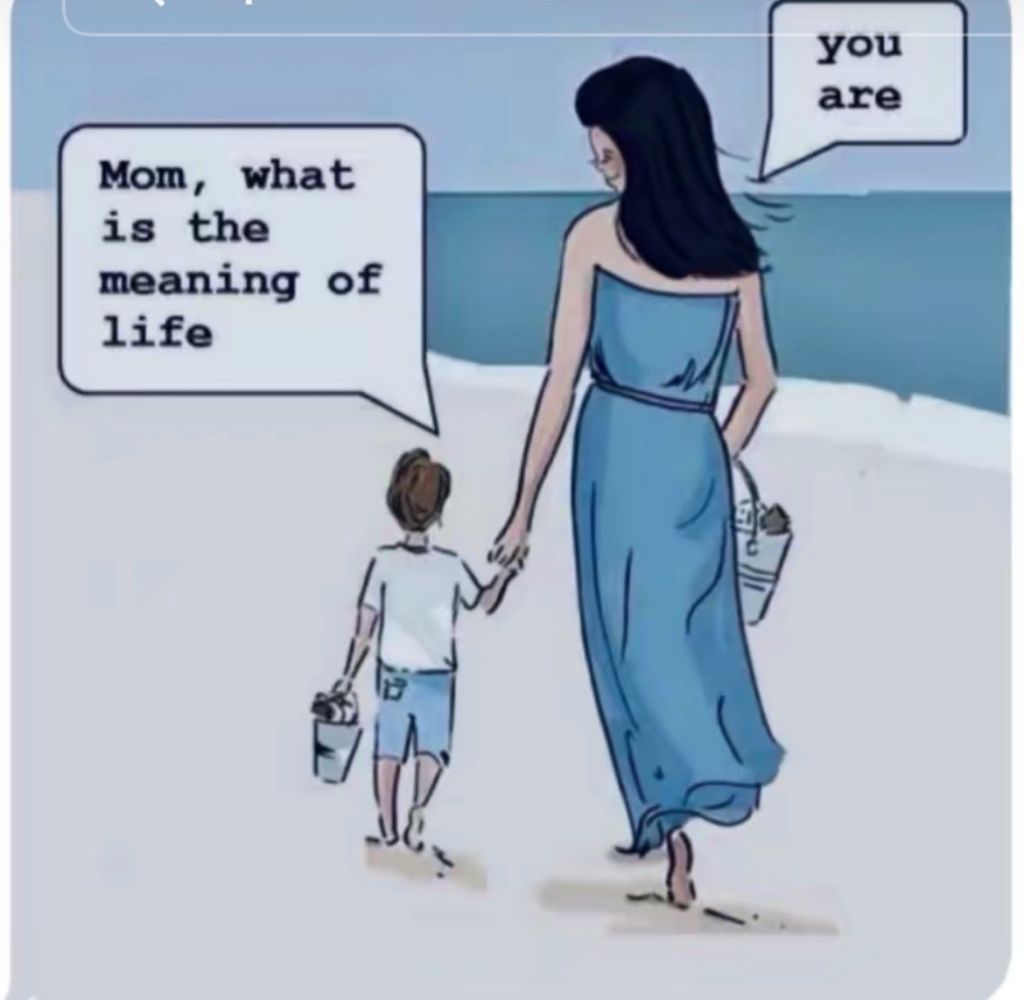
My kid was trying to imagine what heaven looks like and concluded that it must be exactly like her regular life because what can possibly be better?
Every day is Mother’s Day with such a kid. Or with any kid. Because there’s nothing better in the world than being a mother.
Experience Economy
Let’s say you make TV sets. You sell a TV set to a customer. When is the next time he’ll be your customer? Probably not for many years. By selling him a TV set, you’ve lost him as a potential buyer. Every sale is a loss. Every success is a failure.
This is the problem with selling tangible goods. There are all sorts of limitations on how many you can sell to one person. Space is limited, for one.
Of course, there are all sorts of tricks to bring back the customer. Planned obsolescence is one. But still, tangibles are complicated and needy. You have to ship, store, and employ people to handle the very physical thing you are trying to sell. What a bore.
Many purchases in consumerist societies aren’t about the actual objects but the emotions they evoke. A woman who pays $600 for a handbag isn’t paying for the bag as much as she’s paying for the feeling, for the image of herself as a woman with this kind of a bag.
What if we can exclude the bag from the equation completely? Have the customer pay directly for the emotion?
You can sell an experience endlessly. Emotions can be consumed again and again. They are evanescent, and the need is never saturated. Space is never a limitation. Nothing is. As long as the experience feeds the ego, the customer will only need more and more.
Yesterday, a reader of this blog posted a link to a company that sells the feeling that one is a good parent and is developing her baby’s intellect. This is the experience economy. The parent pays to feel like a good parent. The need in that feeling cannot be exhausted. The customer gives money for whatever combination of images and words on a screen can make her feel a certain way.
This is the neoliberal dream of a business model. Minimal costs, minimal space taken, and most importantly, a minimal number of people employed. Everything is intangible and endlessly renewable.
 Clarissa's Blog