Boundaries and Ambiguity

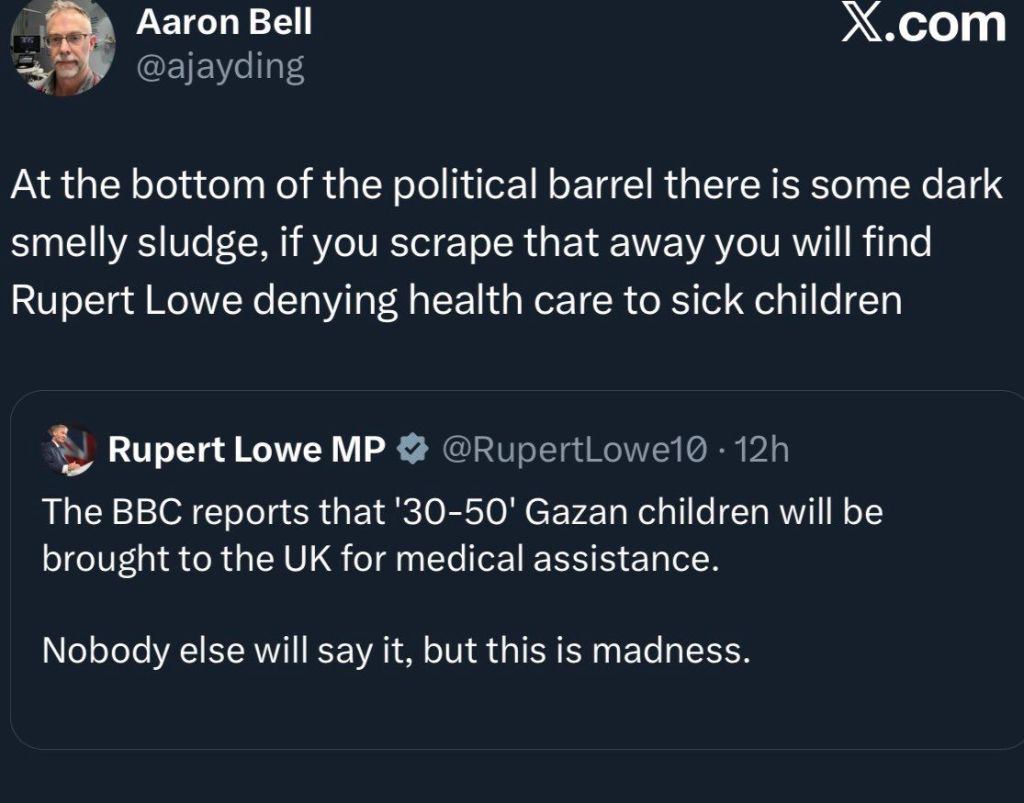
Nothing illustrates the difference in worldview around the nation-state than this exchange. There cannot be a national healthcare system that provides services to everybody on the planet. There cannot be a nation-state that guarantees rights and protections to everybody on the planet. The nation-state is by definition exclusionary.

But this exchange reveals much more than that.

Remember how I recently wrote that a healthy relationship is one that tolerates ambiguity? This is true not only for individuals but groups and countries. Aaron Bell, whoever he is, is incapable of tolerating the ambiguity of wanting to provide healthcare to British children but not to any others. His love is unhealthy because it will ultimately destroy healthcare for everybody except the wealthy who can pay out of pocket.

Aaron Bell doesn’t want to live in reality. He can’t accept that reality is imperfect. He will destroy the imperfect real in search for an impossible perfection. In interpersonal relationships, this kind of an individual will go to pieces if the object of his affections is not 100% attentive to him 100% of the time. The ambiguity of any love, profound as it might be, is that, unless you are an infant, the object of your love will not always be completely available and completely devoid of boundaries all the time. In a healthy loving relationship, you say to yourself, “today, I can see that he’s tired, distracted, needs some space. That is fine. I will respect his boundaries and step back.” In an unhealthy relationship, you throw a fit because you interpret the normal human ambiguity of “I love you to pieces but right now I want to be alone” as lack of love.

Love that doesn’t accept boundaries is not love at all. It’s a destructive, consumerist force that will eat everything in its way. If Aaron Bell really cared about the sick children of Gaza, he’d start a charitable campaign, donate, organize, find money and pay for it. I, for example, care deeply about the plight of the lonely elderly people in Ukraine. I found a group of volunteers who provide food packages and lamps to them. I donate, I help the group (@JuliaSubbotina1 on Twitter) get the cause known. I didn’t privatize the benefits while socializing the costs of my love for these elderly. I assumed the costs. That’s true, healthy love.

We live in a mentality where accepting any form of boundary is intolerable to people. Their self becomes so big that it squeezes out everything around them. There’s no space left for anything else. We need to rehabilitate such concepts as boundaries, borders, and ambiguity.


Better Late

One of the editors to whom I proposed publishing my Ukrainian book sent me an offer. It’s a good offer but the book came out 16 months ago, so it’s kind of beyond the point now.

It’s nice, though, because I can now boast that I had offers from 5 publishers.

Book of the Year

Of course, I had to discover the best book of the year, 672 glorious pages long, the day before the beginning of the semester. Now I stare in mute resentment at anybody who wants me to do anything except read this book.

Details to follow but American literature is alive and thriving.

The Autistic Thing

I very sincerely could never understand this. Maybe it’s the autistic thing. But Taylor Swift’s audience isn’t male. Her fans are very young girls. How is this on target?

Also, and again, maybe it’s the autistic thing, but I can’t understand why a rich woman would want to do this. Isn’t the whole point of having money not to have to do this?

And finally, let’s say you do want to show your butt at age 35 for reasons beyond my comprehension. Why does it have to be shown against the background that reads like a truck stop toilet?

The music sucks, too, by the way.

Centrist Professors

It is simply cruel to post this without giving the slightest hint as to where these centrist professors can be found. My friends in academia have cut contact after I mildly criticized Pritzker on FB. I’d love to meet a few centrist profs who can survive an occasional criticism of Pritzker.

No Offerings

I was helping my Fulbrighter select courses for this semester, and it’s shocking. There are no courses. A lot of intro stuff but that’s it. I never come in contact with other departments’ offerings, so I didn’t know how dire things were.

Nobody is filling the vacated tenure lines, so there’s nobody to teach. I felt embarrassed. In the end, I set her up with courses at my own department but her contract specifies that she must take a course in something related to US culture, and there’s nothing. US-related stuff is limited to African Americans and immigrants. We tried history, English, political science. Bupkes. The Fulbrighter is from Ukraine, and if there’s one thing that’s not in short supply in Ukraine, it’s college courses about the country, its people, history, literature, culture.

The only course we found on US politics is titled “Political Scandals in the US.” In history, there’s nothing about independence, the Vietnam War, or anything at all.

It’s embarrassing, is what this is.

Achieving Flow

If you are stuck in your project and can’t progress, remember to introduce little changes into your process. Change small things about your routine.

Example.

I was stuck on one of the chapters because I’d published on the subject before and felt tired of it. No progress was happening but then mice were found in my office. The exterminator decided to extract them humanely (I don’t know the details) and the process lasted for weeks. In the meantime, I had to write in the lab instead of my office. I have found that writing in an unusual place gives me a huge boost, and this time was no exception. The difficult chapter was finished before all the mice were gone.

To achieve flow, disrupt routine.

Imperfect Blastocysts

Forget blastocysts and religious views. What message do you think it sends to a child to know that her parents only want her on the condition that she causes no difficulties? That they wouldn’t want her if she were sick or imperfect in any way? What would it do to her to understand that, unlike other children, she’s deprived of the unconditional love of her parents from the start? These parents won’t become different people after she is born. The child is bound to be imperfect in some way like all people are. And with these particular parents, that’s not allowed by default.

These same people would be horrified if their spouses or friends cut off the relationship the moment they become sick or problematic in any way. And they are not dependent on these people in every way like a child is on her parents.

If you can’t get unconditional love even from your parents, where can you get it? This whole mentality is terrible.

Transfer of Wealth

Because it’s a way to shuffle large sums of public money to private companies. This childish pouting about who can afford what prevents people from seeing that it’s always about the transfer of public wealth in the most undemocratic ways possible.

Contrast