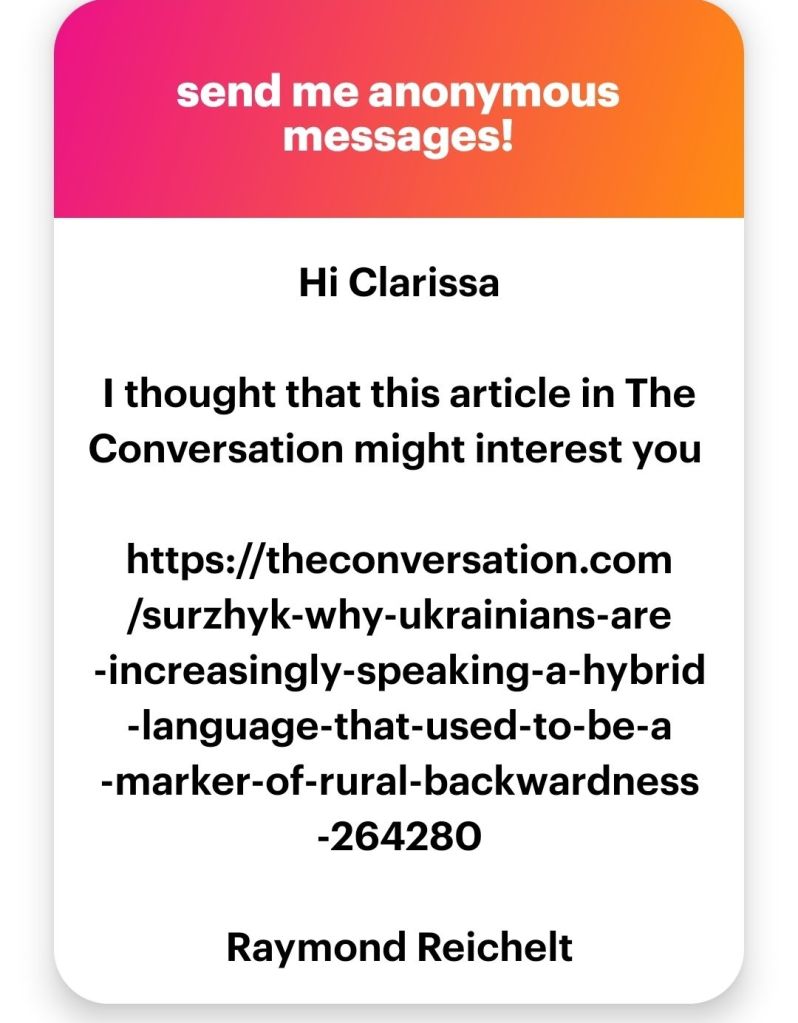
Thank you for trying to distract me. I appreciate it and it worked.
Here’s the link to the article.
I don’t know if I mentioned it but a while ago I helped a scholar with her research on surzhyk. She asked me to watch a few TV programs (news and sitcoms) and identify instances of surzhyk, which I gladly did. She’d say, “You marked “Ah!” as surzhyk. What makes you think it’s a surzhyk “ah” and not a Russian or Ukrainian “ah”?”
But I know just by the sound of it. It doesn’t sound like Ukrainian or Russian. It’s in the middle.
This isn’t voodoo science. You know immediately when Jasmine Crockett switches into her fake Ebonics twang. Or when you reach a call center and hear “hello!”, you immediately know when you are talking to somebody in India.
I can’t speak surzhyk myself but I know and recognize it. I grew up surrounded by it. My mother’s Ukrainian is mostly surzhyk.
So yeah, it’s a fascinating topic and thank you for the link.

 Clarissa's Blog
“mother’s Ukrainian is mostly surzhyk”
I’m reminded of a conversation (almost 10 years ago) with a Slovak colleague on an international project. He watched a _lot_ of Ukrainian TV and mentioned changes over time.
When he began, on channels not overtly dedicated to one of the languages, the default language would be russian and Ukrainian was mostly used only when that didn’t work, by the time we talked the default language was Ukrainian and russian was only used when that didn’t work.
He also said surzhyk (which made up a lot of broadcast time) shifted over time from sounding more like a Ukrainian speaker trying to sound russian to a russian speaker trying to sound Ukrainian.
LikeLike
The Afrikaner nationalist wanted to create a pure Afrikaans language, but there has been much more recognition lately that what many people speak is actually a hybrid.
https://wordswithoutborders.org/read/article/2021-11/november-2021-kaaps-this-language-called-kaaps-an-introduction-olivia-m-coe/
LikeLike
Glad to have been a help
Raymond
LikeLiked by 1 person