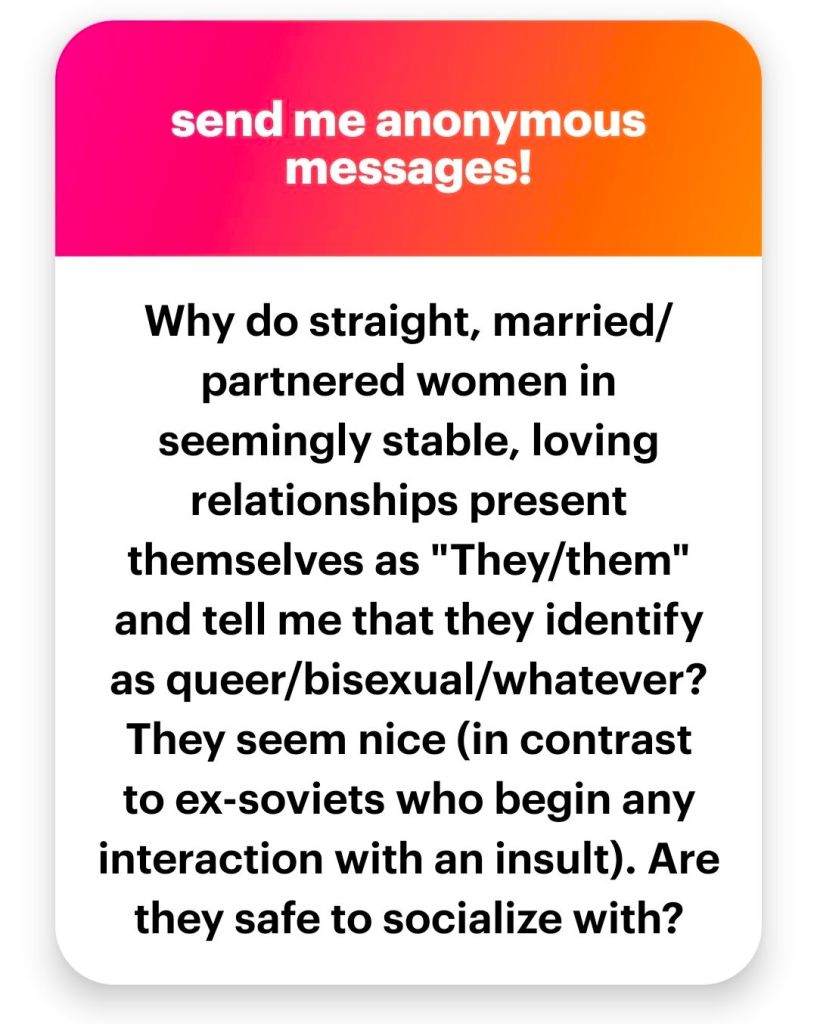
I only know one woman like that, and in her case, it’s done for a very clear purpose of career advancement. There’s a quarter-mil salary with a 5-hour workday riding on it. The woman comes from dire poverty and has an elderly mom, three complicated siblings, and two small children to drag through life. Who’d blame her, honestly?
How come you meet so many of them when I’m in academia and only every encountered one? I’m hearing this is now a working class phenomenon but I refuse to believe it.

 Clarissa's Blog
It’s more an age phenomenon than a class one. I wouldn’t call it a “working class phenomenon” but there are plenty of working class people who’d identify this way. Not just any of them are susceptible though: they either have to be involved in some “alternative” scene (goth, etc.), incredibly online, or both. Overall it’s more common for middle class people to call themselves non-binary ime.
LikeLike
It’s funny but just today I have seen two Youtubers comment on female bisexuality. First was Farha Khalidi (@fuzzzztv), who I find hard to summarize. She’s one of the “contestants” on a TV show about Gen Z virgins looking for love (“Are You My First?”), but she has an OnlyFans, but she goes on manosphere podcasts to challenge them about their woman-blaming attitudes. She could almost be categorized as a relationship columnist or a progressive humorist, except that she’s more like a social media personality who just dabbles in those activities… Her thesis on this topic: “You show me a bisexual woman and nine times out of ten I’ll show you a woman who’s been cucked into polygamy” (by a philandering male partner). So that’s her theory!
The other is a young mother using the name “Tulip Virtues” who is entering the niche of ex-leftists becoming Christian activists. She was raised in a large Christian family, via the emo scene got into a world of young swinging bisexual leftist occultists, then got pregnant by the man she actually loved, and that sobered them both sufficiently that they went back to their Christian roots, at the price of cutting ties with most of their scene friends. (It reminds me of what methylethyl has said here about her niece.)
In accordance with one of this blog’s themes, I could construct an interpretation centered on neoliberal fluidity. We might say: those religions which have been enough to build a mass civilization on, generally promote a life we would now call “conservative”. Such societies still have illicit underworlds, upper classes that break the rules in private, and so on, but the public ethos is conservative.
However, neoliberal civilization tries to bring libertarianism and libertinism within the scope of what is publicly allowed. You see precursors in the lives of some 20th century artists and intellectuals (I was just reading about June Miller and Anais Nin, and of course many pop stars lead famously dissolute lives). Female bisexuality seems to be something that previously thrived only in hedonistic underworlds and in various elite circles, but which became popularized as part of the general rise of neoliberal individualism (and its peculiar symbiosis with the intersectional liberation movements of the post-1960s new left).
But now we are in a period of backlash against liberalism, and so people are noticing the downsides of some of the freedoms they enjoyed. In the case of Khalidi, she appears to be temperamentally a cultural liberal, but she is psychologically savvy enough to note (e.g. on her Substack) that even in the libertine environment of Miami hookups (which is her home ground), women and men are broadly seeking different things, and many women are harming themselves in an attempt to make it work out for them. Khalidi strikes me as the kind of person who in an earlier society, would have been one of the elites who had enough intelligence and discipline to live the life of freedom without falling prey to dissolution.
On the other hand, Ms Tulip Virtues really did lead the life of sensate dissolution. Maybe she fell for one of the traps that Khalidi writes about, maybe she just didn’t know anything better; but in her case the combination of having been raised in a conservative tradition, and the prospect of being responsible for a new life, and the good fortune of having a male partner who was willing to be a parent in the broad sense, allowed her to put together a family life from scratch.
So, you could say this is my interpretation of queer identities among people who are socially integrated enough to have a job. Sexuality is a potent force which unchecked can flow out in many directions. It used to be that the only tolerated form was heterosexual marriage. Having broken the dams after the sexual revolution, we now see an attempt to reconstitute civilized regulation of sexual identities, in a way that has room for the kind of polymorphous experiences that a lot of people have now had. That is the meaning of progressive civilization’s addition of LGBT identities to the traditional “straight” sexual personae.
LikeLike
Very good.
I’d also add that a sexual instinct that is not directed into the (re) productive direction of monogamy and procreation becomes one of the tools of impoverishment and class descent. Neoliberalism liberates sex from being a creative force and uses it as a battering ram to demolish all wealth-creating mechanisms of working and middle classes.
LikeLiked by 1 person
LOL, far more sweet and succinct than my effort…mind you, the meme is amusing ;-D
LikeLike