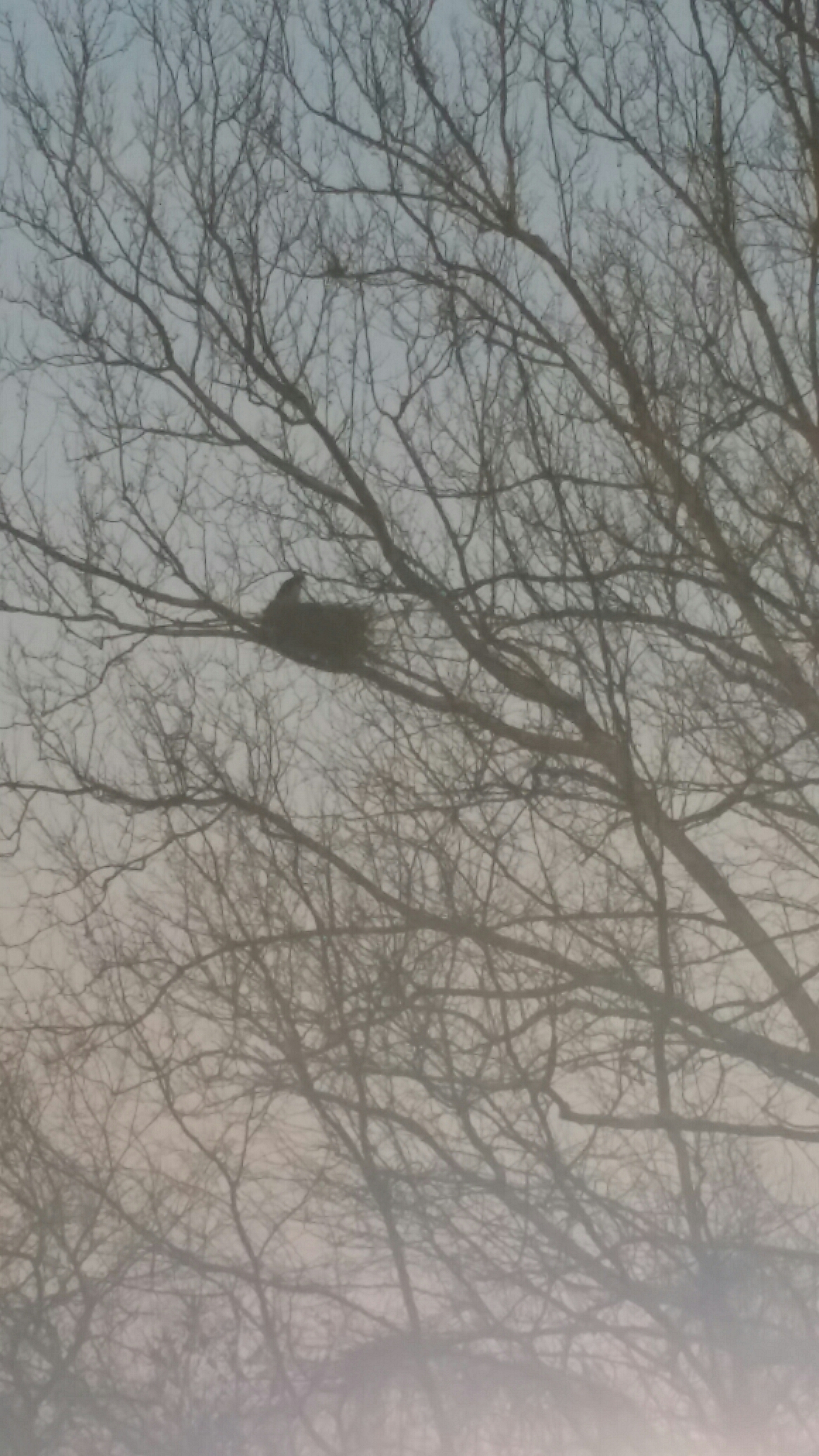
Big Bird

image

I always heard that fathers were protective of their babies but I never knew to what extent.

I had this plan to sit on our verandah  (called “a deck” in this region, as if the house were a ship) while its still not intolerably hot, reading a book and rocking Klara in her pram. N, however, is not happy about the idea because in the trees in front of the verandah there is a big nest. You can see it in the photo but keep in mind that I zoomed in on it. The actual nest is really big. There’s probably a hawk, an eagle or a large owl living in it.

N is afraid that the bird will fly out of the nest, grab the baby out of the pram, and fly away with it. I keep telling him that I’ll be sitting right there by the pram plus it’s highly unlikely that the bird will be able to get the baby from under the blanket and the pram’s protective shield but N is still worried.

And it was only a few years ago that N found it funny that his brother-in-law wanted his little daughter to wear a helmet in case she fell down and hit her head. These days, I’m afraid of reminding N about that lest he’ll decide to go buy a helmet for when Klara learns to walk.

Multitasking

I’m nursing Klara, reading a book by David Lodge, dropboxing photos, watching a documentary on the History Channel, and blogging all at the same time.

Book Notes: Santiago Roncagliolo’s La noche de los alfileres

Roncagliolo is a young Peruvian writer I never read before and decided to check out to keep up with developments in Latin American literature. La noche de los alfileres is a male Bildungsroman and like all novels in this exhausted genre it follows the same tired pattern we have all encountered in countless other male Bildungsromane.

The novel’s saving grace resides in its somewhat heavy-handed yet valuable exploration of the crisis that Latin American masculinity is undergoing. This is a novel about damaged boys and their damaged fathers and the violent, hopeless world that arises when men can’t connect with women and organize reality around their homosocial / homoerotic networks.

The novel can work great for an undergraduate course if you teach on the coasts and not in the Bible Belt. There is a lot of profanity and a lot of discussion of teenage boys’ desperate need to have sex. But it reads very easily, there are tons of history occurring in the background, and lots of theory can be easily introduced.

Nice novel, nice young writer, and a nice reminder that those of us who never had the experience of being teenage boys are extremely fortunate.

ISIS and the Internet

MSNBC aired a very good documentary titled “ISIS and the Internet” last night. The documentary has very interesting footage of ISIS recruitment videos and an interview with a Canadian who ran off to ISIS and then came back. He explained, for instance, that he’d been motivated to join ISIS by the realization that he was never going to be successful in Canada. He wouldn’t be able to get a job, he said, because there was always a possibility that a Jew or a woman would be his boss, and as a devout Muslim he couldn’t allow for that to happen.

What I didn’t like about the documentary is how uncomfortable its creators are with the subject of religion and how eager they are to substitute the word “religion” with “culture” in the discussion of ISIS. The result of this clumsy verbal gymnastics is quite pathetic. We learn that ISIS kills Shiites because its goal is to eliminate “different cultures” and hear that militants destroyed statues in museums as part of some sort of a culture war. Even when a Muslim interviewee explains Islam’s position on human imagery, the narrator follows up with more of “it’s all about cultures.”

The most interesting part of the film is how artistic and deeply Hollywoodian ISIS’s videos are. Most of the videos can’t be shown on American TV because they feature murder and torture but what can be shown is purposefully visually stunning. Watch the documentary if you can, I recommend.

Sanders’s Rigidity

Donald Trump announced he wants to arm (the rest of) Asia with nuclear weapons, nuke Europe and jail women who have had abortions.

In response, Bernie Sanders gathered a huge crowd and told it. . .that Hillary Clinton has received donations from the fossil fuel industry.

It would be such a relief to believe that he’s been bribed by Republicans to help them win the election. But I know he wasn’t. Sadly, this is one more manifestation of Sanders’s worst quality: his rigidity. He gets stuck on something and can’t get out of the intellectual rut. No new information will get him to reconsider or move on from a mistaken position. We’ve seen it in the case of his 1972 views on Cuba that he won’t change in the face of mountains of new information and we are seeing it in the way he runs the campaign.

Rigidity is the quality I battle the most in myself because I know I’m prone to it. But I don’t think Sanders is likely to start trying to become less rigid if he hasn’t considered it necessary in his 74 years of life.

This Isn’t Spain

I only just now saw a longer clip from the interview that features Trump and MSNBC’s unctuous fellow with a combover. The MSNBC fellow says, at some point, “The Church doesn’t rule the government in this country. This isn’t Spain.

I have already noticed that the main qualification for a high-paying job in journalism in this country is resolute, aggressive ignorance. But still I’m taken aback by the smugness of this reporter who obviously checked out of following the news back in the Franco era.

The funniest thing is that this idiot is, without a doubt, spending a lot of time mocking Trump for his ignorance of world affairs.

Mercantile Road

OK, Mercantile Road is a slight improvement over Terminal Street as an address for a doctor’s practice but still. I’ve already been to an OB-GYN who wanted to sell me Botox treatments, and I’m not having good memories of that mercantile type of medical care.

Terminal Street

What kind of an idiot doctor opens his practice on Terminal Street? Great way to make patients feel hopeful and optimistic, doc.

7 Week Birthday

Klara is 7 weeks old today and she has recently arrived at a major developmental milestone: she now has a night-time routine. She now knows the difference between day and night and seriously objects to lights being on at night-time. She also sleeps 4,5-5 hours straight during the night, which doesn’t yet happen during the day. Klara even looks like a person who is aware that nights are for sleeping.

In this entire time, she only cried at night on a single occasion, and I have no idea what the reason was. When she wakes up at night, Klara doesn’t cry. She grunts and moves around to let me know she’s awake and needs to be fed.

She doesn’t recognize us yet, though. Or maybe she does but prefers to act like that boy in the old joke whom his parents considered mute until, at the age of 15, he suddenly said at breakfast,

“Coffee is tepid today.”

“Oh God, son, you speak!” the happy parents exclaimed. “Why haven’t you said anything until now?”

“The coffee hasn’t been tepid until now,” the son explained.

Reading to the Baby

Everybody says that it’s a good idea to read to a baby, but I’m finding it hard to figure out what to read. I looked at books for infants at the bookstore and felt that even just browsing was making me stupid. Neither can I read the book I’m on right now to Klara. It’s by a young Peruvian writer, and every other word is a profanity in Spanish. And I don’t think that now is a good time for either profanity or Spanish.

The best idea I could come up with is to read my newspaper out loud to the baby. It worked out well because I barely have time to read my paper any more, and Klara seemed to like it. She stared at me very attentively the whole time, trying to figure out what I was doing.

The only problem with this strategy is that every other word in the newspaper is “Trump” but that’s unavoidable these days. This will be a very politicized child because the whole pregnancy took place to the sounds of endless televised debates, and now she gets to listen to the newspaper.