She said, “Mommy, one of the things I love about you is that you don’t wait for anybody’s permission, you just do things.”
I remember when she was 4 and we’d come to the Gardens for a walk. There would be a huge boulder placed in the drive to prevent people from using this vast, beautiful space. It was April of 2020, so you know.
I’d get out of the car, roll away the boulder, and proceed to park in the “forbidden” parking lot.
“Mommy, are you sure this is allowed?” Klara would ask.
“Nobody can allow or not allow,” I’d say. “I’m a taxpayer. I pay for the Gardens to be maintained, so I will decide when to use them.”
She was too little to understand the concept back then but now she got it.
Kathleen Stock is celebrating the victory of reason over gender myth-making in the British courts:
Another big problem for transactivist campaigners was the restricted arsenal of argumentative weapons at their disposal. They couldn’t rely on reason or evidence as these concepts are commonly understood, because no good arguments for transubstantiation by means of lip gloss existed. This left only three options: intellectual misdirection, emotional blackmail, and aggressively shaming opponents into silence.
It’s right to celebrate but that it should have taken years and an extraordinary amount of effort to prove that men don’t belong in women’s jails and changing rooms is in itself quite sad.
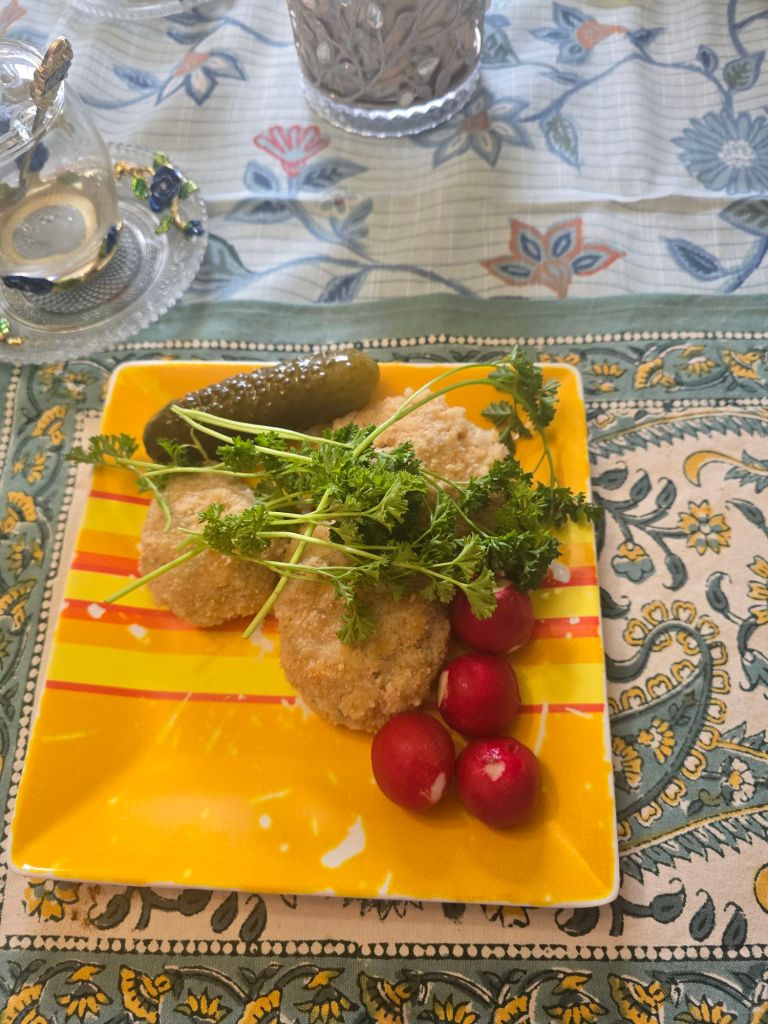
Since people like talking about diabetes, this was lunch:
These are fish kotlety hiding under the parsley. I love parsley and eat it by the bunch.
For kotlety, I found two nice trays of catfish fillets at $5.99 a tray, which is very low for our landlocked area. I put them through the grinder with boiled carrots, garlic, and some leftover quinoa. Added an egg and baked them in pork rind crumbs.
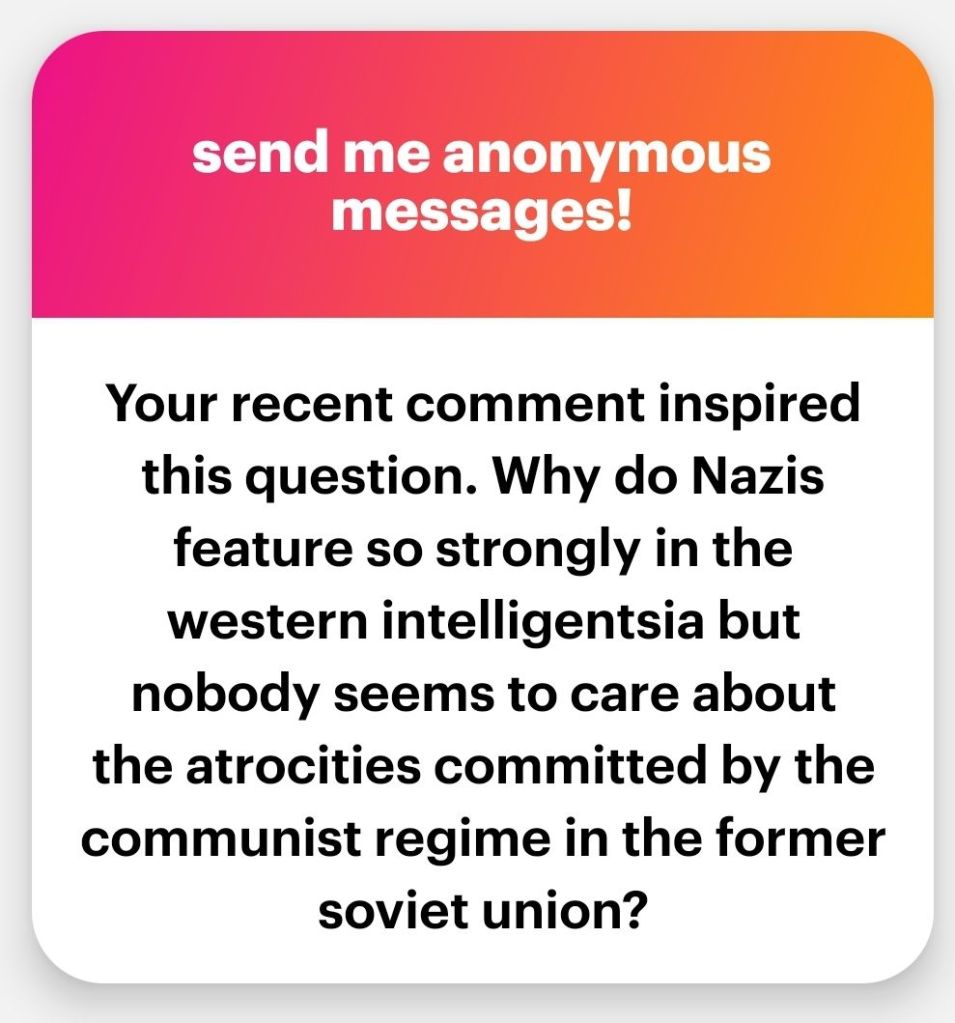
Because the left sets the narrative, that’s why. Nazism is a crime of the (far) right. USSR is a crime of (an equally far) left. Pretty much all of the world intellectuals of the twentieth century were in some way collaborating with the USSR or the regimes sponsored by it. Think of any name, and there’s a 90% chance that writer, thinker, academic, dancer, muralist, philosopher, etc was buying drinks with Soviet money.
Yes, there are exceptions but culture is built by networks. If you haven’t carefully and painstakingly woven a net, you won’t catch any butterflies. The international Left was nourished by the Soviet colossus for 70 years. It got so powerful that it could write the story of everything. And nobody had a platform to say otherwise and be heard.
But the best part? Once the USSR fell apart, the United States of America took over the financing of the international Left. The transition was very seamless, very smooth. And America has much more money. Many more leftists could be funded around the world. Many more projects could be filled to the brim with ready cash.
This is why leftism became much more aggressive AFTER the fall of the USSR. That’s why it reached the heights of lunacy that the Soviets couldn’t dream of. I mean, the worst that the Soviets could force scientists to parrot was that oak branches can sprout out of a birch tree. And even that required thousands of academics to be shot dead or jailed. The post-Soviet leftism, in the meantime, made scientists, Prime Ministers, and every cultural authority declare that women have penises. And without a single shot fired. Step aside, Comrades. The real power is in town.
P.S. To the sweet person who asked my opinion on crypto, thank you for the trust but I sincerely know nothing whatsoever on the subject. I have outsourced everything related to finance to my husband who is a whiz and somehow manages to materialize free business class tickets to Europe (aside from free UberEats meals, free Lyft rides, free Casa del Libro books, free toiletries, etc).
The NYTimes released an article that finally recognizes the enormous disconnect between the science on ADHD and the daily practice of treating it with stimulants:
I’ve spent the last year speaking with some of the leading A.D.H.D. researchers in the United States and abroad, and many of them, like Swanson, express concern over what they see as a disconnect between the emerging scientific understanding of A.D.H.D. and the way the condition is being treated in clinics and doctors’ offices. Edmund Sonuga-Barke, a researcher in psychiatry and neuroscience at King’s College London, described the situation in personal terms. “I’ve invested 35 years of my life trying to identify the causes of A.D.H.D., and somehow we seem to be farther away from our goal than we were when we started,” he told me. “We have a clinical definition of A.D.H.D. that is increasingly unanchored from what we’re finding in our science.”
One more quote from the article because it’s paywalled and I want to share at least the most crucial parts:
That ever-expanding mountain of pills rests on certain assumptions: that A.D.H.D. is a medical disorder that demands a medical solution; that it is caused by inherent deficits in children’s brains; and that the medications we give them repair those deficits. Scientists who study A.D.H.D. are now challenging each one of those assumptions — and uncovering new evidence for the role of a child’s environment in the progression of his symptoms.
And just one more:
Some scientists have begun to argue that the traditional conception of A.D.H.D. as an unchanging, essential fact about you — something you simply have or don’t have, something wired deep in your brain — is both inaccurate and unhelpful. According to Sonuga-Barke, the British researcher, the traditional notion that there is a natural category of “people with A.D.H.D.” that clinicians can objectively measure and define “just doesn’t seem to be the case.”
The facts on ADHD come out in the exact pattern as facts about COVID. People who contradict the propaganda narrative are screamed down, vilified, and accused of wanting to murder grandma. Then, after a while, everything such people said gets recognized as true but no amends are made and no recognition of mistakes made is offered.
There is a large number of absolutely deranged beliefs held by the American public on matters of health. One example is the belief that the extraordinary rates of obesity in the US are “genetic” and utterly unconnected to food quality and eating habits. Another one that I encountered only last week is that people eat sugary breakfast cereals after being diagnosed with diabetes because doctors tell them to eat a high-carb diet with this disease.
Other such beliefs I will not name because I honestly don’t need the drama that will inevitably ensue. All that the NYTimes article says I’ve known for a long time because it’s very easy to find. It’s as easy to find as “don’t eat sugar by the spoonful if you have diabetes” but people will still be shocked when these facts are revealed.
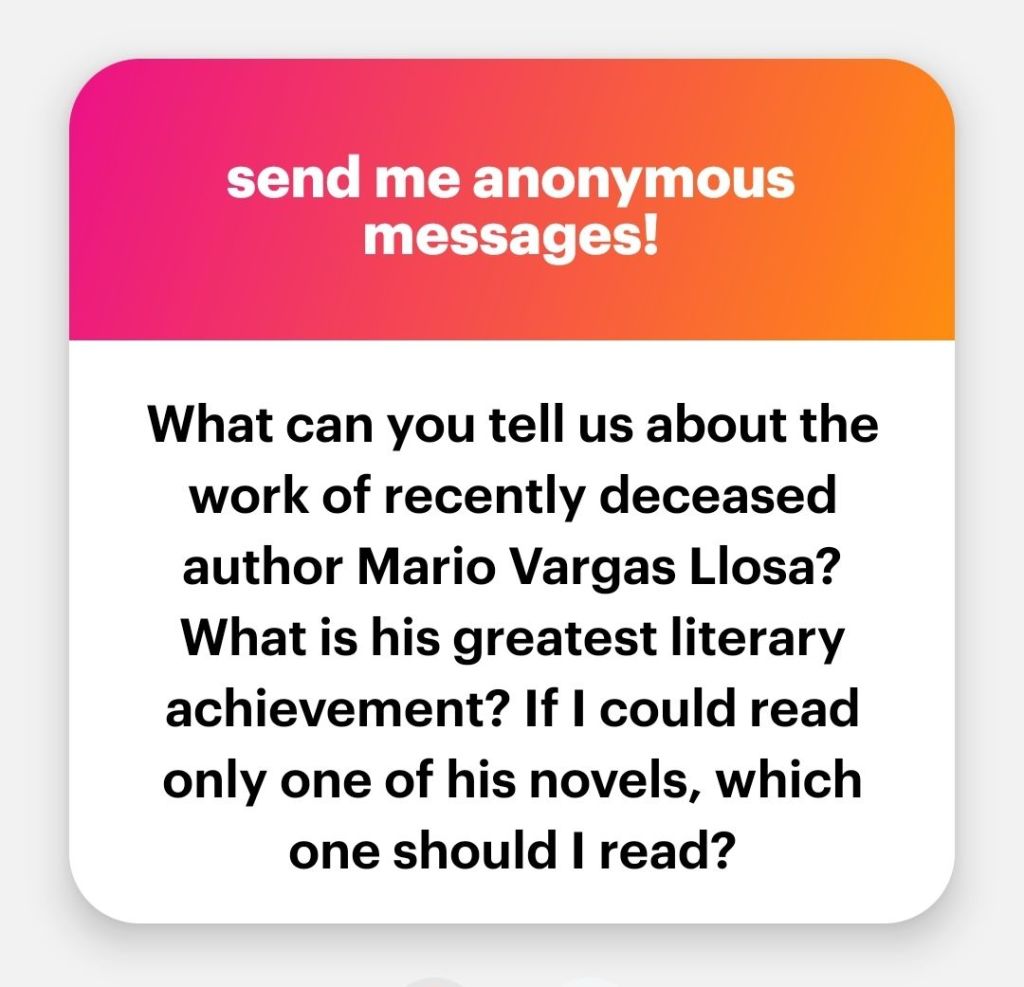
Dude, I’m so traumatized, I walk around dark as a storm cloud in May. Yes, Llosa was 89 but still. Did I mention that I met him in person? I mean, I know I did, but have I mentioned it recently? A hard-working person and a truly great writer, even if his personal life was very ridiculous (see HERE and also HERE. And HERE, as well).
My favorite by Vargas Llosa is The War of the End of the World. But it’s 772 pages of nightmarish, incandescent saga about a religious cult in Brazil. I also love The Green House but it’s very postmodern, and you need to be into South American postmodernism to get it.
I will probably use the writer’s death as an excuse to reread The War of the End of the World. This summer will be exactly 20 years since I read it, and I still shake with delight as I think of it.
Government-mandated conservative hires at elite universities is no way to shift the culture in your favor and will only breed resentment. The right was just starting to win the culture war and now is spectacularly overplaying its hand.
Whose resentment and how come those people aren’t resentful already?
We are in an unequal war where one side goes scorched-earth at every opportunity while another is terrified of overplaying its hand before even beginning to play.
I’m sorry I’m late with a reply, but this is horrible news. My condolences to your family, losing both parents…
“very neurotic about flights” Toward the end of my short vacation in Greece I began feeling very, very nervous about…
Thank you. She was 91 and not in great shape. It was time.
I’m so sorry to hear this, Vic!
I haven’t read her either. Something to correct.
I lost my own mother a few weeks earlier. She passed on what would have been the first day of…
Trump is panicking really badly. Internal polling must be atrocious. If he hadn’t gotten himself into the Iran quagmire, we’d…
“one of her compositions. Atrocious” It’s like temu Dr. Seuss….
OT: In other terrible news… Musk is severely limiting Starlink in Ukraine (probably at Trump’s request since his jihad to…
“Cage a Swallow Can’t You But You Can’t Swallow a Cage Can You” is one of her compositions. Atrocious.
Another literary AI scandal: https://www.theatlantic.com/books/2026/10/caine-prize-winning-short-story-seems-be-ai/688967/ Telling line: “the writers implicated in three major literary scandals this year were all nonwhite…
Really? I’ve always heard about her poetry. Autobiography of Red, The Glass Essay (which, confusingly, seems to be a poem…
For some reason, this was announced as awarding a poet when she’s not really a poet. It seems to be…
“her most important work is in prose” From what I gather she’s also done translations from Ancient Greek that those…
He’s great. I touched upon him briefly here: https://clarissasblog.com/2018/06/16/canadian-literature-exists/
Robertson Davies is a Canadian writer I’ve long thought intriguing …and entertaining!
The Ukrainian one, at least in my part of Ukraine, doesn’t have any poppy seeds. Not that any kind of…
In SA, the things people are most hostile to are mass immigration from the rest of Africa and separatism. I…
Your mother sounds interesting. I will pray for the repose of her soul and for you. By the way, I…
I’m sorry to hear of your loss, and I’ll be keeping you and your family in my prayers. As for…
My parents wanted to be buried at a cemetery that’s about an hour and a half’s drive from Montreal. It’s…
I’ve also been disinherited. This confuses people. Because she didn’t have much of a relationship with my sister, while I…
“kutia. It’s a really yucky dish” I’ve had the Polish version (associated with Christmas) made with wheat berries instead of…
My grandmother died at the hospital like your mother in Canada. One of the best things was that we did…
😆😆
It’s a good thing your mother isn’t around to hear this…
Well, I’m realizing my joke isn’t really funny with the warning that it’s coming, but oh well.
VERY open. Everybody is treating me like a precious vessel and I’d rather go back to being the crass, crude…
Let me know if you’re open to a dark, tasteless joke about this situation (you’ve mentioned Ukrainians enjoying this but…
Sorry for your loss and for being away from home through it.
I’m so sorry for your loss. Thoughts and prayers for you and your family.
Peace and strength to you and your loved ones in this difficult time