The Evaluations Debacle

I’m beyond annoyed, people. Here I was, posting cute pictures of food and enjoying my first free day this semester. And then I received a colleague’s email about a new round of problems with our student evaluations.

Initially, we had the kind of evaluations where students were asked questions and expected to provide actual responses. In their own sentences or even paragraphs. Imagine that, students writing paragraphs after taking courses in the Humanities. We’d ask them what they liked about a course, what they didn’t like, what they thought could be done to improve it, etc. The responses were fun to read, and I even posted excerpts from them here on the blog. Every batch of evaluations allowed me to hear my students’ voices, see what they had to say about my teaching, get feedback. This was both useful and inspiring.

Then, some. . . person in the . . . administration (dots stand for a string of expletives in a variety of languages) decided that the evaluations have to be quantifiable because, otherwise, you have no idea how to interpret them during tenure review. I have no idea what’s so hard about interpreting “Prof. Clarissa is the best teacher ever. I adore her and will recommend her fantastic course to everybody!!!”, but we all know that the administrators are not particularly smart. So maybe reading this kind of responses is, indeed, too intellectually challenging for them.

So now, instead of actual statements from my students, I get a bunch of Scantron sheets. I don’t even look at them because the kind of feedback that tells me I got 4.86 out of 5 is useless to me. Besides, the system takes into account students who weren’t in class as if they were there and gave you zeros for everything. So if there is even one student who was absent on the evaluation day, your ranking drops.

But this isn’t all. Apparently, there has been a problem with the Scantron sheets. Or the person interpreting the sheets got confused. Or the students got confused. Or the makers of the questionnaire did. I don’t know and I don’t care. All I know is that in several sections of the Scantron sheet 1 stands for excellent and 5 for poor, while in other sections it’s the opposite. So now we are all ranked really low because the system processed our high rankings as abysmally low. And we will now have to offer long and convoluted explanations to the Personnel committee during our tenure reviews for why our teaching sucked so much in the past year.

What the flying fuck, people? Until when will we keep allowing these brainless fucks of administrators to get between us and our students because these extremely highly paid jerks are too stupid to read a few sentences?

In case nobody has noticed, I’m very angry right now.
Webster U Throws Out a Student for “Lacking Empathy”

Am I doomed to encountering weird education-related news today?

Webster University (which is located in my area and is quite respected by my colleagues who are from around here) has terminated an MA student for lacking empathy:

A former Webster University student who was studying to be a family counselor says in a lawsuit that he was dismissed from a master’s degree program after it was determined that he lacked empathy. . .
The student, David Schwartz, 44, of University City, had received all A’s and only one C in his course work, according to a school transcript. But he was dismissed from the program on March 14 after he received a “no credit” for failing to successfully complete the practicum, in which he was to apply his class work to a real-world counseling setting. Schwartz alleges in his lawsuit that he was deemed a poor performer after he wrote an anonymous letter to the dean criticizing a professor’s teaching methods and noting the romantic relationship between that professor and an administrator.

Of course, if you object to a professor sleeping with an administrator you must definitely lack empathy. Criticizing somebody’s teaching is also very cruel. Aren’t you supposed to be understanding and tolerant of everybody, no matter how bad they are at what they do?

Jokes aside, it would be great to know how WebsterU measures a student’s empathy level. It is also of interest to me why empathy is so crucial to a family counselor. If I were to visit one, the last thing I’d be looking for would be pity and impotent sighing over my problems. I always thought that a counselor should at least strive to remain emotionally uninvolved in order to avoid any kind of bias. In my view, a valuable counselor isn’t the one who’s sitting there shedding tears over a client’s problems. Just the opposite, a good counselor is somebody who can assess a situation with some degree of objectivity and offer useful mechanisms of dealing with a problem.

For empathy, I go to my friends. It’s their job to be always on my side and tell me how I’m right about everything. A counselor, however, should be able to offer objective insights irrespective of how much the client moans, weeps, and blames everybody else for everything.

Online PhDs

If there is a concept that always makes me laugh very hard it’s that of an online PhD. However, there are quite a few people who don’t see the idea as deeply humorous. Boise State is one of them. The university has now introduced an online-only PhD. The school’s official discuss the program in very pompous terms in a futile attempt to prevent people from laughing out loud at the idea:

Dr. Ross Perkins, associate professor in Educational Technology, warns that although people may be critical of online education, it has every bit the quality of traditional education. “People shouldn’t be discriminated for where they chose to live,” said Perkins.  Online programs offer people in rural areas the opportunity to study programs that may not be available to them.

The program will also boost the university’s research profile.  Having more students graduate from doctorate programs could allow for an increase in grants funding.

What’s truly funny here is that Dr. Perkins is trying to shut down any criticism of the program by presenting it as some kind of a heroic attempt to combat discrimination. The original definition of the word “to discriminate” is the following:

1. Recognize a distinction; differentiate.
2. Perceive or constitute the difference in or between
As much as Boise State administrators would like for people to fail to recognize a distinction between a real doctoral program where students have a chance to get educated through discussions with their peers and mentors and a sad parody of a PhD where you are stuck home alone staring at some PowerPoints, this isn’t likely to happen. Far from raising the university’s research profile, this online program will make it a joke among educators everywhere.
Thank you, Margaret Soltan, for posting a link to this story.

Committee Work: Autistics Win

Now that I’m starting my 3rd year on the tenure track, I have finally figured out how to fulfill service obligations in a way that isn’t a waste of time and is actually fun. I managed to get elected to the university-wide Research and Development committee that distributes $375,000 in research grant money each year to scholars at our university. This way, I will see many grant proposals and learn what makes an outstanding proposal. This is a very valuable committee that everybody wants to be on because it does real work. It isn’t just some mindless paper-pushing. This is really crucial work that will benefit our entire university.

So now I’m on one College of Arts and Sciences committee (that also does really fun, important work) and this university-level committee. They both only occupy one’s time during the Fall semester and leave you completely free (yet still on the committee lists) in spring and summer. Nobody can possibly ask me to do any more service than this, and I’m really enjoying myself in the meanwhile.

And don’t think this was easy. I had to resist certain amount of pressure to assume other, boring, useless and time-consuming service obligations while I was waiting for these two fun committees to open.

The moral of the story: it’s sometimes hard for young scholars to resist the pressure and they end up being pushed into way too many service assignments. However, we have to remember that everything we do has do benefit us in the long run. The person who will come out winning is the one who is the least prone to allowing senior colleagues to guilt trip her into doing things she doesn’t feel like.

Being autistic really helps because it liberates you from wondering if people will still like you if you keep saying “no.”

The Innovative University by Christensen and Eyring: A Review

There is a lot of talk nowadays about the purported crisis within the system of higher education in North America. Every Tom, Dick and Henrietta think they have a recipe that will immediately cure the academia of all its ills. The Innovative University: Changing the DNA of Higher Education from the Inside Out by Christensen and Eyring is one of such attempts to offer a recipe for a cure. In reality, however, the book is more of a symptom of what is wrong with the system than anything else.

Altogether, the book offers a lot of long-winded sentences that state not just the obvious but the painfully obvious. It is, however, very short on substance. The only practical suggestions it makes for the improvement of the higher education system are extremely trivial and well-known to anybody. Moreover, the absolute majority of universities that I am familiar with have been putting these suggestions in practice for a while.

A significant chunk of the book (about 150 pages)is taken up by a very detailed recounting of the history of Harvard University. Since the history of Harvard can be found in a variety of other sources, I felt that its role in THE INNOVATIVE UNIVERSITY was that of padding. Overall, the original content of the book could be summarized in 3 or 4 sentences. The rest is just repetitive, tedious padding.

The things I mentioned, however, are not the worst part of the book. What is really annoying about it is the attempt to analyze the university as if it were a business. Students are referred to as student-customers. Christensen directly compares selling education to selling a box of cereal. And he pushes this “idea” as insistently as he does every other inane observation he makes. With a naivete that makes one feel vicarious embarrassment for him, this author almost exclaims on a variety of occasions, “This strategy works if you want to sell cereal. So it has to work when applied to the system of higher ed, too!”

If anything will end up destroying the American system of higher education – which, in my opinion, is without a doubt the best system of higher education in the world – it is this kind of attitude. Universities are not businesses. Their goal is not to sell the product at all costs. The university’s role in society is completely different. It makes no sense to try to run a business as if it were, say, a charitable organization. Or a household. Or a college. In the same way, it makes no sense to impose on the system of higher education rules and procedures that are alien to it. A much better title for this book would have been How to Destroy a University in Ten Months Or Less because this is precisely what will happen if the ridiculous suggestions of its authors are put into practice.

I’ve been working in the system of North American higher education for a little over ten years now. Every day, I see professors, lecturers, instructors, administrators and students who come together for the purposes of sharing, cultivating and advancing knowledge. And there is nothing more beautiful than a bunch of people brought together by their love of learning and their desire to disseminate their knowledge. However, some colleges have adopted the pernicious practice of bringing in very highly paid business managers to manage campuses. These people are often brilliant business leaders who are, at the same time, absolutely clueless about how to run a university. They begin to apply their knowledge of how to run a business to an environment that is completely different. The results are always disastrous. Even if such administrators manage to raise enrollments by moving most of the courses online and destroying the emphasis on research (which are Christensen’s and Eyring’s main suggestions in this book), the university soon ends up losing all prestige and starts being referred to both at home and abroad as a “diploma mill.”

In the opinion of these authors, it wouldn’t be a problem if most of our universities turned into places that churn out useless online courses and produce no research whatsoever. As long as the “student-customers” are happy with being able to buy a diploma while investing very little intellectual effort into acquiring it, everybody will be happy. As for research, we always have Harvard.

For those of us who believe that our students and our American scholarship deserves better, this is not a valid path.

Growing University Bureaucracy Lets Down Students

In the past, the teaching faculty at my university served as academic advisers to students. Students would come to us before the beginning of the semester, we would tell them about the courses we are offering, and help them choose the courses they would enjoy the most.

Then, the university decided to hire “professional advisers”, whatever that means. These are people who have no knowledge of the courses we are offering and, what’s even worse, they are not even trying to find out. To give just one example, this semester they suggested to quite a few students that they take my course “Intro into Hispanic Civilization” (that is marked in the calendar as “Taught in English“) in order to learn to speak Spanish. I had to spend quite a lot of time explaining to the students that if they want to learn to speak the language, they are in the wrong place. Of course, the students who wanted to take an English-language course in Hispanic Civilization did not enroll in the course which was presented by the advisers as a language course.

This is annoying to me because my course is really great and it can be extremely beneficial to the right student. I should have gone to those “professional advisers” today and made a fuss but I was too sick. I will go as soon as I get better but I’m afraid I will lose too many students before that.

At first, we were glad to hear that professional advisers would take on some of our duties, but the problem is that these bureaucrats are as clueless as paper-pushers normally are. It’s just easier to do the work on one’s own than to rectify their mistakes.

A Doom and Gloom Scenario for Professors

I’m too sick with flu to determine whether this weird article in Inside Higher Ed is some sort of a parody. So maybe my readers can help me figure it out. It is titled “Get Out While You Can” and presents a really apocalyptic scenario of tenured professors being fired in droves all over the country and being left jobless and broke. The author believes in the imminence of this scenario because of the tired old story about the crazy Peter Thiel who paid 20 kids to drop out of college. Apparently, without these very stupid students the entire system of higher education is doomed to collapse extremely soon.

Another bugbear discussed in the article is the scary online education that is going to administer itself without any input from actual professors. I wish the technology-hater who wrote the article provided some links to the places where online courses get generated and administered all on their own. This would save me a lot of time I’m about to spend trying to prepare my own online course. Remember those sci-fi novels from the fifties that kept scaring us about how soon robots and computers would replace real people? It must be the same computers that will run our online courses for us.

The other sign that the author is still hopelessly stuck in the fifties can be found in the following sentence:

If you think that students will always prefer live, human performances to online education, please ask yourself whether many 18-year-old boys would rather be taught by you or by something that came out of the technology used to create this. [Some video game excerpt is inserted here]

The good news is that, nowadays, not only are women allowed to attend college, they also get more degrees than men. Also, in spite of the author’s contempt towards 18-year-old males, many of them can recognize the value of a good education well enough.

According to the article, the only reason anybody goes to college is to avoid some imaginary stigma that attaches to you in case you don’t have a college degree. Remember, this is an educator writing. An educator who has obviously not talked to an actual student in decades. The conclusion by this author who is currently writing a book about the danger of smart people and smart technology is fit material for a standup routine:

Networking is the key to career management. Professors do much networking, but mostly with other professors. I suggest that professors network outside of academia with a goal of having a set of contacts we could use to acquire a nonacademic position. The best way to do this is to use Facebook and Linkedin to keep in touch with some of our former students, especially those who would make good bosses.

I was wriggling with laughter after the very first sentence. After the second one, I started to hiccup from laughter. When I finished reading the article, though, I paused and thought, “What if this very disturbed person is speaking in earnest? And if so, then how can anybody argue that this sort of professor is fit to be retained in his job?”

On Academic Service

Here is an excerpt from a brilliant post by GMP about how to handle service requirements during your journey towards tenure:

Sometimes junior faculty feel that they owe it to someone to put in excessive amounts of service. The reasons for this are different: for instance, women are sometimes pushed into extra committee roles because committees need gender diversity or it is perceived that all women like service because they are stereotypically nurturing and caring. If you are a female, and even if you love service and happen to be nurturing, I recommend you fight tooth and nail to not perform any more service than your male counterparts. This will not only free up your time, but will also establish that you are not a pushover, which is important for your future standing in the department. . . In general, while on tenure track at a university, it is a good idea to be a little selfish. Your goal it to get tenure, and that means the primary focus is on developing your research program and the secondary one on honing your teaching skills. Regarding service on tenure track, find out the minimal requirements for an assistant professor in your department. Stay close to that minimum for the duration of tenure track, even if you burn with desire to serve more. Instead, devote more time to professional service that brings visibility to your work, and enhances your research program and funding prospects.

I agree with this post completely. I know from personal experience that it’s very hard to keep silent when the Chair asks during a departmental meeting, “Are there any volunteers for this committee?” You are new, you want to be liked, that’s normal. However, being momentarily liked for volunteering for yet another service obligation will not help you when you come up for tenure and there are no publications under your belt.

During my last review, I was told that I should seek out a committee at the university level. For me, it only makes sense to serve on a committee if it is going to benefit me in some way and if it doesn’t require a big time commitment on a regular basis. I applied to a committee that analyzes research grant proposals and distributes money. I had applied for this very grant in the past and was rejected because my proposal was crappy. Serving on this committee will allow me to see what the requirements are for writing a good grant and, hopefully, apply for it successfully in the future.  It was hard to get elected to it because, understandably, the committee is very popular. But I did get on it, which makes me very happy.

Of course, the fact that I hate service and am not even remotely nurturing or caring helps me to be smart about choosing what kind of service suits me.

Mental Health on Campuses

An article in Inside Higher Ed discusses the ways in which a Canadian university is trying to address mental health concerns of people on campus. I read the article twice and, from what I could understand, the idea is not so much to offer help to those who solicit it but to identify and assist those who do not:

We discussed the concept of a central repository for information and concerns about students – and struggled with the idea of privacy rights, slander and alarmism. What resulted was a call to the Winnipeg RegionalHealth Authority and the creation of a specific task force on the topic. The long-term plan includes offering a Mental Health First Aid certificate to everyone on campus: faculty, staff and students, as well as establishing a concrete strategy to consolidate potential concerns about all members of the campus community in a sensitive and functional way.

This is not an easy task, and the group is only in its infancy. Much of the talk around the table has centred on how to respond to students who are obviously acting out. One issue is that it has the potential to focus on the punitive. Another concern was that this would only address a portion of those on campus who could benefit from some care and attention. We are a campus community and I believe that we need to show care to everyone – not just the large group of undergraduate students who are the easiest to target. What about the faculty who are struggling with the publish-or-perish-syndrome?

To be honest, I’m bothered by the language of the article. I don’t want anybody to decide whether I need “some care and attention.” Truth be told, care and attention are the last things I seek from my work environment. I fail to see how I could benefit from some do-gooder with no specialized training diagnosing me and offering unsolicited help. From what I understand, no therapist can help a person who doesn’t express a desire to be helped. With the proliferation of TV shows of the Dr. Phil variety, many people now believe they are in the position to inflict their platitudes about mental health on others. I, for one, would like my workplace to be free of any discussions of my mental issues that are not initiated solely and exclusively by me.

I’m afraid that this kind of programs will identify those of us whose ways of behavior are in any way unusual or eccentric and hound us with offers to improve our existences.

The article ends with a series of questions:

When does this “care and concern” constitute an invasion of privacy? Do we have the potential to cause damage with our actions? We are a teaching institution – at what point does our attentiveness over-step boundaries into an area that has nothing to do with the mandate of the Academy?

My answer to them is: Yes, it does. Yes, we do. And, from the very beginning.

Everybody should do what they were trained to do. I should teach and do research. Mental health specialists should treat mental health issues of their patients. Just like I don’t expect a therapist or a psychiatrist to teach my course on Hispanic Civilization with any degree of success, a scholar cannot be expected to provide psychological help to students or colleagues.

How do you feel about such initiatives?

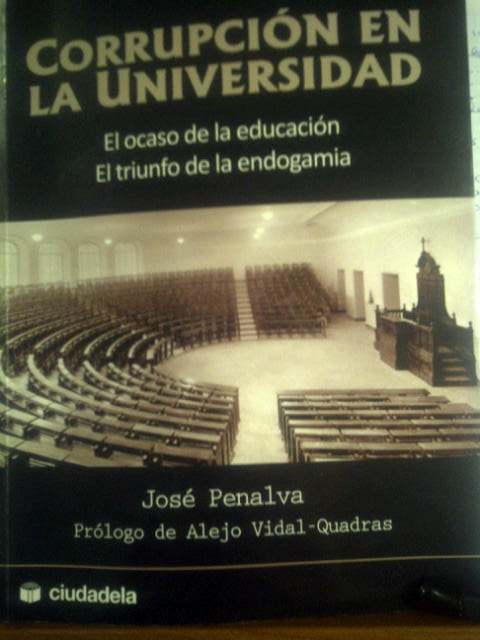
José Penalva’s Corruption in the University (Corrupción en la Universidad): A Review

As much as I was looking forward to reading José Penalva’s Corruption in the University, I have to admit that the author chose the worst possible manner to address the important issues of nepotism, corruption and harassment that exist in the system of higher education in Spain. For one, Penalva chose to write a novel (or something approximating it.) He might be a brilliant researcher in his field (which is Pedagogy), but a writer he is not. The first person present-tense narrative by a fictional young scholar José Montag alternates between short, choppy statements and long convoluted sentences where Latin expressions exist side by side with Sancho Panza-style proverbs. The author’s writing style relies on repetitions to the extent where the reader begins to wonder how much of the text was simply copy-pasted. To give an example, the narrator mentions that he “didn’t want to take off his pants” (meaning he didn’t want to be humiliated by his colleagues) so many times that I was practically ready to howl every time I encountered this phrase yet again.

Penalva makes the book even less endearing to the reader by his insistent references to Don Quijote. The novel’s narrator obviously sees himself as some kind of a Quixotic figure and even uses the famous opening sentence of Cervantes’s masterpiece as the first sentence of his story. An author whose writing is so poor from the aesthetic point of view and who lacks a realistic vision of himself to the degree where he would compare himself to Cervantes is not to be trusted in terms of the message he is trying to communicate about the system of higher ed.

Penalva’s protagonist is as lacking in social skills as he is in being capable of seeing his own actions with any degree of self-criticism. I’m not extremely good at interpersonal communication myself, but even I know enough not to tell my dissertation committee during the process of my defense that the committee members are to blame for Franco’s dictatorship since they lived under Franco and did nothing to fight him. It is also pretty clear to everybody but Penalva’s character that it might not be the best idea in the world to tell the scholar you want to be your thesis advisor that all you want from him is his signature on the dissertation form and that you have no interest in being directed by him in any way.

The book’s protagonist dislikes absolutely everybody he encounters. Colleagues, administrators, undergrads, graduate students, union members, judges, lawyers, journalists, politicians, and secretaries are all profoundly evil creatures who conspire to persecute this brilliant young academic.

The protagonist insists that he is the only one who actually does any work at the entire department of Pedagogy. He is also the only faculty member ever to visit the library, which he does while the evil colleagues meet in secret to conspire against him. Even a former professor who works for a different university and his own lawyers betray José.

Don’t get me wrong, I have no doubt that corruption is rampant in the Spanish system of higher ed. However, I find it extremely hard to believe that every single person at a university – except for one persecuted academic – can really be an irredeemable villain. As my professor used to say, “If it seems to you that everybody else in the room is a complete idiot, there is probably just one idiot in that room. And that’s you.”

In the Prologue that Penalva writes under his own name, he indicates that the reason why he was subjected to harassment at his university in Spain is that his vision of his field is so innovative that other academics find it difficult to accept it. He fails, however, to explain what it is that his approach to Pedagogy entails. I am not completely alien to this discipline and I believe that I would have been able to understand Penalva’s insights into Pedagogy had he managed to transmit them with any degree of clarity. His failure to do so makes his claims of professional and scholarly superiority suspect.

When I first heard of this book, I was hoping that finally somebody had written a fact-based study of corruption in Spanish system of higher ed. We all know that such book is sorely needed. Unfortunately, Penalva’s Corrupción en la Universidad is so poorly structured and badly written that it sounds like a 200-page rant of a person who is so rigid, unbending and lacking in self-awareness that he manages to make enemies wherever he goes.

My heart goes out to a fellow academic who obviously endured some pretty vicious harassment at his university. (Even though I find it difficult to believe that academics who want to get you out of their department are truly likely to resort to death threats.) However, the way he chose to denounce the injustices done to him is simply counter-productive. Penalva’s alter ego José Montag keeps repeating that there will be a sequel to this book. In that sequel, we will supposedly find factual proof of the harassment he suffered. It remains unclear whose harassment the narrator means: the fictional one he experienced in the novel or the real one suffered by Penalva. I don’t think that the readers of the first book in what promises to be a series will care enough to want to find out.