Occupy Museums

The #Occupy movement is drowning in pleas for compassion and whiny personal stories on the one hand and pseudo-revolutionary insanity of kids who read too much Zizek and Baudrillard and never managed to digest their readings.

Via The Mahablog (that I highly recommend to everybody as a great source of balanced and insightful discussions of politics and economy), I discovered an initiative called Occupy Museums and apparently launched by the Occupy Wall Street’s Art and Culture group.

Here is what the initiative’s organizer had to say:

We see through the pyramid schemes of the temples of cultural elitism controlled by the 1%. No longer will we, the artists of the 99%, allow ourselves to be tricked into accepting a corrupt hierarchical system based on false scarcity and propaganda concerning absurd elevation of one individual genius over another human being for the monetary gain of the elitest of elite. For the past decade and more, artists and art lovers have been the victims of the intense commercialization and co-optation or art. We recognize that art is for everyone, across all classes and cultures and communities. We believe that the Occupy Wall Street Movement will awaken a consciousness that art can bring people together rather than divide them apart as the art world does in our current time.

Let’s be clear. Recently, we have witnessed the absolute equation of art with capital. The members of museum boards mount shows by living or dead artists whom they collect like bundles of packaged debt.

I sometimes complain about my students’ writing. None of them, however, could have ever managed to write something as egregiously bad as the above-quoted passage. So this is good news already.

Jokes aside, the real question now is whether the #Occupy movement can offer anything more than pleas for compassion, stories of the intense anxieties of the well-off, and the pseudo-revolutionary proclamations from a bunch of overpampered kids.

An Impossible Standard of Beauty

“Our culture promotes and imposes an impossible standard of beauty on women,” people often say. “I’m expected to be a skinny, wrinkle-free, modelesque type of woman all the time because this is the only kind of female appearance that our culture accepts. This is causing me all kinds of suffering!”

Well, actually, our culture does nothing of the kind. You are simply confusing culture with trash. The culture of our Western civilization bears no relationship to the junk you are choosing to consume in its place. True culture, the one that has withstood the test of time, has nothing to do with impossible beauty standards. And the best thing is that you can gain access to it for a low price of. . . well, to be honest, for the most part, you can access it for free. Here are just a few examples.

1. “Magazines are filled with photos of air-brushed stick-thin models!” That is very true. However, your Vogue and Cosmo are not “culture.” They are trashy magazines that will end up on a garbage heap at the end of the month. Instead of obsessing over them, why not turn, for example, to the immortal art of Peter Paul Rubens.

Three Graces

This incredibly beautiful painting is what our culture has cherished, treasured and worshipped for centuries. Vogue and Cosmo are not being exhibited at the El Prado museum, while this piece of art is. Generations of people have stood in front of this painting with tears of admiration in their eyes. A crowd of people is standing in front of it right now with bated breath. You can do that, too, and forget about trashy magazines.

2. “Music videos show impossibly beautiful thin singers like Beyonce. I’ll never be able to look like she does!” With all due respect to Beyonce’s fans, performers like her are a dime a dozen. They come, they go, and we forget their names the second they stop performing. Why not turn, instead, to the magnificent art of Montserrat Caballé?

Caballé is not a “conventional beauty” by any standards. Her gift, however, is absolutely unique. Opera singers, for the most part, are not know for being thin. So if your consumption of culture makes you think of dieting, why not turn to opera? If this beautiful art does not convince you that weight means nothing, then I don’t think anything will.

3. “You only see very thin actresses with regular features and perfect makeup in the movies!” That’s not true, either. Maybe it’s time for you to realize that the garbage produced by Hollywood has nothing to do with the masterpieces of world cinema.

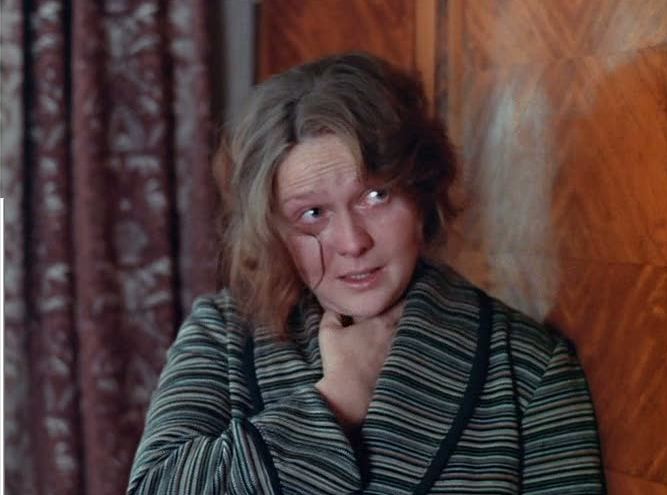
This is Natalia Gundareva, my absolutely most favorite actress in the universe. She died in 2005, which is a huge loss for the cinematographic art everywhere.

The photo is from one of her best roles in the film Autumn Marathon that you can find here. Actually, all of her performances were magnificent. Gundareva was not a conventional beauty and she was never thin. Actually, I look a lot like her and have the same body type. (When N.’s mother asked him what I looked like, he said I looked like Gundareva. This was the best compliment I could have ever received.)

Or take, for example, one of Spain’s leading actresses Carmen Maura.


This is how she looks on her brilliant role in the film The Promise. You could be watching her outstanding performances instead of insipid films starring the incredibly talentless Jennifer Anniston.

People ask me how I manage to be so much at peace with my body when society keeps telling me that my body type is ugly. The truth is, though, that society has immortalized the paintings of Rubens and the acting of Sara Bernhardt, and not inane TV shows and glossy magazines. If you choose to consume the performances of Rihanna and J Lo instead of all the available alternatives, whom can you blame other than yourself for limiting your reality so much?