Terry Eagleton’s Why Marx Was Right: A Review, Part II

Aside from tampons and contraceptive devices, another thing that the Soviet Union did not have was literary critics. The anti-intellectual tendencies in the Soviet Union started with Lenin who routinely talked about “whining and decaying intellectuals” who are “the  lackeys of capital” and “not the brains of the nation but its shit.” If I were a really mean person, I could entertain myself with imagining what the Soviet regime would have done to a nerdy erudite like Eagleton. It is always very curious to observe how people strive to extol and promote the same regimes that would have killed them faster than you can say “dialectical materialism.”

In 1928, the Central Committee of Eagleton’s dearly beloved Communist Party declared its own right to “exercise guidance over the creative process.” This means that artists who refused to practice the artistic style of socialist realism were banned from making their work accessible to the public in any way. If these artists happened to be non-Russian, they were killed. The only literary critic who was permitted to survive was Bakhtin. He was put in charge of creating a new Soviet canon. Works of the world literature for which Bakhtin managed to find a pro-Communist explanation were included in the canon. This means that the Soviet people were allowed to know that these works existed and even read them if they were so lucky as to find a copy. (I can blog about access to books in the Soviet Union later, in case anybody is interested.)

Rabelais and Cervantes made it onto the approved list. Bakhtin and his school managed to create a theory according to which Don Quijote was a leader of a class struggle who opposed his more genuine values to the ideology of ruthless capitalism that was making its way into Spain. (If you don’t believe me, there is a 1957 Soviet film Don Quixote that embodies this scarily insane reading. It was shown during the celebrations of the 400 anniversary of the publication of Don Quijote, Part I. After the showing, an older specialist on Cervantes who came to our university for the festivities came up to me. “My health is not very good,” he said. “Somebody should have warned me about this because I almost had a heart attack while I watched them destroy Cervantes this way.”) Pretty much no literature from the twentieth century made it through the censors. As I mentioned before, world literature for us stopped at Dickens. I hated literature classes both at school and at the university because they consisted exclusively of scouring Homer, Moliere and Pushkin for evidence of class struggle.

Eagleton, who used to be a brilliant literary critic, has now adopted this style of literary criticism. I could have forgiven him for a crappy propaganda of Marxism. What has me completely disgusted by the book, though, is an attempt to discuss Milton, Shakespeare and Goldsmith as proponents of class struggle. Here is an example of this kind of analysis in Why Marx Was Right:

Take this couplet about a wealthy landlord from Oliver Goldsmith’s poem “The Deserted Village”: “The robe that wraps his limbs in silken sloth Has robbed the neighbouring fields of half their growth.” The symmetry and economy of the lines themselves, with their neatly balanced antithesis, contrast with the waste and imbalance of the economy they describe. The couplet is clearly about class struggle.

Or, take the following gem on Hardy’s Jude the Obscure:

In Thomas Hardy’s novel Jude the Obscure, Jude Fawley, an impoverished artisan living in the working-class area of Oxford known as Jericho, reflects that his destiny lies not with the spires and quadrangles of the university, but “among the manual toilers in the shabby purlieu which he himself occupied, unrecognized as part of the city at all by its visitors and panegyrists, yet without whose denizens the hard readers could not read nor the high thinkers live” (Part 2, Ch. 6). Are these poignant words a statement of Marx’s base/superstructure doctrine? Not exactly. In materialist spirit, they draw attention to the fact that there can be no mental labour without manual labour. Oxford University is the “superstructure” to Jericho’s “base.” If the academics had to be their own cooks, plumbers, stone masons, printers and so on, they would have no time to study.

Not only is this kind of literary analysis boring and reductive, it has also been done to death. I spent countless hours as a Soviet and post-Soviet student copying precisely this kind of drivel from the Soviet alternative to literary criticism. I could not have invented a better way of demonstrating the profoundly anti-intellectual nature of communism if I tried. Eagleton demonstrates to us how an intellectual, a famous literary critic, a thinker is reduced to spouting senseless inanities in his own field of knowledge the moment he attempts to defend an ideology that has proven to be a failure time and again.

Terry Eagleton’s Why Marx Was Right: A Review, Part I

In a recent review, I criticized Ernesto Laclau for failing to decide who his intended audience was and writing consistently for that audience. The good news about Terry Eagleton’s new book Why Marx Was Right is that Eagleton is very clear on who he is writing for. His audience consists of hopeless illiterates who have fallen off a pumpkin cart fifteen seconds ago and have hit their heads against the ground really hard in the process. Nobody else would buy into the author’s truly egregious prevarications. I use the word “prevarication” with full understanding of what it implies. Eagleton is a highly erudite person, and it is simply not possible that in this book he speaks out of ignorance. To give an example, at the very beginning of Why Marx Was Right, Eagleton mentions that Marx drew his conclusions on basis of observing the

extraordinarily violent process by which an urban working class had been forged out of an uprooted peasantry in his own adopted country of England—a process which Brazil, China, Russia and India are living through today

The idea of uprooted peasants in today’s Russia is completely bizarre. All of Russia’s peasants were uprooted with the goal of creating an urban working class out of them during Stalin’s industrialization. I know that Marxists are given to wild leaps of imagination but, surely, not to the extent of imagining crowds of uprooted peasants marching through a country that has been heavily industrialized for decades?

Another equally ridiculous statement comes when Eagleton begins to enumerate the so-called achievements of the Soviet Union, a task he engages in with the earnestness of a brainless male cheer-leader:

Soviet Union played a heroic role in combating the evil of fascism, as well as in helping to topple colonialist powers. It also fostered the kind of solidarity among its citizens that Western nations seem able to muster only when they are killing the natives of other lands.

Given that the Soviet Union brought Hitler to power and promoted the imperialist goals of the Russian Empire, this statement sounds, at the very least, disingenuous. Eagleton’s suggestion that it “fostered solidarity among its citizens” is equally confusing since it is common knowledge that the Soviet Union exploded in a mass of ethnic conflicts beginning in 1989. These ethnic conflicts and their attendant genocides are still going on in many of the former Republics of the Soviet Union. I wonder if Eagleton ever heard the word “Chechnya” or asked himself which historical events promoted the feelings of solidarity that are still making the Russians and the Chechens slaughter each other. (In case you don’t know, in 1944 Stalin deported the entire Chechen and Ingush population, consisting approximately of 400,000 people to Siberia. About 30% of Chechens died during the deportation.) One has to be either completely cynical or in the throes of a massive attack of Alzheimer’s to use the word “solidarity” to describe the horrible relations between the different ethnic groups within the Soviet Union.

Eagleton is equally annoying when he pontificates about “the loss of women’s rights” that the collapse of the Soviet Union supposedly brought about. He gives no examples, of course, which is a shame because, as a woman who has lived through the collapse of the Soviet Union, I would surely love to hear which of my rights were lost as the Soviet Union fell apart.

Does Eagleton refer to the right to abortion as the only form of contraception available in the Soviet Union, which led many women to undergo dozens of abortions within their lifetime? Abortion is still free and legal in the non-Muslim republics of the former Soviet Union. Now, however, people have easy access to condoms, oral contraceptives, IUDs, patches, etc. Absolutely none of this was available to the citizens of the USSR.

Maybe Eagleton is talking about the horrifying sexual harassment that existed everywhere in the USSR and for which there was no legal remedy? It is still present everywhere in the FSU (former Soviet Union), but at least now there are people who have discovered the word “feminism” and are speaking out against it.

Is it possible that Eagleton is talking about the absolute lack of any hygienic aides to menstruation? Now, women of the FSU have the same choice of tampons and sanitary pads as women in all developed countries. And if you think that this is not a big deal, I strongly suggest you go through a single menstruation with no methods of hygiene available to you. (And please don’t ask me why we didn’t just use cotton wool and gauze. It was easier to encounter diamonds growing on fir-trees than buy cotton wool and gauze in the Soviet Union).

(To be continued. . .)

How to Become a Member of Amazon Vine?

Amazon provides the following definition of its Amazon Vine program:

Amazon Vine™ is a program that enables a select group of Amazon customers to post opinions about new and pre-release items to help their fellow customers make educated purchase decisions. Customers are invited to become Amazon Vine™ Voices based on the trust they have earned in the Amazon community for writing accurate and insightful reviews. Amazon provides Amazon Vine™ members with free copies of products that have been submitted to the program by vendors. Amazon does not influence the opinions of Amazon Vine™ members, nor do we modify or edit their reviews.

As you can see, the only way to join the program is to be invited personally by Amazon. There is, however, a number of things you can do to maximize your chances of being invited. When I first heard about the program, I realized that, since I obviously write really great reviews (as witnessed by their popularity on this blog), there is no reason for me not to be in the program. People keep saying that the way Amazon selects its Vine Voices is completely arbitrary. I don’t know whether that’s true. I do know, however, that several months after I started working actively towards being included into the program, I got an invitation to it. The opportunity to get books by some of my favorite authors months before they appear in print is priceless. It is also pretty good to get the free products (sometimes, extremely expensive ones) through the program.

Sitting down and writing a huge bunch of reviews, though, is not going to help you get invited into the program. You need a strategy. The strategy should be aimed at giving you a very high Amazon reviewer ranking within a short period of time. This means that you need to get many positive votes on your Amazon reviews. In order to do that, you have to be the first or the second person to publish a review of a book that is going to be hugely popular. Reviews of such books appear extremely fast, and it will not help you in any way to be stuck at review #237. Nobody is likely to notice it and you will get no votes. So if the book already has over 20 reviews, don’t waste your time posting yours. Unless, of course, you are dying to express your opinion and don’t care about whether this will help your ratings or not.

After you have chosen a bestselling author who is planning to release a new book soon, you need to be among the first people who will get the book, read it and post a review. What I did was pre-order such books on my Kindle. New Kindle releases appear on your device at 3 am Eastern Time (or 2 am Central Time, which is my time zone.) The second you get the book, you need to read it. Reading in such a hurry and staying up all night, kind of spoils the enjoyment of reading. But everything in life comes at a price, and so does Amazon Vine membership. As soon as you get through the book, you need to force yourself to stay awake and write a review of it for Amazon. The good news is that if you choose your books right, you won’t need to go through this complex process more than a few times.

In order to receive good ratings, your reviews need to be fairly long and offer something of value to the readers. (Retelling the plot is obviously not one of such things.) Ask yourself what you would want to know if you were to consult a review before making a purchase.

It is a good idea to review a variety of products in many different categories. An object doesn’t have to be bought at Amazon to be reviewed there. Is there a particular piece of clothing or jewelry that you bought recently and can discuss in an interesting way in a review? A special gadget or a computer game? A favorite brand of cereal or raisins? All this stuff is sold on Amazon and can be reviewed.

The goal is to become one of the top 300-400 reviewers, and then you just have to sit tight and wait for your invitation. Of course, you have to be a resident of the US and it looks like it also helps if you don’t live in a huge city. Nobody is going to need thousands of Vine Voices from the same geographical area. This is where it finally becomes a good thing to live in a God-forsaken little town.

And once you get on Amazon Vine, the best piece of advice I can offer you is to keep as far away as possible from the community forum. It is populated by some really strange people who construct their entire identity around being a member of the program. There are, of course, many perfectly normal people there but the scary ones are too scary for the forum to make sense.

Have fun reviewing!

Ernesto Laclau’s On Populist Reason: A Review

>

I have to confess that I’m extremely disappointed by Laclau’s 2005 book On Populist Reason. One thing you need to figure out before you start writing is what your audience will be like. Are you trying to address the specialists in your field or do you want the book to be accessible to any reasonably educated person? Once you have decided who it is that you are writing for, then you need to make sure that both the ideas you express and the language you use to transmit them are on the same level.

In On Populist Reason, Laclau seems to have forgotten how important it is to know your audience. He uses extremely complex, jargon-ridden writing style to transmit ideas that are beyond basic. If I am to struggle through the author’s convoluted sentences and displays of erudition, I expect his argument to lead me to something better than the kind of trivialities that Laclau offers in this book.

Laclau begins his study of populism with an overview of the existing definitions of this concept. He points out that  the perception of populism as something that is a priori negative is the only reason why such definitions only succeed in demonizing populism in terms that are as negative as they are vague. Instead of analyzing populism, political theorists attempt to demonstrate how much they condemn it and then allow this condemnation to taint every conclusion they make. Laclau attempts to move away from such facile definitions and offer a more profound analysis of populism. However, he fails at that task quite spectacularly.

More often than not, it felt to me that Laclau was talking to people he considers to be deeply unintelligent and unaware of the most basic tenets of political theory. He does it in the kind of language, though, that would prevent these ignoramuses from following his line of reasoning. Here is one of the many examples:

The complexes which we call ‘discursive or hegemonic formations’, which articulate differential and equivalential logics, would be unintelligible without the affective component. . . We can conclude that any social whole results froman indissociable articulation between signifying and affective dimensions.

This statement concludes over 100 pages of a very convoluted discussion and does nothing more than announce in this extremely technical language that communities are bound together not just by reason but also by emotions. Well, duh. This idea has been studied, discussed and argued ad nauseam for over 100 years now. There is hardly any need to convince those of us who are capable of reading Laclau’s texts of something so banal.

In a similar way, Laclau offers a very plodding discussion that is supposed to lead his readers to the earth-shattering conclusion that – believe it or not – populist movements can exist both on the Left and on the Right of the political spectrum. I am sure that there are people who are unaware of this fact but these are not the same people who can get through 40 pages on floating signifiers.

I have also discovered from On Populist Reason that in the US populism has been hijacked by the Right that, against all reason, managed to convince farmers and blue-collar workers that the Republicans represent the interests of the regular folks as opposed to the Democrats who supposedly only defend the rights of the long-haired East Coast elites. I know that you must have already yawned twice as you have been reading this paragraph. We all know this, we have all heard this said a gazillion times. Why Laclau believes that it needs to be pointed out yet again is beyond me.

The book is filled to the brim with inanities of the most disturbing kind. On page 177 (close to the end of the book), we find out that in order for the populist appeal to be effective, there have to exist some problems in society. A society where institutional stability is complete, will not respond to populism. But, of course, perfect societies do not exist, so this situation is completely hypothetic. “Surprise, surprise!” I wrote on the margins when I read this. For the most part, this was my reaction to the entire book.

Coco Louco Restaurant in St. Louis: A Review

Now that I have discovered N. Euclid Ave in St. Louis, I can’t stop going there. It even reminds me of Montreal a little in spite of being as empty as the rest of the city. And that’s the highest compliment I can pay to a city. So yesterday we went to a Brazilian restaurant called Coco Louco. In the reviews I read before going there, people almost unanimously agreed that the food there was fantastic while the service was abysmal. In my experience, however, the food at Coco Louco could be a lot better while service was impeccable. (It’s not like I’m doing this on purpose, people, but I never manage to agree with the popular opinion on anything.)

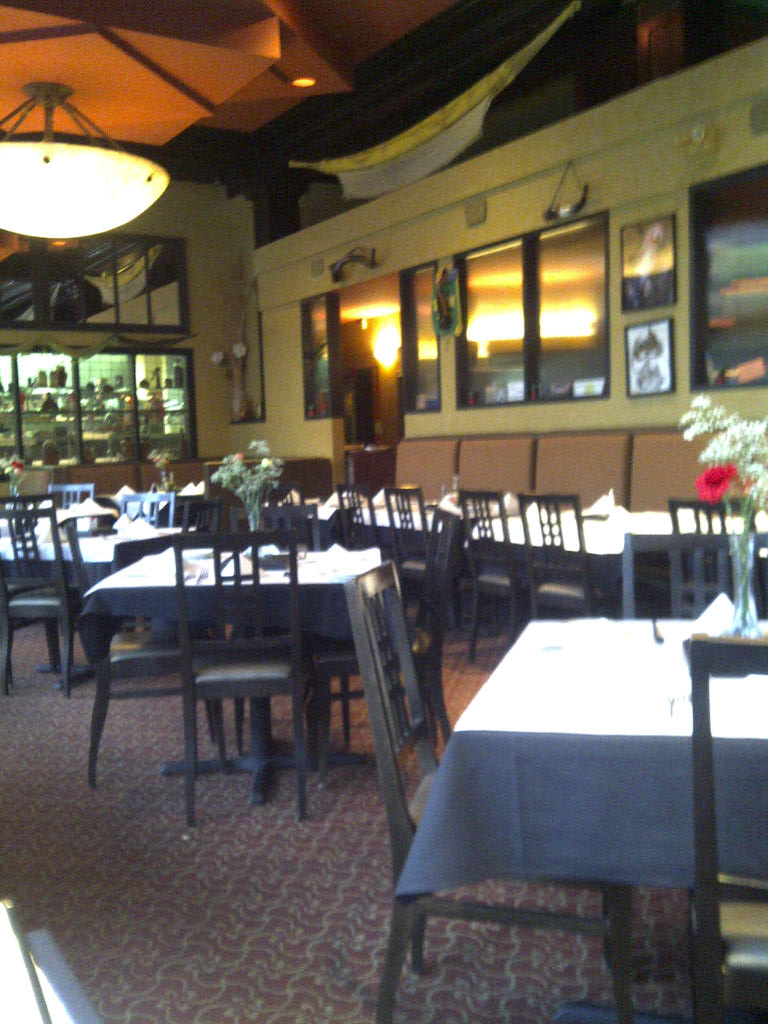
As you can see, the restaurant was pretty empty.
It was a Sunday, of course, but I
find it impossible to believe that there are
people in this city any day of the week
Our waiter’s name was Benya and he turned out to be a Russian-speaker. That’s one of the things I love about this country. You go to a Brazilian restaurant in the Midwest and get served by a Russian-speaking waiter. How cool is that?
As for the food, one thing that I can recommend highly is the appetizer plate for $14. Here it is:
The appetizer plate contains these great meat and cheese filled pastries that are called “pastel.” The best kind is the beef pastel. It as so good that we ordered several extra ones to take home with us. As for the main courses, I wouldn’t say that the ones we tried are really worth the price. I had the red snapper that you can see on the picture here:
It is quite good but it really didn’t feel like it was worth the $27 the restaurant charges for it.
Then, there was espeto mixto wihich is different kinds of meat grilled on a skewer. Brazilian cuisine is almost as famous for its meat as the Argentinean, but this meat was quite a disappointment. It was simply mediocre and unworthy of the famed name of Brazilian meat. You can see the skewer with some remnants of the espeto mixto on the picture here:
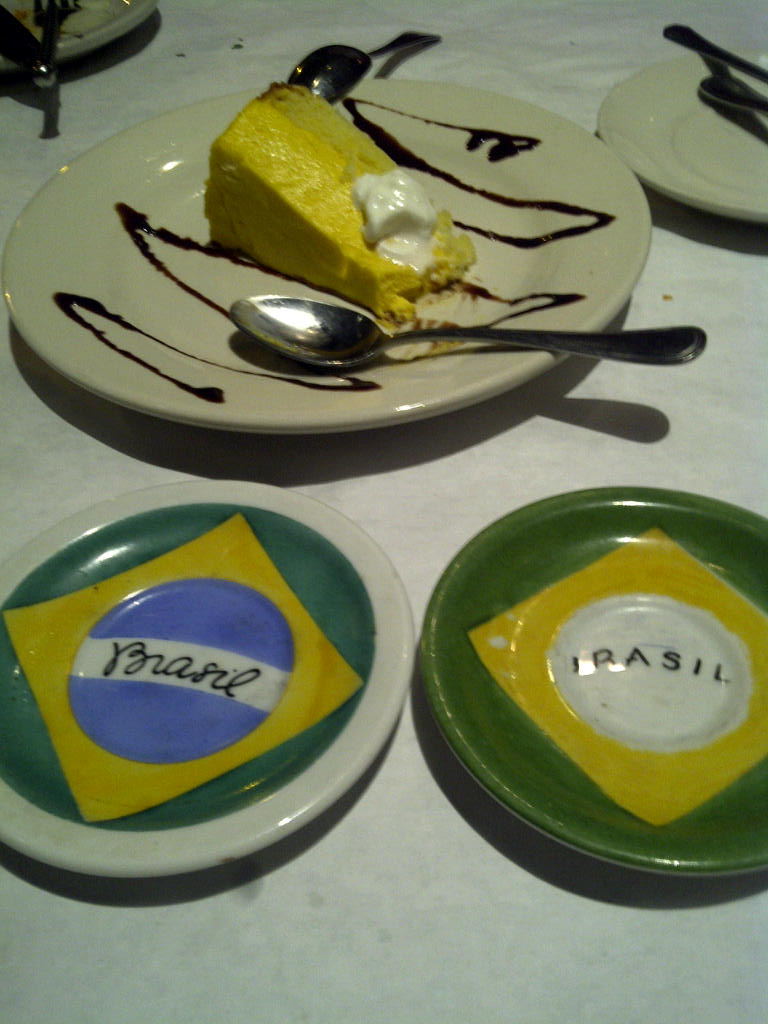
The dessert was really good. It’s a mango mousse and we got it on the house. Here it is:
Overall, we had a splendid time because we always enjoy discovering new restaurants. The food, however, didn’t really do justice to the great Brazilian cuisine. If the weather is nice next weekend, we will probably go back to St. Louis, and I will share with you a review of an Indian restaurant they have on N. Euclid.

Jo Nesbø’s The Snowman: A Review

The inexplicable success of Stieg Larsson’s mysteries is the best thing that has happened to Scandinavian writers since Selma Lagerlöf. Larsson’s untimely death left a void that publishers are trying to fill desperately. Scandinavian names, long descriptions of cold weather and depictions of carnage in Sweden, Norway and Denmark are suddenly in vogue. Since many Americans are a bit confused on where Sweden is actually located, all European mystery authors are experiencing a surge of interest in their books.  

As you can see from the cover of Jo Nesbø’s The Snowman, this author’s publishers are doing all they can to milk Stieg Larsson’s fame for all it is worth. This, however, is something that, in my opinion, this author doesn’t need. This book is very good. Its only defect is that it is too drawn out. In his zeal to create as many twists to the plot as humanly possible, Jo Nesbø goes a bit too far and creates a 100 or so pages somewhere in the middle of this long book that feel quite redundant.

If I had to compare Jo Nesbø’s style of mystery writing to another author’s, I would say he bears no similarity to the weirdly boring Stieg Larsson. Rather, Jo Nesbø is the Norwegian version of Michael Connelly. (Connelly apparently agrees and has published rave reviews of this writer’s work.) Nesbø’s protagonist called Harry (sic!) Hole is a police officer on a mission. He is also a lonely drunk and a die-hard romantic who gets treated badly by the woman he loves. Nesbø isn’t nearly as good as Connelly in creating a complex and richly-layered protagonist. His Harry looks a little cartoonish at times. He is much better than Connelly, however, in writing the ending to his mystery. Connelly’s endings tend to be much too abrupt. This gifted writer doesn’t seem to realize that you cannot announce the culprit’s name on the last page and just be done with it. The laws of the genre require that after the culmination there should be a winding-down period where the readers are offered an explanation of either what drove the murderer to commit the crimes or a description of the deductive process of the detective that resulted in solving the mystery. Nesbø’s ending is absolutely perfect.

The Snowman is a serial killer mystery. In the novel, Norwegians seem quite frustrated with the fact that they alone, of the three Scandinavian countries, have failed to produce a serial killer of their own. There are other cute moments in the book that have a very specific Norwegian flavor. See, for instance, the following passage that would have Ayn Rand die all over again were she around to read it:

‘It’s a very small shop. We don’t have many customers. Almost none until the Christmas sales, to be honest.’‘How. . .?’‘NORAD. They support shops and our suppliers as part of the government’s trade programme with Third World countries. The message it sends is more important than money and short-sighted gain, isn’t it.’

This is, of course, a very dangerous game that the third richest country in the world (after Luxembourg and Qatar) is playing. Oil comes and goes while people who have been corrupted by such ridiculous handouts remain.

There are some sparks of wisdom in this novel that I wanted to share with you. One of the characters says, for example:

Our generation has turned itself into servants and secretaries of our children. . . There are so many appointments and birthdays and favorite foods and football sessions that it drives me insane.

Anybody who has observed the frantic scrambling of the Western parents to organize endless play dates and activities for their children will have to agree with this observation. 

I enjoyed this book quite a bit and recommend it highly. Of course, it didn’t hurt that snow was mentioned pretty much on every single page making this summer heat somewhat more bearable.