Anti-Semitism in the Soviet Union, Part II

In 1945, Soviet Union defeated the Nazi Germany and liberated the surviving Jews from the concentration camps. Soviet Jews had participated in the war effort heroically, in every capacity imaginable.

Three years later, a vicious anti-Semitic campaign was unleashed within the country against the Soviet Jews. If Stalin hadn’t died (or had been killed, which is far more probable), Soviet Jews would have been deported to Siberia. This was a very doable plan for Stalin, since he had already deported several nations to Siberia in their entirety. The deportations were going to be preceded by 1937-style trials over prominent Jews. The first such trial was going to be one where famous Jewish doctors would be condemned to death for, supposedly, organizing the murders of the Communist leaders of the Soviet Union, starting with Lenin and Gorky.

Many people believe even today that this anti-Semitic revival was a result of Stalin’s personal dislike for Jews. Nothing could be further from the truth. There is no evidence that Stalin ever relied on personal sympathies or lack thereof in any of his crucial decisions. Let’s remember that he played the key role in the creation of the State of Israel. Besides, he collaborated with Jews in his government for decades. It’s very hard to believe that one day he just woke up and decided to entertain some long-held grudge against Jews all of a sudden.

Just like everything else he did, Stalin’s anti-Semitic policies served very practical purposes. On the one hand, anti-Semitism was what the country needed to vent the grievances caused by the war. During the war, many people crossed the Soviet borders for the first time in their lives. My Ukrainian grandfather was from a small village that had been ravaged by the Soviet policies aimed at destroying the Ukrainian agriculture. He walked across the entire Eastern and Central Europe with his regiment. And that was when he discovered that Soviet propaganda had been lying to him his entire life. Polish and German farmers lived incomparably better and richer lifestyles than he on the most fertile soil in Europe, in Ukraine. Even after the destruction of the war, it was obvious that he was a pauper compared to these “poor victims of capitalist greed.”

There were millions of soldiers and prisoners of war who came back with such stories. Many of them were sent to the concentration camps. Stalin couldn’t jail every single war veteran, however.

(To be continued. . . )
Free Birth Control from Obama

This is really cool:

Health insurance plans must cover birth control as preventive care for women, with no copays, the Obama administration said Monday in a decision with far-reaching implications for health care as well as social mores.

The requirement is part of a broad expansion of coverage for women’s preventive care under President Barack Obama’s health care law. Also to be covered without copays are breast pumps for nursing mothers, an annual “well-woman” physical, screening for the virus that causes cervical cancer and for diabetes during pregnancy, counseling on domestic violence, and other services. . .  The new requirements will take effect Jan. 1, 2013, in most cases. Tens of millions of women are expected to gain coverage initially, and that number is likely to grow with time.

So let’s not rush to condemn Obama outright. He is doing some important things. Unless you are convinced that a Republican president will not overturn these measures, then, please, don’t say that it doesn’t matter who wins the 2012 elections.

This one measure will do more for lowering the rates of abortion than decades of anti-choice screechings.

I Wonder If Chomsky. . .

. . . has been following the recent events in the US Congress and whether he still feels that the Tea Partiers can be recruited for massive support of progressive causes (the video has been removed by YouTube, but it’s clear from the comments what it was about.) A year ago, I said the following:

There is this huge delusion on the Left that there is a way of connecting with some of these people [Tea Partiers] and getting them on our side. Now Chomsky is participating in that delusion as well. But I don’t think that strategy will work. It never has before.

Everybody was trying to persuade me that Tea Partiers are the movement of the disadvantaged and the unemployed who have a huge potential of coming to support a Liberal agenda.

Today, the representatives elected by those same Tea Partiers have destroyed what this country still had left of its welfare system.

Now, was I right or was I completely right?

A Sad Evolution of a Former Feminist

It isn’t easy to understand a writer who tells you that “Bachmann can summon the spirit of McCarthy to raise the equally bizarre specter of socialism’s tentacles.” A spirit that raises a specter is too convoluted an image for my liking.

It is equally difficult to decipher the writings of somebody who believes that the Tea Party movement and feminism have a natural affinity because

the core of feminism is individual choice and freedom, and it is these strains that are being sounded now more by the Tea Party movement than by the left. . . Feminism is philosophically as much in harmony with conservative, and especially libertarian, values – and in some ways even more so.

But the most frustrating thing of all is seeing how a formerly brilliant feminist journalist has degenerated into a semi-literate, bumbling defender of the “true feminism” of Palin and Bachmann. This is precisely what happened to Naomi Wolf. You can find her most recent exercise in celebrating the supposedly feminist Thatcher, Palin and Bachmann here.

Servant Mentality

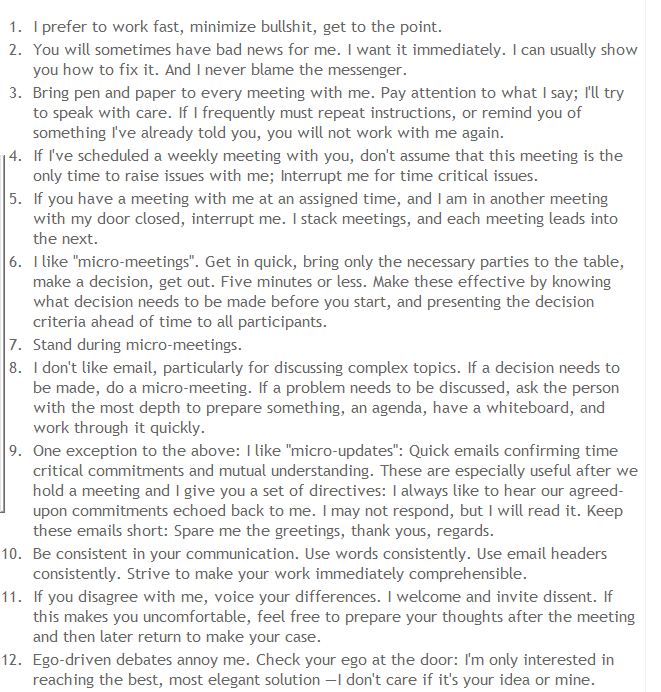
Crowds of people in my blogroll are peeing themselves with delight over the following list of instructions an unnamed important person sent to his or her future collaborator:

This isn’t all. The list continues, and you can see it in its entirety here.

I have known poverty and the hopelessness it brings. However, I can absolutely promise you that I would never ever consider working with an individual who’d disrespect me to the point of handing me such a list. There is no amount of money – not a million, not a billion, not a trillion dollars – that I would accept for spending even a day in the same room with this neurotic.

People who are gushing over how much they admire the “no-bullshit author” of the list should get out a dictionary and find the definition of the words “dignity” and “self-respect.”

Anti-Semitism in the Soviet Union, Part I

Reader el asked me to write a post on the trajectory of anti-Semitism in the Soviet Union, and I’m happy to oblige.

The revolution of 1917 was welcomed by most Jews. The Russian Empire  had been violently anti-Semitic. The Jews were only permitted to reside in the Pale of Settlement, their access to education and entrance into professions was severely constrained. The tsarist government encouraged pogroms that kept the Jews in constant fear for their lives. In my own family, we had a scientist, a brilliant mathematician, who had to renounce his religion and convert to Christianity in order to continue pursuing his research.

When the revolution took place, the absolute majority of Jews was extremely happy (Ayn Rand was an exception.) Now they had full rights and nobody discriminated against them.The opposite often took place. When the first round of cleansings started in the mid-1920s, Jews were pretty much the only people who had nothing to worry about. In case you don’t know, a cleansing was a process of investigating every person’s antecedents. Those who had a rich relative, a business-owner of some sort in their family, or, God forbid, an aristocrat (no matter how far removed) would lose their jobs and be ostracized in the first round of cleansings. In the second round, they would be sent to the concentration camps or exterminated. For the Jews, cleansings represented no danger. They were all dirt-poor and in opposition to tsarism. The best thing you could be during the cleansings was a Jew.

Right after the revolution and until the end of World War II, the Jewish culture experienced a veritable boom in the Soviet Union. There were dozens of newspapers and magazines in Yiddish. Every major city had a Jewish theater of its own. Jews could have great careers and any kind of education they wanted. In case you haven’t read the story of my Jewish great-grandmother, who went from an illiterate family in a shtetl to a position of great responsibility, you can find it here.

There was a price for all this, of course. In return for these great things, Jews had to abandon their religion. This wasn’t discriminatory, though, because everybody was expected to move away from religious practices. Exploited and degraded for centuries by corrupt priests, the former Christians of the Soviet Union forgot the religion they never really perceived as their own very easily. The Jews followed suit. They found non-religious ways of preserving their identity and practice their culture.

The popular anti-Semitism of the Russian Empire was eradicated during the first decades of the USSR’s existence. If a kid made an anti-Semitic joke at school, for example, that kid was berated and ridiculed forever. Among adults, an anti-Semite was perceived as a counter-revolutionary (once again, because the Jews were seen as extremely pro-revolution). By 1940s, people of the Soviet Union didn’t even know, for the most part, that it was possible to be anti-Semitic.

In my next post, I will tell you how this all came to an end, and why the USSR became profoundly anti-Semitic (both on the level of the government and among people at large) right after the Soviet Union defeated Nazism in 1945 and liberated the European Jews from German concentration camps.

Cowabunga and WordPress

WordPress always congratulates me whenever I publish a new post. “This is your Xth post. Good job!” or “This is your XXth post. Amazing!” are the messages I get after I submit a new post. The problem is, though, that I post like a maniac. So now poor WordPress is hard-pressed (what a clumsy pun, but I like it) to find fresh words of encouragement for me. This is what it came up  with after I published my most recent post:

Does anybody even know what “cowabunga” is?

And the funniest thing is that in a second I will press the Publish button for this post, so WordPress will have to come up with something new yet again. I’m afraid that soon it will get so fed up with me that I will get messages saying, “This is your XXXth post. Bitch.” Or, “This is your LCth post. Jerk.”

Through the Eyes of a Stranger: Where Do Bad Children Come From?

One of the things that surprise me the most in North America is that people see upbringing and its results as completely unrelated. How many times have I observed in horror a TV show where parents of a teenage drug addict were being consoled by Dr. Phil, Oprah or any other psychobabbler of the moment with “I know you are good parents and you love your child.” And the audience is shedding tears of compassion for the poor good parents who are cursed by this messed up, addicted kid who had probably been dropped in the midst of this happy family from an alien spaceship.

Seriously, though? How can anybody be a good parent if the result of their parenting is so abysmal? Everything we do is normally judged by the results we manage to achieve. Will you thank a chef who slaves over your meal but sends you stinky, uneatable slop in the end? Will anybody tell me I’m a fantastic teacher if my students don’t speak a word of Spanish at the end of my language course? Will I celebrate the students who produce a garbled mess instead of a final essay at the end of the course? Will it change anything if they claim that they worked very hard writing it? Obviously not.

If the result of parenting is a kid with severe issues* like, say, extremely low-self esteem (which manifests itself in anorexia, bulimia, drug addiction, alcoholism, etc.), then how on God’s green Earth can anybody claim the parenting itself was anything but horrifyingly bad? If a teenager goes and shoots up a classroom, how does it make sense to pity his parents instead of questioning what they’d been doing to him all his life to get him to this point**?

I understand that this is a culture that values resourcefulness and self-sufficiency. I’m as much into the “pull yourselves by your bootstraps” mentality as the next person. The moment we reach adulthood, we can only blame ourselves for not handling our issues. But to expect this from a child or a teenager who, by definition, cannot have the freedom or the resources to take care of themselves is quite ridiculous.

The end result of a good upbringing is a genuinely happy, self-sufficient, socialized (not to be confused with sociable), mature individual. You can’t be considered a good parent if you are not even in the ballpark.

Then again, there is always television and video games to blame in case something goes wrong.

* Obviously, I’m not talking about the normal teenage moodiness and acting out. If anybody is interested, I can give my recipe of bringing up a moody, seemingly difficult teenager in a way that doesn’t make everybody’s life a total misery and produces great results. My teenager is now 29, so we can comfortably say that the results of the upbringing have manifested themselves in full.

** In the case of Columbine, this book makes the answer to this question abundantly clear without ever proposing to do so.

Avoiding the Syllabi Drama

I just did both of my syllabi for next semester and left them at the copy center. My syllabi are like little brochures because they are so detailed and long. It makes sense to have such a detailed course program because it allows me to think very little about the courses during the semester.

I always create my syllabi well in advance because running around like a scared bunny the week before the beginning of the semester gives me nightmares.

At this point, I’m so good at creating syllabi that the whole thing took me exactly 4 hours (including pictures and the hyper-controlled course schedule).

This semester, my goal is to streamline teaching as much as possible in order to do massive amounts of research. I will force myself only to think about teaching for one hour 3 days a week (besides the actual classes).

I will keep my readers updated as to the progress of my struggle against overpreparing classes as a strategy to avoid doing research. At least, I know that it’s an avoidance technique. Many people go through life congratulating themselves for being good teachers who are so immersed in teaching they don’t do an hour of research in an entire week.

Being Contentious

I am contentious and contrarian by nature. I was brought up to see this as part of my Jewish identity. In the Soviet Union, Jews were not allowed to practice any aspect of our religion, language, or culture. We had to forget the very word “Jewish” in return for the removal of the pale of settlement. Anti-Semitism was completely absent during the first few decades of the USSR’s existence. After the Soviet Union defeated Nazism, though, it paradoxically (not that paradoxically, of course, but this is a topic for a separate post) became institutionalized. Still, Jewish identity persisted and was transmitted from one generation to another. One part of our identity* consisted in always being a thorn in the side of every reigning ideology.

Once, when I was twelve, I saw a program on television where a famous poet was being interviewed. “I completely agree with what this guy says,” I commented.

My Jewish father was a huge fan of this poet’s writing. Still, he was horrified with my reaction. He gave me a four-hour lecture delivered in an outraged whisper (so as to avoid exposing my mother to the horror of my compliance) on why it was wrong for me to agree with what the famous poet said.

“You are a Jew,” my father told me. “We have survived for thousands of years in alien cultures and have been able to preserve our identity because we have a goal. Our ultimate aim is to be the a thorn in the side of every authority imaginable. Whenever we hear an accepted opinion our first, completely automatic response should be to disagree. When you hear something on television or read it in a book – even one written by your favorite writer, even when expressed by your parents – you first impulse should be to voice disagreement.”

“Well then, Dad, I think you are wrong,” I said just to bug him.

“Now I hear my daughter speak,” he responded. “Whenever some old fart tells you what to do, just say you think he is wrong.”

This lesson was crucial in setting me on the path of becoming a literary critic. It also defines everything I do as a blogger. Often, I say things aimed at shocking people  on purpose and try to get them to think about daily realities in unconventional ways. I like to believe that this is what has helped me become a popular blogger in no amount of time. I keep losing faithful readers because of this strategy. They write me impassioned emails trying to convince me that wording my ideas in a milder way will gain me more followers. However, I don’t  want to gain followers at the cost of diluting my message. I want to preserve my identity of an outspoken, shocking, contrarian Jewish feminist autistic academic who doesn’t mince words and doesn’t care about not hurting anybody’s sensibilities. The Internet is a free space (still) where people can wander in and out of blogs whenever they feel like it. People keep coming back to mine, though, which makes me think that my way of approaching things has some relevance to others.

When I first started blogging, I was convinced that only the four people I forwarded the link to would ever read the blog. (One of them never even checked it out, which tells you a lot about my social life). I was terrified when I first realized that, in spite of the horrible writing skills, people still wanted to read me. I still remember the terror I felt when my blog started getting indexed by Google and I got my first seven unsolicited visitors in one day.

The funny thing, though, is that I regularly participate on conservative, Republican, Libertarian, Chicago School of economy, MRA, PUA, “Sarah Palin For President”, “Sarah Palin Is Evil”, anti-feminist, anti-public education, anti-Ukrainian, “Academics are evil”, and anti-blogging blogs. I love generating controversy and I go to those blogs to voice dissent – always in a very respectful way, of course. And on none of them have I been insulted, excoriated, banned, shut up, accused of really outlandish things and asked to leave as I have been on feminist blogs. At this point – and just two years into blogging – I have been banned or asked to leave from pretty much every feminist blog I tried participating in. I still leave my links at Feministe’s Self-Promotions Sundays from time to time, even though I have been asked by a regular participant why I bother since I “never agree.” (Apparently, there is an agreement every reader is expected to reach before saying anything on the blog.) They haven’t banned me yet, so kudos to them. Other than that, I’m not welcome at any other feminist blog I have been able to discover. That really makes me very sad.

* This was just one part of it, of course. If people are interested, I can blog later about how people preserved their Jewishness in completely non-religious ways.