Where Is the Mail?

This post by Spanish prof made me think of a conversation I once had with one of my favorite professors of English literature.

“I’ve been getting so worried lately,” she said. “I used to get a lot of inter-university mail in my mailbox but then it started to dry up. I never get invited to departmental meetings, nobody informs me of events that are being organized, I never get any mail at all any more. I felt like everybody was just snubbing me out of spite. And do you have any idea what I just discovered? It turns out that we are now being sent all of this information by email. I even have an email address of my own assigned to me. I checked it, and it’s filled with hundreds of those email messages. This is very annoying to me. Why do people have to adopt all these new-fangled inventions?”

This speech was delivered in the British public school accent, which made it even better.

The conversation took place in 2005, in case anybody is wondering.

I’d Rather Just Wait for Godot

I’m sitting here waiting for a committee to begin at 5:20 pm. In the meanwhile I:

a) created a mini-quiz;

b) prepared tomorrow’s lectures;

c) published several posts;

d) returned books to the library;

e) worked on my translation;

f) ate;

g) answered 11 work-related emails;

h) created a new PP presentation;

i) took a walk;

j) advised a student;

k) wrote a long report for a committee.

Now I just feel like taking a nap but I’ll have to be here until 7 pm.  😦

The Crucial Dates for Hispanic Civilization Course

In one of the recent posts, I gave a list of dates that I want students in my Hispanic Civilization course to remember. They are:

711, 1492, 1898, 1910, 1939, 1975.

Reader Diego made fun of my choice in his trademark sarcastic manner:

Of the 6 most important events in Spanish civilization, two are the invasion & passing of the aerobics and two are the invasion & passing of Franco. Hmmm….

There is an obvious Peninsularist bias in the selection of these dates. (I wanted to add 1605 and 1615 but that would make the bias even stronger).

Does anybody have other suggestions for the crucial Hispanic Civ dates?

Civilization Is Here!

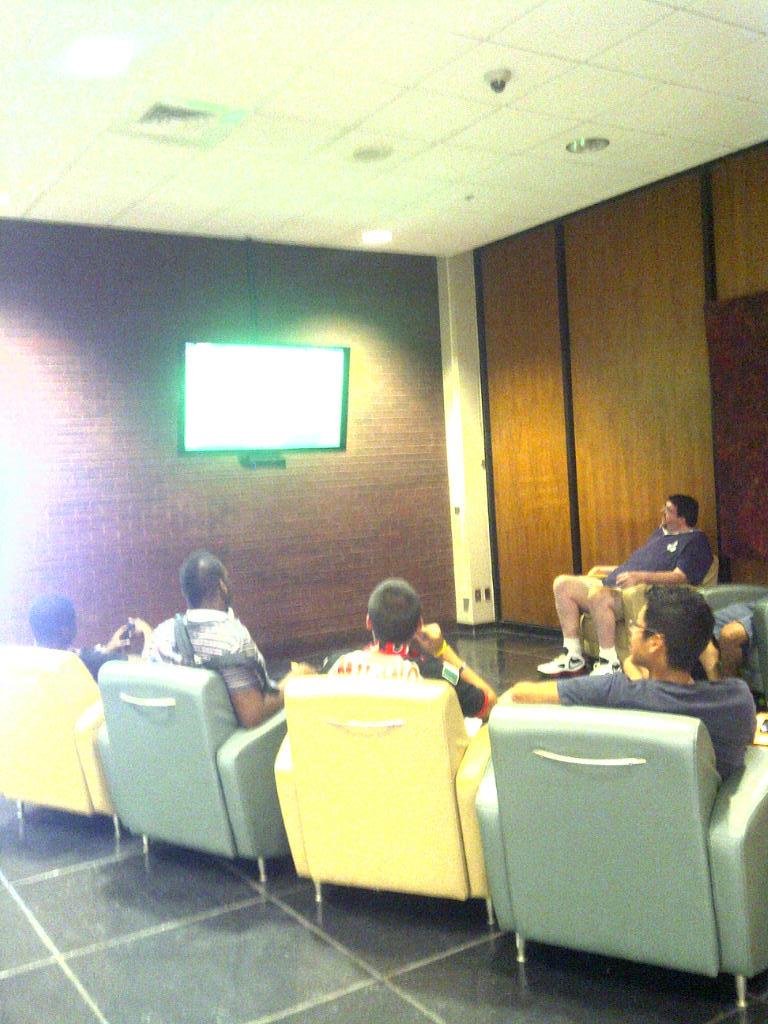
A small group of students are watching a soccer game between Barcelona and Milan in our student center. These must all be international students, but still, what joy!

Finally, I see students watch a real sport for a change. Yesterday in class, only a couple of students got a hockey metaphor I used when discussing Spanish Golden Age theatre. What a shame!

Alimony

I passionately believe that everybody should pay child support to their children, irrespective of everything, including the circumstances of conception.  People who don’t support their underage children are the vilest cockroaches I can imagine.

However, when I hear of “spousal support” or alimony to former wives and husbands, I’m appalled. What is it with the idea that one able-bodied individual should support another able-bodied adult because they used to have sex together? This is just ridiculous.

The argument that a person should be entitled to “the same standard of living” upon divorce as they had while being married is patently ludicrous. Say, a person gets accustomed to a very vigorous and regular sex life in marriage. Should the partner who decides to leave them be obligated still to have sex with the partner who is being left to maintain the same standards of sexual satisfaction in the abandoned ex-spouse?

Look what Wikipedia has to say on the subject in what concerns the US:

In Massachusetts, Mississippi, Texas and Tennessee, for example, there are 135 Appellate cases in addition to 47 sections of State Statute that shape divorce law. As a result of these Appellate Cases, for example, Massachusetts and Mississippi judges cannot order an end date to any alimony award. Most alimony awards in the states are made for life usually regardless of the length of the marriage or civil union (for marriages or civil unions over 10 years).

No end date? For life? What is this if not a blatant attempt by the government to coerce people into not getting divorced?

I think that there should never be any question of people paying a dime to anybody they used to be married to after the separation and the divorce. And I say this as a woman who was a struggling student when she got divorced from a man who was extremely highly paid (I mean, seriously, very very highly paid) at the time.

This isn’t about child support, of course. Child support is sacred. But alimony must go.

Teach Me the Right Way to Think

A student interrupts my lecture and asks anxiously, “How come what you are saying is different from what it says in the textbook?”

(Our textbook is written by Carlos Fuentes, a great Mexican writer, whose perspective on Hispanic Civilization is understandably different from mine.)

“Remember how I told you guys at the beginning of the semester that my goal is to introduce you to different perspectives so that you can reach your own conclusions?” I ask. “My goal is not to teach you the right way to think about these issues. I aim to provide you with tools that will allow you to figure out what you think about the subjects we discuss.”

After a pause, another student suggests, “Maybe you should just go ahead and tell us the correct opinions.”

I see many students nod vigorously.

American Parenthood

I really like observing scenes from American family life because they are so different from what I’m used to.

A colleague is greeting guests who have arrived at her house for a visit. As she is doing it, her kid keeps tugging on her sleeve pretty hard.

“Mom! MOOOM!! MOOOOOOOM!!” the kid repeats loudly while the mother is telling the guests she is happy to have them over.

The mother interrupts herself, turns to the kid, and with a truly angelic patience asks, “Yes, sweetie. What can I do for you?”

“Open this bottle of Pepsi,” the kid says.
The mother opens it and continues the conversation.

Can anybody guess how old the kid in question is?

Fourteen. Years old, that is. Not fourteen months. Years.

When I imagine acting like that in front of my mother at any age, my blood runs cold.

So I don’t know how I feel about this. On the one hand, I truly admire the mother’s patience and love for the kid. On the other hand, I’m perplexed because, culturally, I’m completely unprepared for this kind of thing. I know that if I were the parent in this situation, I would not be kind or understanding. I’d be livid.

Opinions?

Another Reason to Love My University

We were just told that 26% of our Freshmen will be the first ones in their families to go to college. 29% come from ethnically under-represented backgrounds.

I think that’s really great, everybody. This makes me feel that we are doing something really important here.

Affirmative Action, Part II

Before I started teaching at my current public school, I had only a theoretical knowledge of the Affirmative Action. Now, I teach at a university which is located right on the border with Missouri, a former slave state. We have two programs in place that I’m aware of that give an opportunity to students to attend university even if their grades don’t qualify them. The profs are informed which of the students in their classes are part of the program and are asked for regular updates on their progress.

Now that I have seen this program at work, I am a believer.

A significant segment of these students don’t make it, of course. Many, however, do. From the beginning, one can notice easily that they are not prepared for the university. Academically, they are really behind the rest of the students. As a teacher, I have to work very hard to help such students catch up and do well in the course. I am completely ready to make the effort, though. I have seen several such students flourish and get from the bottom of the class to the very top. This requires extra effort from the prof but I, for one, am more than ready to invest extra time and work to help these students to succeed.

In the comments to the first part of this post, readers have suggested that the structure of society needs to be altered in a way that will remove the racist and classist barriers that prevent these kids from doing well from the start. Eventually, this will make Affirmative Action unnecessary. This is a great goal and I support it in full. For now, however, I live in an area where the racial divide is huge and racism is flourishing.

To give just one example, the inhabitants of my town voted down the proposal to extend the Metrolink from St. Louis to our town. Even though this would have made everybody’s lives easier, would help commuters and simplify traveling to and from the city for all of us, the people of my town sacrificed all that because they don’t want to make it easier for the carless people of St. Louis, “the undesirables”, to make it to our town and “spoil” it. Would anybody like to venture a guess as to the race of the undesirables that are being kept out at all cost?

As a result, for now, the only way for black students from the poor and dangerous parts of St. Louis to get to our little suburban paradise is by going to our university. They need to be in class, whether their grades initially qualify them for that or not, because other places where they are likely to end up are not good. We also need them to be in our classes because, otherwise. our school will turn into a place where everybody is the same, looks the same, and has the same experiences to share.
Half a Million!

Today, we have had our 200,000th hit on the blog since it moved to WordPress on May 19 of this year. Together with over 300,000 hits we’d had on the previous version of the blog, this makes 500,000 hits altogether in less than two and a half years.

A Ukrainian banknote for 500,000

Yay for me, people! And yay for all the readers and commenters who keep reading, visiting, arguing, and linking. We have done ourselves proud here!