Are you familiar with the work of Gürbüz Doğan Ekşioğlu? He is an absolutely genius artist from Turkey. Here is an amazing painting by him:
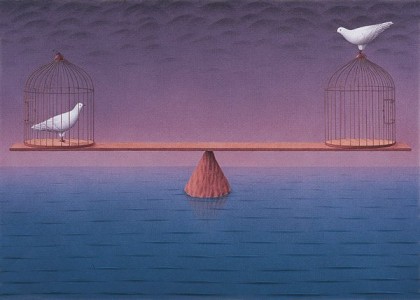
When I first saw it, I was not impressed. But then I discovered what it was supposed to mean and was stunned by the profoundness of its meaning.
What title would you give to this painting for it to make sense?
More great art from Gürbüz under the fold.
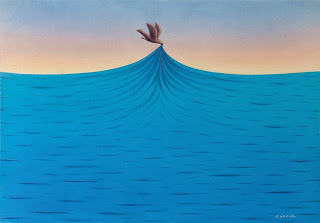
This work of art tells us that that every book we read requires many more books that have inspired this one:


Just think of everything this means:

 Clarissa's Blog
What is the 1st picture supposed to mean? Freedom = slavery? It reminds me of the idea of blind justice because of the weights (cages).
RE the 2nd picture, did you mean that the author has to read many other books before writing his own? Or that a reader has to prepare himself by reading other works (that this is based on)?
LikeLike
nb. the following aren’t necessarily my opinions, but the overall message I get from the paintings (doubtless colored by my world view but not equivalent to it).
The first means there can be no peace between the free and the imprisoned as peace requires balance and if only one side can fly the balance is lost.
My message on the second is that reading is a recursive act, about itself as much as anything else.
The third, freedom is not a natural state but an illusion constructed out of oppression.
The last one: all is artifice (or perception is artifice)
LikeLike
Very profound… but aesthetically unappealing. I would picture this in a generic hotel room, a generic hotel room for geeks.
LikeLike
Something about the colors, proportions and brushwork seem very remiiscent of Botero (who completely blew me away the first time I saw his work). Later he (Botero) seeme to suffer from overexposure (and probably backlash though I was out of the US by then) but there was/is something animalistic and alive in his work that’s also present here.
LikeLike
I agree, I thought about Botero too as soon as I discovered this artist.
LikeLike
I’m a geek who loves hotel rooms. 🙂 🙂
LikeLike
Freedom not, when our love is caged.
LikeLike
Wanted to ask whether you read “The Way of All Flesh” by Samuel Butler. Just finished it, and thought there were things you would like there (patriarchal family’s criticism, narrator’s constant dry-humored remarks).
The Way of All Flesh (1903) is a semi-autobiographical novel by Samuel Butler which naively and simplistically attacks Victorian-era hypocrisy. Written between 1873 and 1884, it traces four generations of the Pontifex family. Butler dared not publish it during his lifetime, but when it was published it was accepted as part of the general reaction against Victorianism.
In 1998, the Modern Library ranked The Way of All Flesh twelfth on its list of the 100 best English-language novels of the 20th century
LikeLike
Another book is “The Prime of Miss Jean Brodie” by Muriel Spark. A good and short review:
http://www.nytimes.com/books/97/05/11/reviews/spark-brodie.html
LikeLike
Wait, only now noticed – if the free dove flies away, it will drown / kill the dove in the cage. Not make it free, but kill. What’s up with that? It can’t be “freedom will kill slavery” since the 2nd caged dove is innocent too.
LikeLike
I would interpret the first to mean that the two birds are equal materially (i.e, they have the same amount of weight), but they are still not equal socially; one has the freedom to leave, the other is a prisoner. I suspect that it’s a commentary on the futility of attempting to reduce all Human differences to economics.
LikeLike
This is really brilliant.
LikeLike
My interpretation is: Freedom is in your head. While two people might seem the same by some measure (e.g. both have the same kind of job, seemingly the same kind of marriage, the same kind of obgliations), internally one might feel free and the other trapped. One might tell herself that she can leave anytime, the other might tell herself that she can never leave. Both will behave the same to the outside world but one will do it voluntarily and the other feeling subjected to other’s expectations.
LikeLike
This is a very profound reading.
LikeLike
Thank you for posting these; they are lovely and thought provoking.
LikeLike
What is your interpretation of the last picture? I just don’t “get” it.
LikeLike
Had another thought about the second picture: the book’s words stay the same, but each reader chooses what to see in the text and / or is capable of seeing things only in a certain light(s). Thus, each in practice reads his personal version of the book.
LikeLike
I thought about Magritte. It’s about freedom for one can mean death sentence for another.
LikeLike