In my native city of Kharkiv, somebody put up a holy image where the enormous statue of Lenin used to stand:
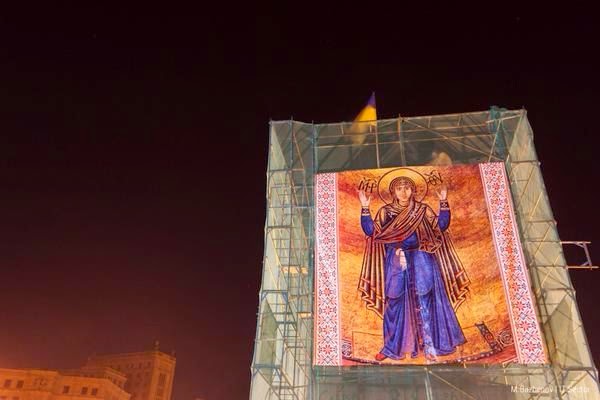
I don’t see what the point was of removing Lenin just to substitute him with an image that is frankly irrelevant to Ukrainians.
It’s time to assume our history, such as it is. It’s time to stop imitating the Russians in their fake and showy religiosity that looks embarrassing in a country where less than 2% of people practice (as opposed to blab about) religion.
These enormous religious images are an outdated barbarity that freaks out civilized people and sends the message that Ukraine is ready neither for Europe nor for modernity. And the saddest thing is that Kharkivities won’t even be able to say who it is in the image.
All religious denominations in the USSR collaborated with the KGB. So in a way, it’s fitting that Lenin would be substituted with the imagery of a church that disgraced itself with unrepented collaboration with the Soviets. It’s sad, though, that Ukraine should abandon one of its greatest achievements – breaking out of the restrictive and barbaric churchiness to become a fully secular state – in a rush, yet again, to put another idol in the place of the fallen one.

 Clarissa's Blog
For a differing view,
It’s much nicer looking than any Lenin monument could ever be (I like icons and icon-like art)
If Ukrainians are not very religiously observant then so much the better. Mining religious imagery for aesthetically pleasing images is a very consumerist thing to do, as long as they don’t go vatniki and blather on with a lot of false piety.
It’s a great artistic tradition (I understand if you disagree) and cannibalizing the more beautiful images as part of the construction of a truly non- (as opposed to post-) Soviet identity seems psychologically healthy.
Did all religions collaborate equally? I thought that in the USSR the choices were roughly a) collaborate b) die.
Who is it? The letters look like M R O U (M P O Y ) and I have no idea what’s a reference to….
LikeLike
“as long as they don’t go vatniki and blather on with a lot of false piety.”
LikeLike
К пасхальным праздникам ведущие социологические службы провели опрос населения, результаты я описываю по материалам группы Рейтинг
Согласно результатам исследования, большинство опрошенных украинцев (74%) относят себя к православию, 8% – к греко-католицизму, по 1% – к римо-католицизму и протестантским и Евангелическим церквям. Просто христианами себя считают почти 9% опрошенных, не относят себя ни к одному из религиозных вероисповеданий 6%.
Что здесь бросается в глаза – всего 6,1% указали, что не принадлежат ни к какой религии, как по мне, то это указывает на весьма высокий уровень религиозности населения.
Материалов под рукой у меня нет, но мне кажется, что религиозность в Украине всегда была выше, чем в России, а события последнего года еще увеличили степень религиозности населения Украины.
http://trim-c.livejournal.com/439823.html
LikeLike
And now let’s ask them how many kept the 40-day-long Great fast with no alcohol, no sex, and very little food. That’s when we will have our real answer.
You can’t be Orthodox if the church does not recognize you as such and if you don’t follow its dogma.
LikeLike
There’s this huge difference between people who identify themselves as believing in a certain religion and people who actually practice said religion. For example, 90% of Romanians are, apparently, Christian Orthodox (with a large amount of the other 10% identifying as other sorts of Christian) but only 80% knew that Easter celebrates the resurrection of Jesus (as opposed to the birth, or hell knows what else). The fasts are kept fully by almost nobody over 80. The teachings are completely ignored.
However, the recognition of the church stays, no matter what people do. One thing I’ve heard often is “as long as you were baptized, you’re Orthodox”. What this seems to mean is “keep taking part in our ‘religious’ services and keep paying for them”.
LikeLike
That’s exactly what I’m talking about. “I’m Orthodox” is a way of saying “I’m anti-USSR” in Ukraine.
What a pity that one of the few good things we inherited from the USSR should be discarded in this unthinking way.
LikeLike
My emerging idea is that however much some people wish it were otherwise, post-religious is not the same thing as non-religious.
Post-religious does not preclude self-identification with an organized religion and/or messing around with some religious observance from time to time.
Post-religious means subordinating religious identity to other identities (or using them for non-religious goals) and is more or less like a club than traditional religious affiliation.
And I’m having a hard time thinking of non-religious societies that are not also strongly dysfunctional so post-religious is probably a better way to go.
A quick, kind of, typology
religious: orthodox Jews, evangelical Christians, religious workers (priests, nuns etc) extremist muslims. Here religion and religous observance are the core of life and identity.
post-religious: Mainstream US and many European christians (catholic, orthodox, protestant), many US Jews (the type that makes a big deal out of not celebrating Christmas but will order pork and shrimp at the Chinese restaurant they go to in order to celebrate Christmas)
non-religious: Former protestant Scandinavians (and some other Europeans) who have mostly stopped reproducing and will be gone in a generation or two
Muslims are the big unknown (for me). There’s a lot of evidence that a large majority of self-designated muslims in the middle east are actually post-religious (mosque attendance in Iran is ridiculously low) but theocratic governments make it hard to get an accurate picture.
European muslims (from immigration) are a mixed bag. The general tendency is for immigrants to be more religiously observant in their new country than they were in their old country (psychic defenses for the win!) On the other hand, as has been pointed out here, many younger muslims go traditional to screw it to their more apathetic parents (puerile rebellion for the win!).
LikeLike
This is a great comment that I somehow missed.
We cannot take ourselves out of history, not even if we hide in Amish – type communities. The religiosity of the Middle Ages cannot be brought back. There is no more religion for its own sake. We all achieve other purposes through religion or lack thereof.
The best way to go about it is to recognize how artificial our religiosity is. Because when we hide from that truth, the results are ugly.
LikeLike
It raises a question of whether (and what kind of) organizing principle needs to exist for a society to be functional as a political unity. Are icons essential?
LikeLike