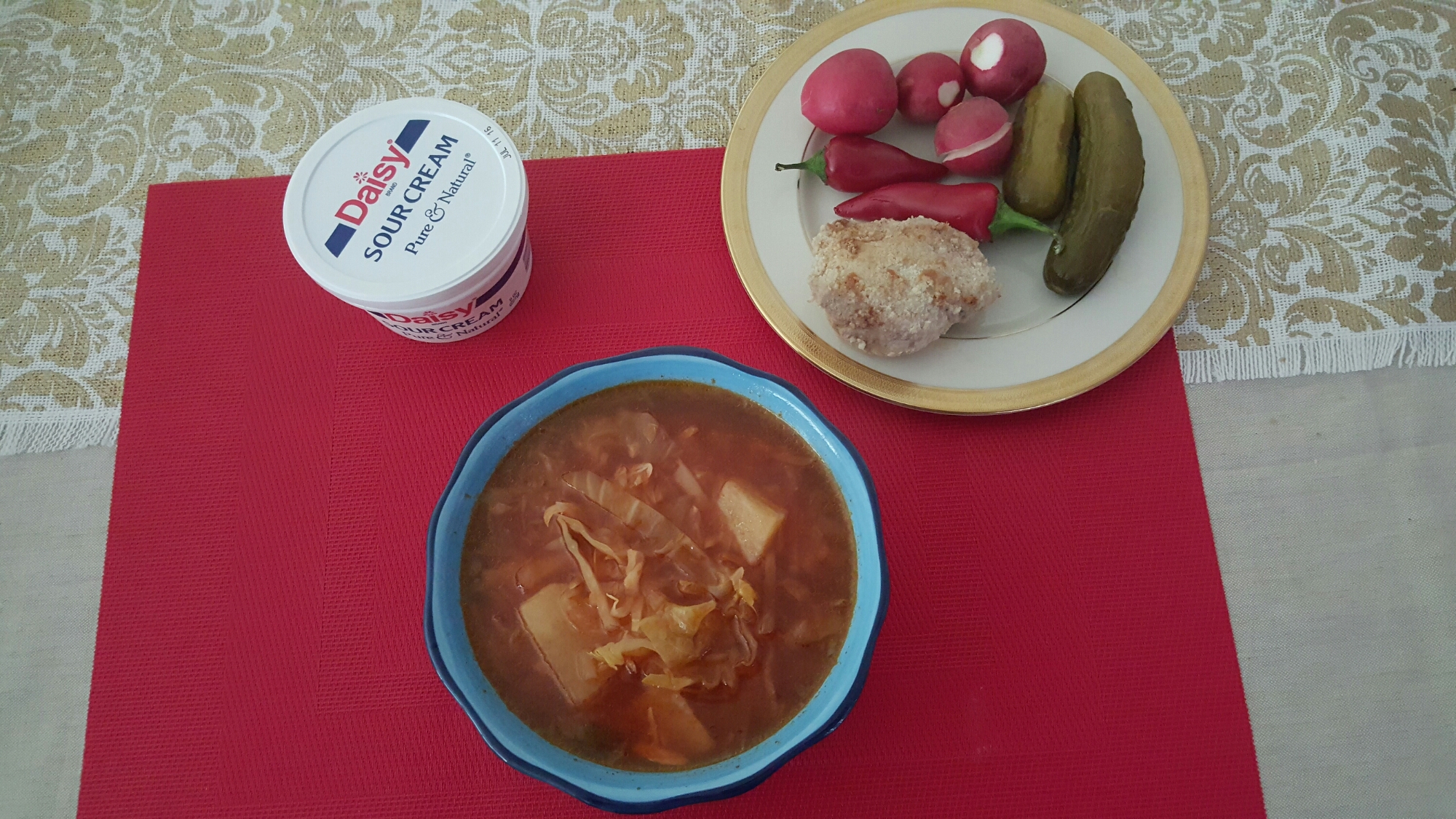
One of the differences between Russians and Ukrainians is that the former think borscht is soup while the latter know it’s a philosophy of existence. You can find out a lot about people based on how they make and eat their borscht.
People who come from the Ukrainian countryside, put salo in their borscht. They do hard physical labor, and need to raise the caloric content of borscht because this will be their entire meal. When people move from the countryside to a city, they drop salo from their borscht.
Ukrainians who are poor and whose borscht ends up being too thin, eat it with a very hot red pepper to mask the lack of flavor.
Russians who are poor use a different money-saving approach. They skip the step of sautéing their vegetables in sunflower oil and just dump them raw into the stock instead. For a Ukrainian, however, it’s unimaginable that borscht can be disrespected this way.
Jewish Ukrainians like to accompany their borscht with a kotleta, instead of a slice of bread.
And I always accompany it with radishes because I’m addicted to radishes and eat them 5 times a day.

 Clarissa's Blog
This should have been done as a personality test, with a bunch of pictures of borscht prepared differently and brief descriptions so that the reader that can pick the borscht they identify with. They could then see how that reflects on their personality.
(Mine would be a toss up between the one with salo or the one with a kotlet)
LikeLike
What a brilliant idea! I should have totally done a personality quiz with this one.
How about something like “Which Soviet dish do you prefer and what that says about your personality”?
LikeLike
It’s not too late to delete this post and redo it as a test, but the Soviet era dish test is also a good idea. Mine might well be chłodnik litewski (Lithuanian cold beet soup although I don’t know if that’s actually served in Lithuania or is just a Polish thing).
I have a great idea for a personality test but I’ve been too busy (read: lazy) to put it together. I’m hoping for the summer since my year is just now entering the super busy season (now until mid June).
LikeLike
I think I’ve seen a cold beet soup once but I never tried it. I don’t get cold soups.
I’d be happy to post your personality test here if you felt like it.
LikeLike
Šaltibarščiai is definitely a thing in Lithuania. I don’t particularly like the taste, but the purple-green colour palette on that dish is certainly striking. I’ve mostly seen it being eaten as a light summer snack or as part of a course of other things in a garden party. It definitely feels too light to be a full mean on its own.
LikeLike
“And I always accompany it with radishes because I’m addicted to radishes and eat them 5 times a day.”
Have you ever had Mooli (radish in Hindi) paratha in an Indian restaurant? It’s flatbread stuffed with grated radish and is the most divine thing ever.
LikeLike
No, they don’t serve it at our Indian restaurant. But it sounds like something I’d love. I’ll be on the lookout for it when I travel!
LikeLike
Have you read Anya von Bremzen’s book “Mastering the Art of Soviet Cooking”? It’s a unique combination of personal memoir and USSR history brought into focus through foods,recipes and decade-by-decade characteristic meals from the author’s and her mother’s lives. (And it doesn’t hurt that the author is stylish writer and interesting storyteller. And knows a lot about food, too.)
Here’s the link to the NYT review, if you’re interested: http://www.nytimes.com/2013/09/15/books/review/mastering-the-art-of-soviet-cooking-by-anya-von-bremzen.html?_r=0
I’d be curious to know what you think of it.
LikeLike