This kind of thing makes me want to stick my index fingers into my ears and scream, “Go away, go away, go away!”
Seriously, ef off far far away from us with your bleating, stupid political correctness. How does it occur to anybody to choose precisely this moment to use us to virtue signal?

 Clarissa's Blog
I kind of love it, in the sense of it being amusing to see something so deeply slow in all senses of the word trying to keep up with the world.
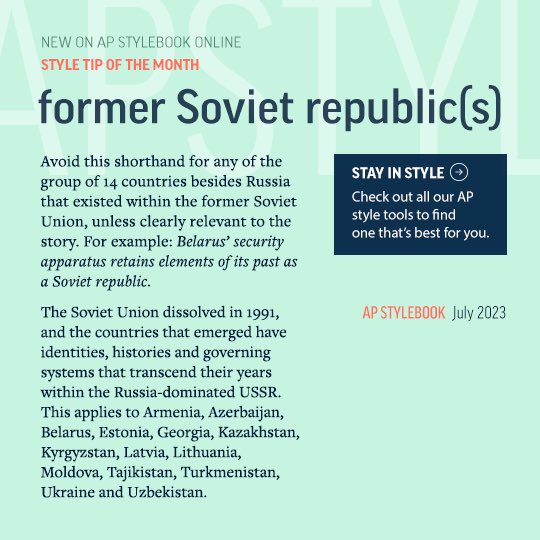
There’s just so many layers to it, too. The whole “don’t think about purple elephants” schtick where you’re told not to use specific words, but the way the humble guidelines are structured means you still need to keep the concept in mind. When you name these 14 countries, be sure to exclude the only relevant context in which you’d name these 14 countries together. Great!
Then there’s the whole “identities, histories and systems transcending” bit which is primarily a sign that the writer wants to learn fuck all about what they’re describing but still want to fit in polite society.
The magical thinking of the most important thing being english-speakers being careful around the words they intone, lest their careless incantations summon the wrong beasts.
The factual level of being post-soviet being pretty damned important on any level you’d care to mention, and something we had and still have to grapple with.
And the little deniable smattering of doublespeak, “we can’t mention the Soviet Union in a positive sense right now, best hush about it altogether. Just be patient!”
It’s like seeing a doddery old man who thinks he’s a wizard trying to be oh so sly. Very, very difficult to choose between mirth and concern.
LikeLiked by 1 person
There’s nobody except for a fellow ex-Soviet who’d get every facet of the deep, abiding lunacy of all this.
This is the typical liberal trick of wishing bad things away (and good ones into existence) through word play. They have the strangest relationship with language. Somebody ought to study it. I have no doubt many interesting things would be revealed.
LikeLike
“They have the strangest relationship with language. Somebody ought to study it.”
It’s a form of arrested development.
Make-belief wordplay is typical of early childhood, when the child hasn’t yet achieved a fully developed concept of cause and effect but already has a certain grasp of conversational implicatures inherent in everyday language use.
While still hazy in the child’s mind, this is sufficiently clear to give him the opportunity to recreate it in his smaller-world existence: “Let’s play kings and queens! I am the king, now I am getting off my horse, you take my mantle and you my sword…” Children can go on like this for hours, and this game feels no less real to the child for being made up.
Likewise, in this form of magical thinking, not saying something makes it go away: the child thinks that if he doesn’t tell mum that he broke the jam jar, the jam jar is not really broken, regardless of any evidence to the contrary.
Adults thinking that one can simply wish reality into existence by uttering some magic words are both infantile and tyrannical: the power they hold over the rest of society relies on other people pandering to their fantasies. Such power, however, is real enough if – and as long as – people let them get away with it instead of shouting that the emperor has no clothes on.
LikeLike