Low birth rates in developed countries aren’t about contraception, abortion or feminism. They are about a completely new subjectivity, a new way of understanding the concept of a human being that was born with the Enlightenment and became consolidated throughout the 19th century. The very concept of a child as we understand it today was invented fairly recently in historical terms and has not been adopted worldwide. We don’t, for example, have our children crawl across the US border on their own. Our concept of a child is different. You can’t be a parent like I am or anybody on this blog is to 12 children. You expect to build a relationship with a child. It’s not a fact of nature, it’s an individual. It’s a miraculous, complex human being that you need to nourish in many more ways than food. When there’s no possibility of quality because that thought doesn’t even occur, quantity becomes the norm.
My friend from Africa is one of 13 children. Her husband, one of 11. In the US, they have 3, and she says all the time that it’s a completely different kind of motherhood and these are completely different children. You can’t relate to them like you would in Africa. You can’t push them out and forget they exist. My friend’s mother doesn’t know that she had her third kid in May. I asked if they had a fight but the friend stared at me in confusion. There was no fight. But with 13 kids, the mom doesn’t really care about one more grandchild. She’s never seen any of the 3 kids, and she lives in Canada. It’s a different way of being.

 Clarissa's Blog
There are some ideas so stupid & repulsive only an Academic would believe them.
Yes. There are cultures that treat children (and other human beings) as disposable things. And yes, both Christendom and the newborn United States (see De Toqueville) had novel ideas about love and family affection.
And neither is a function of the size of the family.
LikeLike
I really wish people chose another place to pout.
LikeLike
You’re good.
LikeLike
“neither is a function of the size of the family”
Intractable group differences are intolerable for the neoliberal mind…. everyone’s a unique snowflake and genetic and cultural differences are trivial and easily dealt with through the correct social programs… (more consumption).
LikeLiked by 1 person
People feel extreme anxiety at the idea that they aren’t completely the product of their own free will. And absolutely, it’s the neoliberal way of thinking that can’t tolerate the fact that you are part of something that you haven’t chosen.
LikeLike
Everybody is obviously a product of the society they grew up in. The question is what you do about it.
The extreme libertarianism of Ayn Rand was a rejection of communism. In SA libertarianism is mostly a rejection of fascism.
https://www.dailymaverick.co.za/opinionista/2013-12-10-my-old-south-african-flag/
LikeLike
I dunno. My grandmother was one of eleven– all eleven turned out to be good, responsible, hardworking, good-humored people whom I loved (two still alive). They all spoke reverentially of their mother, and the grandkids, my mother’s generation, also held her in high esteem. Among the 8 girls, the consensus was that spending time with “Mother” was incredibly rewarding, and they all, in their own ways, cultivated some of her interests and actively pursued her daily chores with her, deliberately and enthusiastically, so that they could spend more time with her, as she was quite busy. In this way, three of my aunts took up fishing, two became avid gardeners, several were talented seamstresses, and all of them kept immaculate homes. Because Mother was busy, but if you could keep up with her weeding the rows or scaling the fish, or wanted to learn crochet (no idea how she found the time, but the woman made lace tablecloths), you had her time and attention.
I mean, there may be something to what you say, but… I have doubts, and I think there must be a lot of other things playing into it. Extended family. Siblings. Everybody working out there somewhere, where the kids can’t tag along. Kids being raised by schools and daycares. Just not at all sure that family size is the primary thing, you know? And with cranky parents… I can’t imagine how awful it would’ve been if I’d been a lonely only. Siblings are one of the good things in life, even when it’s a foxhole friendship!
LikeLiked by 1 person
Cost of living is also a factor. People are having the number of kids they can afford.
LikeLike
Not in Africa. It’s the poorest countries that have the highest birth rates.
The idea that a child needs things, and it’s the parents’ obligation to provide those things is precisely the product of that massive change that the West experienced and the non-West did not.
LikeLike
I’m pretty sure Asian tiger parents aren’t a product of Western culture.
LikeLike
They are a product of the one-child policy in China. They don’t see their children as individuals. They see them as objects to optimize and then extract value.
LikeLike
That’s complete BS.
The number of kids people think they can “afford” is hugely dependent on the lifestyle standards to which they are accustomed.
That’s a game for middle-class people, who forgo having a third, or fourth kid because “then we’d be minivan people, and I just can’t imagine being minivan people”. People who can’t imagine making kids share a bedroom (or a bathroom!), and so think that they’d somehow have to afford a larger house if they had another one. People who actually believe the “each kid costs eleventy zillion dollars!” cant, because they honestly can’t imagine any kind of household thrift.
There is, of course, the “we’ll never be able to retire!”
But the thing is, we’ll never be able to retire anyway, kids or no. And that, weirdly, makes us more able to afford kids than people with three times our income. It’s only at higher tax brackets that kids become a luxury item you can’t afford. At lower brackets, they’re what makes life meaningful, gives purpose, and will enliven your old age (whereas if we did the “financially responsible” thing and never had any, we could just die poor and alone! Awesome!).
LikeLiked by 2 people
For our subconscious, money is the equivalent of energy. When people say they can’t afford to have children, what they are really saying is they don’t have the inner resources. Money is never the real explanation.
LikeLiked by 2 people
That certainly makes more sense.
I have a hard time decoding that one, when people who live in swank suburbs with 2 kids are like “oh, we couldn’t possibly afford another one!” It’s like talking to a completely normal person and then they say that… and they may as well have just started talking about elves in the garden, or how Santa wasn’t coming this year because they’d had to cap the chimney, or “the Jooz” are responsible for all the world’s ills. Like, ok, now we’re going on a visit to crazy-town. Huh. Didn’t see that coming, not sure how to respond…
Here on out, I will try translating that into “I’m mentally and emotionally overstretched with the kids I’ve got, and can’t take any more” and see if it works better.
LikeLike
“they’re what makes life meaningful, gives purpose, and will enliven your old age” is selfish and is about extracting maximum value from kids. It’s not about them, it’s about you.
LikeLike
“They are about a completely new subjectivity …”
The r-selection vs K-selection difference is still a thing, and it’s far from new, even if it’s the tip of a stereotype that acts as a surface phenomenon to describe a system of interrelated things.
Being the youngest separated from your numerous siblings by over a decade means you grow up with K-selection whereas your siblings grow up with r-selection, even if it’s ever so slight, which in a lot of cases it truly isn’t.
It means you grow up with attention that’s in excess of what they experienced, or so they believe.
In reality, it means that you are probably the linch pin for saving your father’s horrible marriage to your mother, because why else might someone have a child that late for what could be completely manipulative reasons?
Phrases to watch for: “our special late child”, “bonus baby”, etc.
These phrases are then used to hide the fact that while it looks like you get a lot of attention, you don’t get many resources, especially since the parents have eaten the seed corn before you came along, believing for a number of years that child rearing was in fact over.
These kinds of parents make up for it by being over-involved in everything, and you get used to having to find spaces away from them where you can live an independent life. The first to kick you when you’re down, the first to own your successes by proxy when you are fighting to get out of “the foxhole” as methylethyl described it.
Nota bene: this is me trying to describe somewhat distasteful aspects of my situation without creating some kind of bullshit “pity factory” for it.
“Cranky parents”?
Ah, consider yourself lucky if that’s all you had to deal with, there are much worse Hells than these.
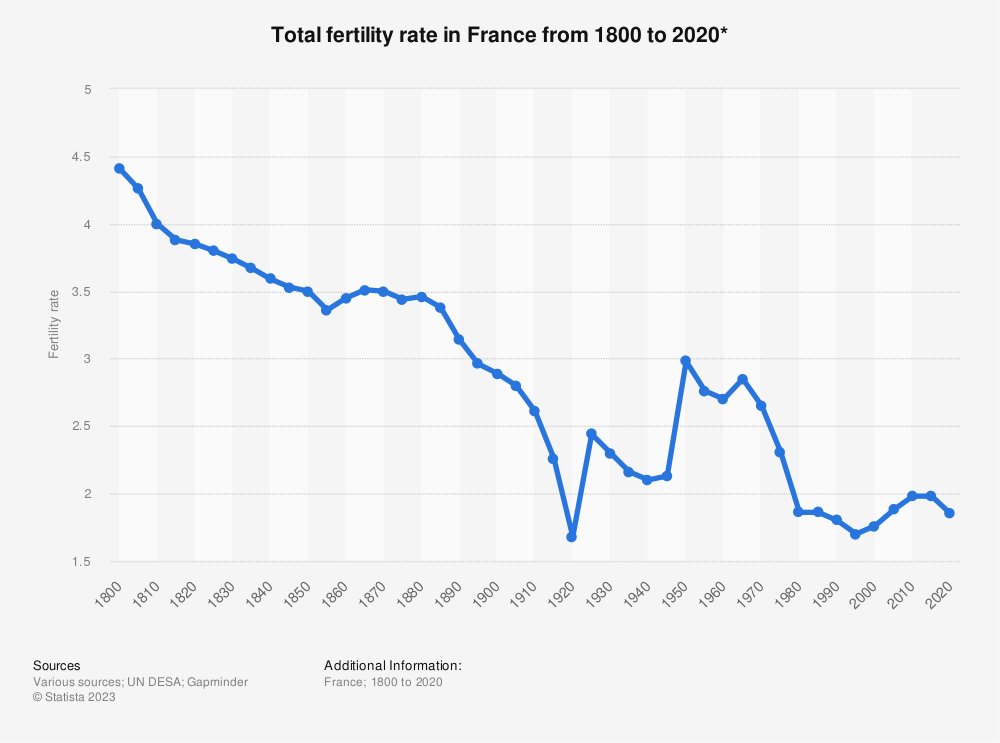
So what that chart of French birth rates leads to is that as a population shifts from being K-selected to r-selected, it stops embodying the things that it represented, it stops having the common culture with interwoven branches that it had, and more importantly it stops being the named thing that it professed to be, because it is no longer self-supporting or self-perpetuating.
And so this is numerical evidence of the fact that France will eventually cease to be France.
Israel, paying attention?
Gaza, West Bank, Palestine in general, paying attention?
You’ll all have to sort this out unless you’d like to cease to be the things that you claim to be.
While Clarissa is right that it isn’t necessarily one thing, as in it isn’t feminism qua feminism and so forth, it’s an interrelated system of things that work together to pull stereotypical K-selection into a more or less bog standard r-selection.
That persists until the system snaps, reconfigures itself rapidly around a hastily imposed K-selection due to the arrival of long-postponed constraints, and then everyone living off the “seed corn” gets it good and hard.
Where I agree with economist Martin Armstrong is that people in “the humanities” and “social sciences” as well as those in somewhat specialist branches of science and engineering fail to look at economic cycles or “business cycles”, and so the inevitable shifts from r-selection to K-selection are ignored as unwelcome realities by people who don’t want to admit the existence of economic drivers.
So we have some pouting about distasteful realities?
Try this on for size: genocide is part of a fractured long-term economic cycle, has always been a part of it, and the sooner people stop trying to avoid this reality, alternate economic cycles may emerge to avoid seemingly unwelcome developments of economic existence.
When K-selection sweeps out r-selection, it typically does it with such things as cordons sanitaires, believing the r-selected to be a function of an illness within society, then dealing with it in terms of weaponised medicine.
Heard this distasteful flavour of rhetoric lately?
There’s really no limit to the cruelty that humanity can imagine, so try this on anyway.
LikeLike
“cranky”– My siblings and I all agree that our childhood was not idyllic. But also that it is not worth complaining about, and nothing to feel sorry for, as we have all known people who had it much, much worse. In the end, we turned out mostly OK, and benefitted hugely from having each other, and the massive and amazing backstop of a large (and local!) extended family, friends, and neighbors who gave us templates of harmonious family life not available to us at home. We all had one or more very kind “surrogate families” that we insinuated ourselves into, growing up. Yes, there are much worse hells than these.
I worry that in an environment where large families are actively discouraged– my MIL gives the stink-eye to anybody having a third-or-better kid, and she’s pretty typical of the PMC species, I think– we lose this. We lose all those things that made my own childhood bearable in spite of a subpar home situation. We had, very nearly, a clan (I know that’s a banned word, but most of my people came from the English borderlands so it does apply) to belong to. Nuclear family is great, but not in isolation! It grieves me that our family reunion attendance has dwindled over the years.
My husband comes from what you’d call a K-selection environment, and has basically no extended family, no contact with adult siblings, no aunts and uncles to speak of. He’s miffed by our culture of family obligations, visiting, frequent contact, and mutual economic benefit, though he at least understands the economic part– without understanding how it is tied to the rest.
The “Small Nuclear Family” model is just one step removed from the neoliberal ideal of total atomization, and it is lonely, fragile, and in every way except income per capita, desperately impoverished. Nobody who has ever belonged to a functional clan would ever choose this voluntarily. It’s understandable for people who come from dysfunctional kin networks– sometimes you just need to escape, whatever the cost– but that doesn’t make it good.
LikeLiked by 2 people
In an actual clan, you don’t become an adult until the previous generations die. You don’t really have the authority over your own children. I’m not saying it’s your situation in the least but it’s absolutely the situation in pre-nuclear-family societies.
The only model in which parents have the final say over the children, and grandparents don’t meddle is the nuclear family model. I’m the first generation in my family that’s doing the nuclear model, and God, what a relief. My mother didn’t breastfeed me because her mother didn’t approve for reasons we’ll never know. My parents once bought a trash basket (with their own money) without getting the other grandma’s permission. It’s been 40+ years, and I haven’t forgotten what happened next. In return, the older generations were always there, bringing food, organizing housing, spending tons of time with me. It’s convenient, for sure. But you become this stunted person with no privacy, no decision capacity. I’ve never been humiliated in front of my child like my parents were in front of me. And that already makes my model vastly superior.
The traditional clan structure has the function of preventing strong bonding between parents and child. Strong bonding automatically goes to “quality over quantity” and that doesn’t exist in ant-heap societies. But then, one can’t feel humiliated as an individual because one isn’t an individual like we understand it.
LikeLiked by 2 people
Perhaps clan is the wrong word– we throw that word around amongst ourselves, because “kin network” is an awkward, lumbering sort of phrase. But it’s a thing– when my mother meets someone new, who’s in any way “from around here” the very first thing she has to establish is “who you’re kin to”– they will then sit down and spend ten minutes figuring out how they’re related, and/or what acquaintances they have in common, so my mother can mentally place them within the massive genealogical/social map she carries around in her head. It’s how she, and pretty much all her generation, orient themselves. It used to be a small town.
I 100% understand escaping dysfunctional kin networks. I just happened to come from one where my parents were the black sheep of the family, and everybody else was surprisingly well-adjusted, so for me it worked kind of in the inverse. When things got too claustrophopic at home, we’d walk the three blocks to the home of my grandmother’s sister and her husband, genial old folks whose only child had died before I was born, and who always had time and cookies for us. They were the best. Six blocks the other direction, another aunt– eccentric, hilarious, and as everybody termed it “a hoot”– was also usually home and good for a visit, and lived right by the library too, so that was a twofer. A third aunt lived right next to my school, and I spent a lot of afternoons with her, pruning the roses and weeding the flowerbeds and chatting. They were a beautiful, undeserved gift– may their memories be eternal. My grandmother lived pretty far away, but I’d spend a few weeks with her each summer, and she taught me to sew, embroider, crochet, and propagate exotic plants.
Whatever that sort of network is called, it was never autocratic– the older generations exercised no authority over the younger. It was more of a mutual-assistance club. If you needed job references, a washing machine, a contractor, a babysitter, or a used car… you tapped the family network first, and more often than not, they’d come through for you. Whatever my parents’ faults, the larger family group did not hold them against us, the kids, and were always willing to give us a fair shake. It was nice.
LikeLiked by 1 person
“The “Small Nuclear Family” model is just one step removed from the neoliberal ideal of total atomization”
It’s a model that’s extremely rare in pre-industrial societies (I had one old textbook that referred to it as the ‘Eskimo’ family because they were among the very few examples found. When people talk about ‘family values’ in terms of the nuclear family it’s kind of funny because that doesn’t represent traditional families but rather their breakdown and it’s an inherently unstable model that tends to break down further.
That said, the hardcore clan model has its drawbacks too, one is never free from an endless cycle of obligations and one’s place is determined by immutable factors like birth order. It’s protection against poverty and simultaneously a guarantor of further never ending poverty.
There are more or less happy mediums, like an extended family maintaining separate autonomous households who aren’t all up in each others’ business 24/7 and with limited senior privilege (or you get what Clarissa describes of tyrannical elders micro-managing adults and treating them like foolish infants).
There’s no free lunch ever in any kind of system and that includes family structure.
LikeLiked by 1 person
This is true. It flusters my husband that he can come home from work, and find my parents at our house for dinner (they live two hours away) without any notice. “Don’t you guys ever plan anything?!” Well, yeah, they called three hours ago and asked if it was a good day to visit, and I said sure, so here they are. You were at work. This is still an improvement on when we lived in the same town and they didn’t call first 😉 But I had worked out a system where I kept spare pre-cooked chicken and pork chops in the freezer just for when Dad dropped in without warning, and I could pop them in the oven and have dinner in twenty minutes. I think all he wanted was a home-cooked meal anyway.
I don’t begrudge it, because they let us live in the family fishing cabin rent-free for years, while we were getting on our feet financially. Mutual obligation. My mother used to be very bad about trying to micromanage us, but we’ve patiently trained her out of the worst of that– it was a group effort amongst siblings. She will take no for an answer, if it’s delivered firmly. It took me a long time to figure out how to do that.
It is easy to see how that whole arrangement could go very very badly, were the personalities and circumstances different– at heart, everyone involved is basically honest. I think we’ve negotiated something that works imperfectly, but well enough, for all of us. It requires active maintenance to keep it going– nothing about it is automatic. On the balance, we are all financially better off for it.
I have known families where the mutual obligation was quite oppressive, and dragged everyone down– where everybody puts themselves in hock to pay Jimbo’s bail, and there’s constant tension because you can’t say “no” when a relative gets evicted and needs to come live in your house, with their kids and dogs, for an indefinite amount of time. It’s not a magic solution to all ills. When it works well, it works great. When it works poorly… it’s hell and you’re better off without.
LikeLiked by 1 person
“I have known families where the mutual obligation was quite oppressive, and dragged everyone down– where everybody puts themselves in hock to pay Jimbo’s bail, and there’s constant tension because you can’t say “no” when a relative gets evicted and needs to come live in your house, with their kids and dogs, for an indefinite amount of time.”
You’re giving me traumatic flashbacks.
I am so glad I live thousands of miles away from extended family. Growing up, I hated all the people constantly coming and going, and always having to host random relatives, endless obligations toward destructive people just because we’re related.
My father ended up transferring his apartment to me (I was already overseas, so this was of no consequence to me) to avoid his family pressuring him to sell it so he’d pay off the debts of his idiot brother who’d borrowed money from some criminals.
Yes, my grandma provided free childcare for the benefit of my mother and father, but my mother was never allowed to grow up and was under her mother’s thumb throughout my childhood. The incessant meddling of my grandparents contributed to the dissolution of my parents’ marriage.
I’m a big fan of not having to answer to anyone and being self-sufficient. It’s priceless. The solitude is a bonus.
LikeLiked by 2 people
“incessant meddling of my grandparents contributed to the dissolution of my parents’ marriage”
Very common pattern in Poland, I’ve known of lots of young marriages that fall apart because the parents would not let them solve their own problems and instead tried to micro-manage everything and jumped into the middle of every newlywed argument which just made everything worse….
LikeLiked by 3 people
The main battlefield in these families is the raising of the children. The parents are constantly downgraded and disrespected in front of their children. My paternal grandmother, for instance, would announce that I was a good girl, so I deserved dinner but my mother misbehaved, so she was punished and would get no dinner. Seeing my own mother as a figure of authority after that was out of the question. But Grandma herself was treated exactly like this by the great-grandma. Grandma died long before her mom did, so she never got a chance to be an adult. Never. In her whole life. I can’t imagine living like this.
LikeLiked by 1 person
“main battlefield in these families is the raising of the children. The parents are constantly downgraded and disrespected in front of their children”
In Poland, if the marriage lasts up to the point of children the parents usually back off…. maybe because there’s not a huge amount of dissenting ideas about raising children maybe because of stigma around divorcing with kids…. but in most families the grandparents don’t have the same authority with children as do their parents and can’t exercise absolute authority over adult children with their own children. They’re still supposed to be respected but it’s a subordinate role.
A pattern that happens fairly frequently is that during adolescence the grandparents are sort of a safe harbor during conflicts with parents. They can’t override parental decisions but they sometimes try to intercede on the grandchildren’s behalf (the idea of interceding on behalf of someone is very deeply ingrained here… most people aren’t that religious but catholic practices soak through every sphere of life).
LikeLike
“In an actual clan”
Apropos of nothing in particular, my family had contacts with some circus families (very close contact with one and a bit more superficial contact with a few others).
Circus families are something else… probably closer to a medieval guild than anything most here would recognize as family. The senior (performing) member, usually a man but sometimes a woman has more or less absolute control over vast areas of everybody else’s life. Papa’s (or Mama’s) word is absolute law not only over children and grandchildren but even siblings and their children.
LikeLiked by 1 person