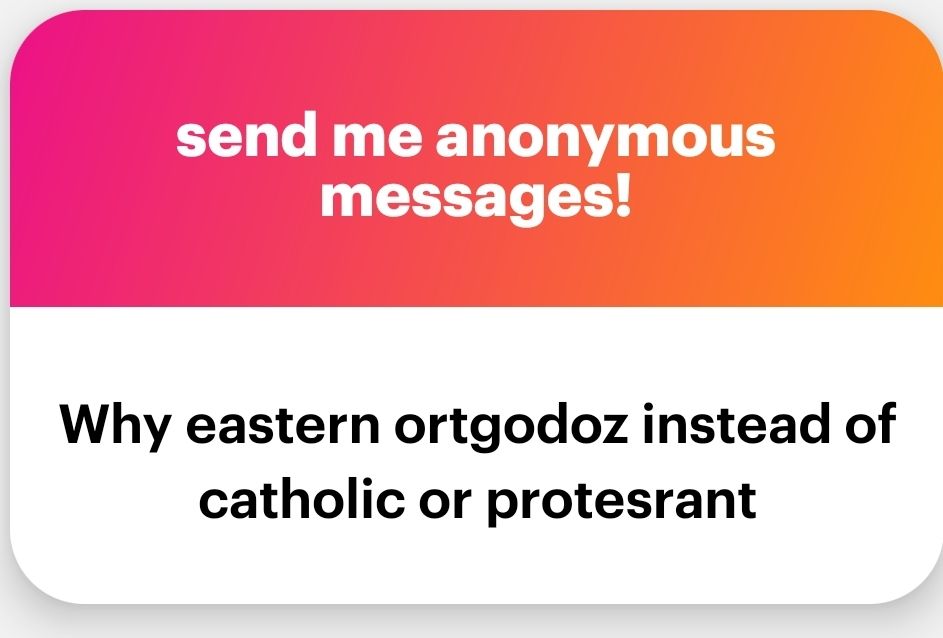
This is an excellent question.
Religion is about history and memory to an enormous extent. You need to go into a house of worship and feel connected to your great-great-grandmother who stood in the same kind of church and listened to the exact same service. Otherwise, you lose a gigantic part of what it’s supposed to be.
In American Orthodox churches the pews and the bright lights keep throwing me off because they are a nod to the ubiquitous Protestantism and not natural to how we practice Orthodoxy. But when I close my eyes, it’s like I’ve been hearing this same chant for hundreds of years. I feel connected to generations upon generations of my family. I feel their presence in myself.
I attended Catholic mass several times as part of learning about the Spanish culture. I attend Lutheran services regularly because my kid’s in a Lutheran school. I like them. They are all very nice. But I don’t feel anything in particular. In an Orthodox church, especially a real one without the blasted rows of pews, I feel everything.
And I don’t even need to be inside to feel it. During COVID lockdowns, I prowled around the church building because even just seeing the architecture plugs me in big time.

 Clarissa's Blog
I’ve heard a lot of people’s “why Orthodox?” explanations, but that a new one on me!
LikeLike
This is such an important point. I wonder how people who convert to another religion later in life feel. Can they even have the same connection to god as their ancestors?
Somewhat related. My mother passed away in 2019. There was so much pain inside me that I thought I would die. The only thing that helped me survive was going through the rituals of the funeral. Even though I was a person without religion, just chanting some verses that the priest instructed me, in a language that I did not know (Sanskrit), and following every little instruction to the letter gave me a sense of peace that I thought I could never feel. It was unreal. And for the first time in my life I realized the value of religion and customs. I remember walking away from the funeral pyre with my dad and brother, and in the ride back home for the first time we had a normal conversation, we even cracked a silly joke and laughed about it, when even 2 hours ago I felt that I would kill myself because I couldn’t deal with my pain.
And when I returned to the US, my (well-intentioned) MSNBC-watching lib professor neighbor suggested that I look into mexican grieving rituals (“I hear they’re good”), as if it’s a commodity to be purchased, and not something that it intrinsically tied to your culture, history, and past. I was amazed at this person. The perfect neoliberal subject who can install any software in their brain at any moment to deal with any problem. I was almost envious of her lol.
LikeLiked by 2 people
FWIW I converted to Orthodoxy 15+ years ago, in my late twenties. I have no ancestral connection to it at all– my people are protestants going way back.
It may be a necessary thing for our generous host, but that’s not universal.
LikeLiked by 3 people
Honestly, with the state of Protestantism and Catholicism, I wouldn’t blame anybody for converting. My priest converted, too. And so did the Popadia.
Orthodoxy can go the same way if we aren’t careful. The large Greek church in the city has welcomed its new priest straight from Greece. Everybody was very excited until the priest started talking about how the church needs to go where the people are, not being too demanding, not placing heavy burdens on parishioners because “kindness is more important than liturgy.” Now the poor parishioners don’t know if he’ll wrap himself in a rainbow flag or bring a guitar to service. He’s new to the US and probably doesn’t know that people who are looking for fun, short, undemanding service already have dozens of denominations to choose from.
LikeLiked by 1 person
The best kept secret of the Catholicism is the Traditional Latin Mass, suppressed since Vatican II. It did survive. We discovered it during the Covid and make an effort to go every week even if we have to drive an hour to get there. I highly recommend it when you get a chance. Some options are within the diocesan structure, some outside of it (SSPX), totally worth the effort. After I understood what Vatican II has done to the Catholicism I felt cheated. I know that some people in that situation convert to Orthodox, some find a Eastern Catholic rite parish and some find a Latin Mass community.
LikeLiked by 1 person
My dad is a born-again catholic. He solves the problem of modernist meddling by attending an asian immigrant parish. Says if the bishops don’t speak the language, they leave the parish alone.
LikeLiked by 2 people
That’s very ingenious.
The idea that people will flock to more permissive churches has been proven false time and again. Yet it refuses to die.
LikeLiked by 1 person
What’s interesting is that he’s been the only roundeye in the parish for most of my life. But in the last couple of years, suddenly there are several others who’ve trickled in from the more liberal surrounding parishes, because they like how liturgically conservative it is. I hope this doesn’t bring them added scrutiny.
LikeLiked by 2 people
Following the instructions of the ritual is hugely important and brings great peace. It’s giving yourself over to something bigger than yourself, something that was settled long before you came along. When I first started going to church, I felt this huge sense of relief that this was something big that I didn’t have to decide or reason out.
Religious rituals around death have been devised through centuries to give relief to the living. And you are right, you don’t even need to understand them to find solace in them.
LikeLiked by 1 person
I’ve had conversations about that so many times recently, I now have an elevator pitch for it, talking to non-religious people.
Nothing cultural survives for thousands of years without serving a useful functional purpose. Cultural transmission has limited bandwidth, particularly before writing, before mass printing ability. Anything not essential gets jettisoned over that timespan. So no matter how you think about religion, or what you do or don’t believe, you can’t reasonably just discard stuff that humans have successfully, conscientiously transmitted down the generations for eons. If you don’t understand it, you need to be asking: why is this so important that it gets passed down even through spans of time where technology gets lost. It means the tech was *less* important to people’s survival than the rituals. That has some implications.
LikeLiked by 1 person
“Cultural transmission has limited bandwidth… Anything not essential gets jettisoned”
I mostly agree but on the other hand, it’s often necessary for the real purpose to be hidden from conscious awareness….
So we openly say that rituals about death are about the departed while in actually they’re for the survivors.
We openly say marriage is about uniting a couple in the eyes of God while in reality it’s about tying the people down in the community so they don’t do a runner the first time they get bored.
etc etc
LikeLiked by 1 person
I can see where it’d look that way to an essentially materialist person.
But I’m religious, and frankly I’ve been haunted a bit by a dead relative, so I’m 100% onboard that rituals surrounding death are beneficial to both the living and the dead– as our ancestors have pretty much always asserted. Going by the occasional contacts, I think the relative in question is a bit lost, and could use some help, but also since all this, the Asian notion of the hungry dead makes total sense to me. The dead need help on their way, we need help to grieve, process, and keep going, and also we sometimes need to protect ourselves from the dead. All of those things at once. Death rituals do all those things.
Marriage: there’s no reason it can’t be both. Yes, we do need ways to nail people down into contributing members of the community instead of sexual loose cannons, freeloaders, and deserters. But *also* we are given to each other for our mutual salvation. *And* there is a transcendant element possible in the marital relationship that I think probably is largely missing from more casual relationships.
That’s the thing: Stuff that gets preserved is mostly (always?) serving multiple purposes. It’s efficient that way.
LikeLike
“it’d look that way to an essentially materialist person”
I’m not nearly as materialistic as the post may make it look, and my words were not the best, I meant more something “also” (just that one reason is more overt and talked about while the other reasons are less overt partly because talking about them is awkward,,,, not quite the right word but close enough.)
“haunted a bit by a dead relative … the relative in question is a bit lost, and could use some help”
Yeah I’ve heard of similar cases and I hope that things work out for both of you and the relative can get to where they should be (or get headed in the right direction).
LikeLiked by 2 people
I dunno. It’s possible that’s correct, but my soul rebels against it. I’m a profoundly honest person, and I hate the idea of truth being hidden from us for our own supposed good.
That doesn’t make my inclinations correct.
LikeLike
My little nephew said that on Sunday, which was the anniversary of his grandpa’s death, grandpa sat next to him on a long train ride. One wants to think he’s inventing this but he did look like he was in a state of grace after the experience.
LikeLiked by 1 person
I have noticed that non-religious people really like to teach one how to be a correct Christian. “What kind of a Christian are you if you are afraid of death?” is a question I’ve been asked repeatedly. One would think that the fact of having a small child is answer enough but apparently not.
LikeLiked by 1 person
It’s not that they want you to be a better Christian. It’s just that they want to show how superior they are. A cheap dunking game.
We wish each other “many years” because we want everyone to have as long as possible to repent of their sins, before they face the final judgement. It is a drastic misreading of Christianity that “being saved” means you should be facing eternity without the appropriate fear and trembling. Common enough among “I got saved yesterday” protestants. But not, you know, what the church fathers advise.
LikeLike
Once upon a time, a wandering Zen Buddhist scholar drove his car into a California town where he met a visiting Rinzai Zen abbot of a Zen temple in Japan.
That abbot came to America to try to find a replacement abbot …
… long story shortened, I refused the abbot’s offer, but helped create a solution.
The prefectural government created a programme to save old Zen temples and Shinto shrines, and so with the passing of the abbot, having found no replacement, the temple grounds fell under the jurisdiction of an agency tasked with their upkeep.
Visitors fees offset some of the costs paid by this programme, and small gift shops run by older ladies in the communities helps with a lot of the rest.
Nearby foot traffic at dense urban scales tends to help.
If you think Rinzai Zen abbot life is for you, become a Zen monk first, then find a temple lacking an abbot.
Maybe you’ll find the one I said no to.
“Can they even have the same connection to god as their ancestors?”
Can a Western Buddhist help save Japanese Buddhist temples?
Would you believe I started out as Society of Friends, aka the Quakers?
But I never felt connected to them.
LikeLike
“I hate the idea of truth being hidden from us for our own supposed good”
Theory I’ve read: Supposedly dreams are about sorting information from the day and deciding what to put into longer term memory. They look the way they do because the mind uses associations and not language to store information.
But… there’s a ‘head nanny’ that prevents unpleasantness from unpleasant associations by adding a layer of associations that don’t make conscious sense. A person can get at their own private language of associations (and dreams start to make more sense then) but it can be surprising. One person found that a particular color seemed to be her brain’s way of handling memories about a person (the relationship was… not good).
For another a plant or object that seems out of place in our daily reality might be the head nanny’s way of letting you process the information in your dreams in peace.
It’s not tremendously far-fetched to imagine collective forms of this…
LikeLike
Seems plausible.
There’s definitely a lot of practical truth that we can’t really get at, except through metaphor and symbol.
But I’m not sure how or whether to apply that on the collective cultural level.
LikeLike
… but it still conflicts in my head, with the bulk of my experience: that when truth is hidden from us, it’s very much not for our own good, but so that we can be exploited by people with more information than we have.
LikeLike
I’m probably wrong.
St. Basil has this to say, about proverbs:
“The name proverbs (paroimiai) has been by heathen writers used of common expressions, and of those which are generally used in the streets. Among them a way is called oimos, whence they define a paroimia to be a common expression, which has become trite through vulgar usage, and which it is possible to transfer from a limited number of subjects to many analogous subjects. With Christians the paroimia is a serviceable utterance, conveyed with a certain amount of obscurity, containing an obvious meaning of much utility, and at the same time involving a depth of meaning in its inner sense. Whence the Lord says: These things have I spoken unto you in proverbs, but the time cometh when I shall no more speak unto you in proverbs, but I shall shew you plainly of the Father.”
I must defer to his superior grasp of things 😉
LikeLike
A propos of nothing in particular, I’ve been having horrific nightmares. Awful stuff. Went back to psychoanalysis because I can’t live like that anymore.
LikeLike
” having horrific nightmares”
Your hometown is a prime target of the russian military while “allies” dither and find excuses to not confront russia and Jews are being demonized in the US (and presumably Canada) in a way I once thought wouldn’t be possible.
I’d say nightmares are understandable (it would be weird if you weren’t exhibiting massive stress somehow)
LikeLiked by 1 person
I’m trying to prepare myself for Kharkiv becoming another Mariupol, and I can’t, I can’t. I still haven’t fully accepted that the war is real. My brain isn’t managing to process.
LikeLike