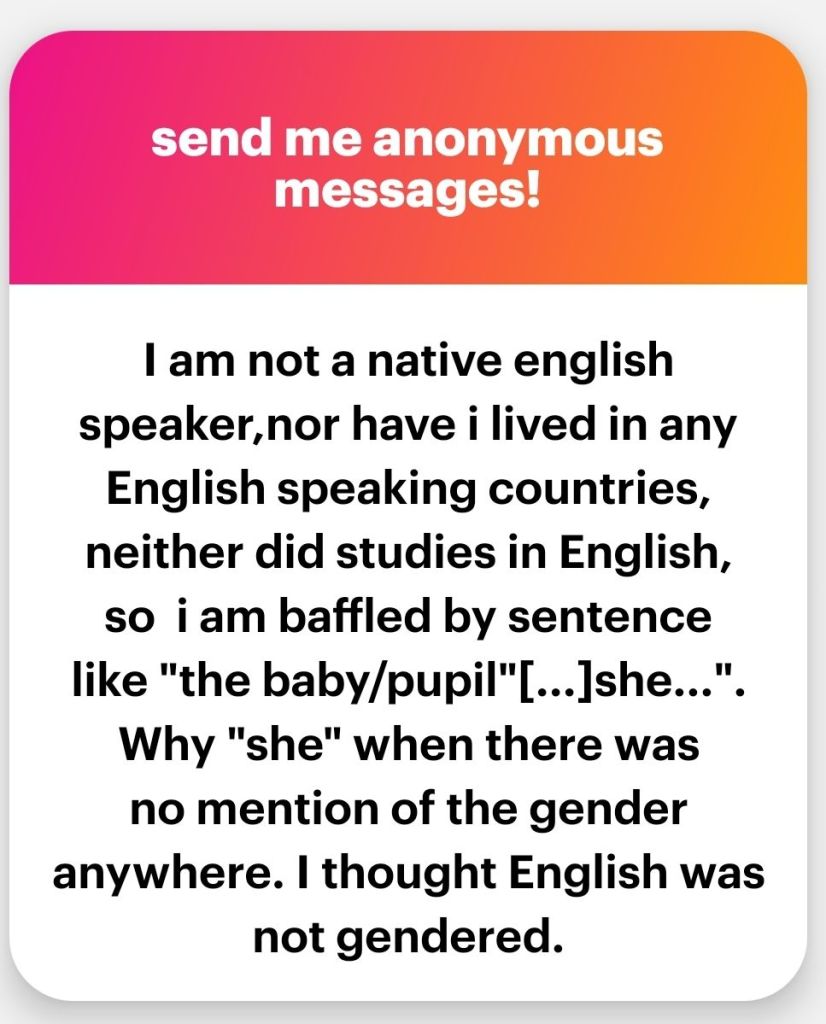
I’d say “it” to refer to a baby but for anybody older you can’t use “it”. If it’s an imaginary person or the sex is not known, you can say “they”. Sometimes, though, that’s confusing because people might think you are talking about a group. In these cases, I randomly use “he” or “she”.

 Clarissa's Blog
“I’d say “it” to refer to a baby”
I would only do that about a hypothetical baby or if I don’t”t know the sex. If I know the sex a baby is he or she.
Rules are very similar for animals, especially pets.
I’ve always used ‘they’ to refer to hypothetical single people or when the sex isn’t known (or occasionally when the sex was known but the person was unknown to me*).
That’s another thing I dislike about the trans/nonbinary agenda — ruining or trying to ruin epicene they.
LikeLiked by 1 person
Yes, “they” now immediately makes one wonder if there’s some “non-binary” weirdness happening.
LikeLike
Old-style standard usage was to use “he” as the default. For some time, some feminists have thus chosen to default to “she,” to redress the balance. Grammatically/historically there is no reason not to use “it.”
I have heard uninformed people insist that “it” can be used only for inanimate objects and that it is insulting to use “it” for humans. However, in Old English as in modern German, and, I believe, other Germanic languages, there were three genders, masculine, feminine, and neuter. Where appropriate, as in modern German “das Mädchen,” a neuter pronoun could be used in Old English to refer to a human. Of course language changes and present-day usage need not be historically informed, but it nonetheless irritates me when people invoke false ‘rules’ about language that could be easily checked in a History of the English Language textbook! Just say “I don’t like using ‘it’ for humans” if that’s the case!
LikeLiked by 1 person
(I will add that I am a native speaker of English, a professor of English, and a teacher of courses on the History of the English Language, as well as having studied Old and Middle English, modern German, and Old Norse.)
LikeLiked by 1 person