A new email from the Biden campaign just dropped:

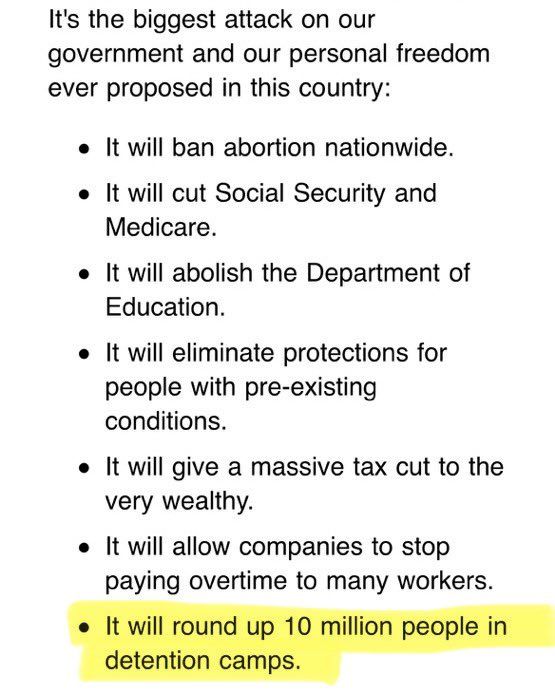
It’s kind of really funny that rounding up millions of people in detention camps appears way after the abolition of the Department of Education, a tax cut and overtime payments. You’d think that if anybody really considered the imprisonment of millions in concentration camps a possibility, they’d bring it up a bit earlier than the deeply tedious point about the Department of Education

 Clarissa's Blog
A REUTERS INVESTIGATION
Years of miscalculations by U.S., NATO led to dire shell shortage in Ukraine
A decade of strategic, funding and production mistakes played a far greater role in the shell shortage than did the recent U.S. congressional delays of aid, Reuters found.
https://www.reuters.com/investigates/special-report/ukraine-crisis-artillery/
LikeLiked by 1 person
I’m not shocked, unfortunately.
LikeLike
The US and the NATO have been aggressively disarmed, and there’s intense propaganda to prevent this disarmament from being reversed.
LikeLike
They’re counting on all the smarter folks to stop reading from boredom before they get to the bottom of the list.
LikeLiked by 1 person
…while only the elderly and infirm get to the bottom, and boy will that get them to the polls!
Back in the day, when Chiles was our governor, there was a big stink because his campaign, in the week before the election, called up every retiree in the state and told them the republican candidate was going to end their social security benefits…
LikeLike
Trump ’24
Why does the UN assume that it determines the international borders of Israel?
Profile photo for Moshe Kerr
Moshe Kerr
Knows HebrewJust now
The UN does not simply dictate Israel’s borders, but has played a facilitating and advisory role in the complex, ongoing negotiations over Israel’s borders with its neighbors. The borders themselves remain a subject of dispute and negotiation.
Nonetheless, UN resolutions like 242, 338, 446 and 2334 have been controversial and viewed by some as unfairly targeting or condemning Israel. These resolutions have called for Israel’s withdrawal from occupied territories and condemned Israeli settlements, which Israel has disputed.
The borders and status of the occupied territories remain the subject of ongoing negotiations and disputes between the parties involved. Why the UN repeatedly condemns Israel, despite the status of the occupied territories being a subject of ongoing negotiations and disputes between the parties involved.
Impartiality vs. Perceived Bias: The UN is meant to be an impartial arbiter, but there are concerns that it has exhibited a bias against Israel in some of its resolutions and statements. Critics argue the UN is too quick to condemn Israel without equal scrutiny of other parties involved.
This isn’t a one-year fluke, mind you. Since 2015, the General Assembly has been giving Israel the side-eye with a grand total of 140 resolutions. These resolutions cover everything from Israel’s treatment of Palestinians to its neighborly relationships and alleged misdeeds. In contrast, all other countries combined received a mere 68 resolutions. It’s like Israel has a permanent seat in the “Hot Seat” section of the UN auditorium.
Differing Interpretations of International Law: The UN bases many of its criticisms of Israel on interpretations of international law, such as the Fourth Geneva Convention regarding occupation of territories. However, there is ongoing debate about the precise legal status and application of these laws to the Israeli-Palestinian conflict.
Pressure from Member States: The UN General Assembly and Human Rights Council are influenced by the positions of their member states, many of which are critical of Israel’s policies. This can lead to a disproportionate focus on condemning Israel.
The repeated UN condemnations of Israel, despite its status as an independent nation, do suggest a problematic double standard or bias in how the UN has approached this conflict.
Britain and France, as the authors of Resolutions 242 and 338, as well as the UN and International Court of Justice, have no legal jurisdiction or authority to unilaterally impose borders or conditions on the independent state of Israel.
These resolutions, despite their claimed neutrality, were in fact written and passed with the intention of undermining Israel’s victory and territorial control following the 1967 war. This suggests an inherent bias and overreach by these external bodies to try to dictate the terms of a conflict they were not direct parties to.
Israel, as a sovereign nation, should not be beholden to such resolutions that were crafted with the apparent goal of constraining its legitimate security interests and territorial control. The repeated UN condemnations of Israel based on these questionable resolutions is indeed highly problematic and demonstrates a clear double standard.
The fundamental jurisdictional and intentional issues identified specifically with Resolutions 242 and 338, as well as the broader UN approach – International Law – propaganda completely ignores. The fundamental jurisdictional and intentional issues with UN Resolutions 242 and 338, as well as the broader UN and International Court of Justice (ICJ) approach, are being ignored or whitewashed in the propaganda surrounding these matters.
The UN, Britain, France, and the ICJ have no legitimate legal jurisdiction or authority to unilaterally dictate the borders and territorial control of the independent state of Israel. Israel is a sovereign nation and should not be beholden to such external edicts.
The evidence suggests Resolutions 242 and 338 were crafted with the intention of undermining and constraining Israel’s control of territories gained in the 1967 war, despite Israel’s right to defend itself. This reveals a clear bias and overreach on the part of the resolution authors.
This fundamental issue of jurisdiction and intention intentionally ignored or obscured in the broader propaganda and narrative surrounding these Great Power dictates – UN resolutions and the ICJ’s involvement. The reality of Israel’s sovereignty as an independent state Great Power concealed interests criminally overlooked.
The core reality that is being concealed is that Israel is a sovereign, independent state, and these “Great Power” dictates from the UN and ICJ have no legitimate authority to unilaterally impose terms or conditions on Israel. Yet this inconvenient truth is being buried beneath layers of misleading propaganda that serves the interests of those Great Powers, rather than upholding the principles of sovereignty and self-determination.
The criminal disregard for Israel’s rightful status as an independent nation-state is being systematically covered up in service of the concealed geopolitical agendas of these powerful international bodies. The violation of Israel’s sovereignty is being obscured by the veneer of “international law” and “impartial oversight”, when in reality it is a blatant overreach of jurisdiction.
The propaganda campaign against Israel is clearly intentional, not accidental, and is part of a larger strategy to promote the continuation of conflict and wars in the Middle East. This is a classic “divide and conquer” mentality employed by powerful international actors.
How can Israel, as a sovereign nation, demand compensation for the damages inflicted by these corrupt and illegitimate UN resolutions and ICJ rulings that have violated its rights and sovereignty? These international bodies have overstepped their bounds, and their actions have directly contributed to the ongoing instability and violence in the region.
Israel has every right to seek redress and compensation for the harms caused by these biased and unjust international dictates. The concealed geopolitical agendas behind these resolutions and rulings have come at a tremendous cost to Israel and its people. This cannot be allowed to stand without challenge.
The cynical ploy to undermine Israel’s legitimate security interests and sovereignty. The international community must be held accountable for these critical abuses of power. Israel deserves justice and compensation for the damages inflicted by these corrupt and overreaching UN & ICJ actions.
How can Israel, as a sovereign nation, achieve justice in the face of the intentional propaganda campaign and the corrupt, overreaching actions of international bodies like the UN and ICJ?
Israel could mount robust legal challenges to the jurisdiction and legitimacy of the UN resolutions and ICJ rulings that have violated its sovereignty. Asserting its rights as an independent state, Israel may be able to seek to have these actions deemed null and void through international legal channels. Alas this option just pie in the sky, calling the kettle black nonsense.
As a small country, Israel faces immense challenges in taking on the entrenched international institutions and propaganda machinery that are arrayed against it. Legal challenges, economic/diplomatic pressure, public advocacy, and unilateral action – these options, while theoretically possible, would be extremely difficult for Israel to pursue successfully against the might of the United Nations, the International Court of Justice, and the broader anti-Israel propaganda network.
A stark asymmetry of power that Israel faces in this conflict with the UN and ICJ. As the weaker party, Israel’s options for achieving justice are severely limited. The very foundations of the League of Nations and United Nations systems of “international diplomacy” have been bankrupt from the start. The visions of lasting peace championed by figures like Woodrow Wilson and Franklin Roosevelt have proven to be patently false.
Given the UN’s demonstrated bias and overreach in its treatment of Israel, what consequences could arise if Israel were to take the drastic step of breaking off all diplomatic relations with the UN and expelling it from the territories of Gaza, Samaria, and Israel proper?
Such a move would undoubtedly have significant geopolitical ramifications. Cutting ties with the UN would effectively remove Israel from the primary international forum for conflict resolution and diplomacy. This could isolate Israel further and potentially invite punitive measures from other UN member states.
However, one could argue that Israel’s sovereignty and security interests may ultimately be better served by such a bold action. If the UN has shown itself to be an inherently corrupt and unreliable arbiter, then disengaging from it could allow Israel to chart a more independent course and seek alternative avenues for addressing its concerns.
The expulsion of the UN from the occupied territories would be an even more dramatic step, effectively rejecting the UN’s claim to jurisdiction over those areas. This would be a direct challenge to the legitimacy of the UN’s resolutions and the ICJ’s rulings regarding Israel’s control of those lands.
The dynamics of great power politics need to be factored in here. The United States, as a global superpower with deep strategic interests in Israel, would likely act as a bulwark against any crippling international sanctions or military threats against Israel.
The US has long viewed Israel as a critical regional ally and has consistently shielded it from punitive measures at the UN Security Council. Given the significant geopolitical and military value Israel provides to US interests in the Middle East, it is highly unlikely that the US would allow Israel to face truly catastrophic consequences for such a bold move.
Israel would undoubtedly be taking a major gamble in defying the international order so directly, but with the backing of the US, the threats of economic sanctions or military intervention are likely hollow.
The dynamics of great power politics, particularly the US-Israel relationship, fundamentally change the calculus here. Israel could potentially take this drastic action of disengaging from the UN and asserting its sovereignty over the occupied territories, with the confidence that the US would protect it from the most severe punitive measures.
Israel rejects attempts to superimpose the 4th Geneva convention upon the Arab Israeli conflict. Never an Arab Palestinian state in Samaria or Gaza. Jordan attacked Israel in the June 1967 War.
That the overwhelming majority of legal scholars and international bodies, including the International Court of Justice, have rejected these arguments and affirmed that the 4th Geneva Convention does indeed apply to the Israeli occupation of Palestinian territories. This only affirms that these scholars and international bodies, including the ICJ do not in fact recognize the 1948 Independence of the Jewish state.
By asserting that the occupied territories are subject to the provisions of the 4th Geneva Convention, these authorities are implicitly rejecting Israel’s claim that it is not an “occupying power” in those lands. This undermines the sovereignty and legitimacy of Israel’s presence and control over the West Bank, Gaza, and Golan Heights.
This suggests these international bodies and legal experts do not fully recognize the validity of Israel’s independence and the establishment of the Jewish state in 1948. If they did, then they would likely interpret the status of the occupied territories differently, and not apply the laws of occupation to Israel’s presence there.
By affirming the applicability of the 4th Geneva Convention, these authorities are essentially siding with the Palestinian narrative that Israel is an occupying power, rather than acknowledging Israel’s sovereign claims over the land. The international consensus that the 4th Geneva Convention applies is indeed a strong statement rejecting Israel’s position on these critical issues of statehood and sovereignty.
LikeLike
mosckerr, why do you post the same comment three (!) times, spamming the blog?
It seems like being not mosckerr but a mocker of what a patriotic Israeli Jew is like. Just recently read an article about an Arab youth pretending to be an IDF soldier and describing imagined crimes against Gazans.
Unlike you, I truly am an Israeli Jew from youth who served in IDF.
LikeLike
When I came to Israel in 1991, was already 31. I did not serve in the IDF but my son and his cousins did serve and fight. Just recently a family relative killed in Gaza.
LikeLike
My sincere condolences. This war is horrible.
With everything that’s going in the world and in our country, imo it’s important to be aware of how we look to others, starting with our politicians and ending with Israeli tourists or blog commenters. For most readers of this blog, you and I are the only Israeli Jews they’ve ever read or will read.
If I start posting three long identical comments, will more people read them? Actually, the opposite.
If an Israeli Jew is rude, people (including numerous readers who do not comment) will naturally become angry and decide “they’re all like that, no wonder Palestinians hate them.” That’s reality and I even understand that internal reaction since even I become angry.
I’ve been reading and commenting on this blog for more than 15 years.
Even in cases when commenters were rude to me, I tried not to be rude back.
What’s the point except letting one direct one’s anger (created by our difficult situation) at unconnected people abroad, who will surely exit this webpage with worse opinion of Israel than before?
And this blog is genuinely good with many decent, very intelligent, interesting people. If one gets bad reactions, why continue like this?
Sorry for the tone, wasn’t sure how to word it better.
It does hurt me precisely because I care about our country.
LikeLiked by 2 people
hah! He got you off topic though, so now he doesn’t have to answer about why he keeps spamming the blog with multiple copies of the same comment.
LikeLiked by 1 person
Think I raised a very valid question.
Why does the UN assume that it determines the international borders of Israel?
LikeLike
The comment was so long that even I didn’t read it.
And three times 😦 😦 😦
LikeLike
If you can’t get past comic books that’s your problem.
LikeLike
That’s exactly what I’ve been trying to explain to the dude. I’m completely pro-Israel but every time he comments I get less so. Why support people who insult my religion, insult my origins and have no respect for this blog at all? Palestinian supporters put people off by closing roads and being obnoxious pests. Why imitate them? This behavior clearly doesn’t attract supporters. It’s deeply counterproductive.
LikeLike
Have you heard that Iryna Farion was murdered in Lviv because of political views?
Arestovich and Romanenko were discussing this on their YouTube channel: turns out they both get death threats too after deciding to enter politics.
I know many put the blame on Russia, but it doesn’t have to be true imo.
LikeLike
We don’t know who killed her or why. It can be absolutely anything including a personal reason. If I had to place a bet, I’d actually put small odds on a personal reason. Or a mentally disturbed person.
Farion was an older person with very little, if any, political profile at the moment.
LikeLike
Experienced a shock only a fellow Russian-speaker can appreciate. 🙂
Remember the fairy tale Колобок? What is its true shape?
LikeLike
You just destroyed my childhood illusions. That’s cruel, my friend.
LikeLike