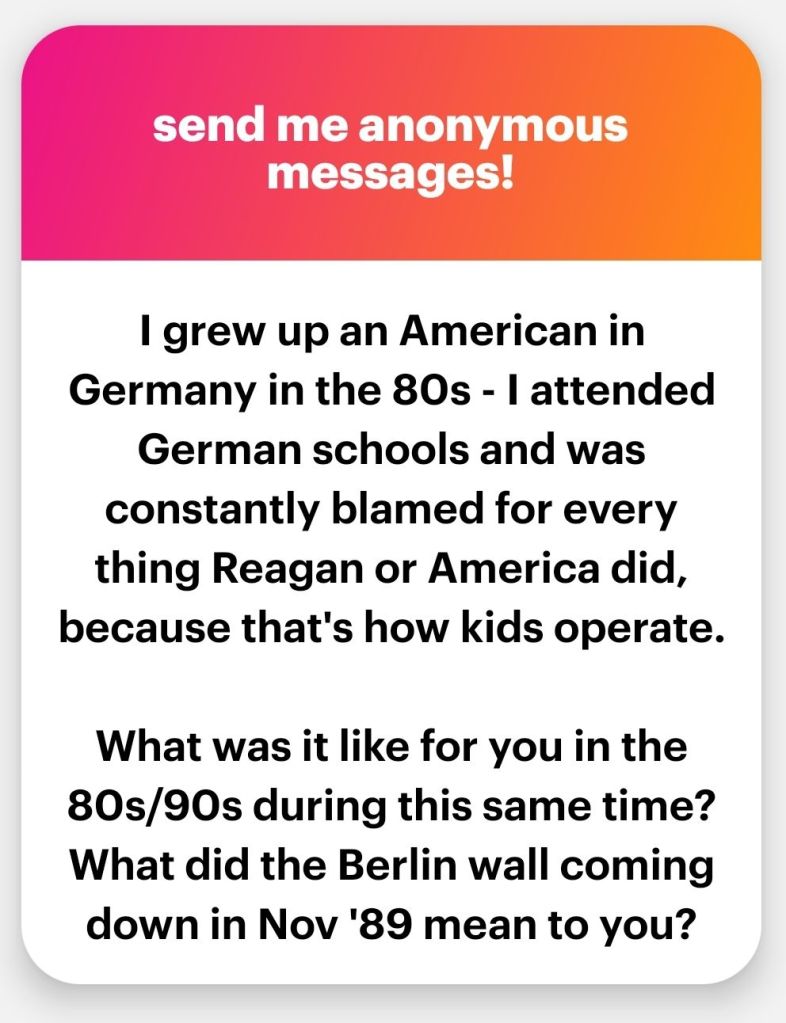
That’s a great question. I’m loving these great questions I’m now getting.
The fall of the Berlin Wall meant nothing. It was in the same category as Princess Diana, a thing you saw on TV.
I had very politicized parents. Starting in 1987-8, they’d act like Evangelical preachers of sorts. We’d be walking down the street or strolling through the park and suddenly either my dad or my mom would stop and start ranting loudly about the need for democracy, Ukrainian independence, all sort of anti-Soviet stuff. A crowd would gather, listening , asking questions, arguing. My father looked very Jewish and I was perennially afraid that somebody would sock him in the face. But no, it always went very well. I’ll never forget two old babcias whispering behind me, “What’s that Jewish boy saying?” “He said we, Ukrainians, should be proud of our history.” “Really? Well, you know Jews are smart. He must know what he’s talking about. What does it mean, though? What history?”
But even for our very anti-Soviet, highly vocal crowd the Berlin Wall wasn’t a big deal. We never perceived Germans, even the East ones, as being anything like us. We saw them as fabulously well off compared to us. Wall or no wall, they had a charmed life. We weren’t sure what they even had to complain about. The few very lucky people who were allowed to visit East Germany shared whispered stories about the magical existence in that land of opulence.
We never thought that, oh, well, now that the Berlin Wall fell, we’ll also be free. We knew that they can let Germans go but they’ll never let us leave.
And we were right, weren’t we? They are still not letting us leave.

 Clarissa's Blog
People forget that our mental image of the Berlin Wall and the VAST majority of historical photos of the Berlin Wall are from a western perspective. People in West Berlin could walk right up to the wall, touch it, graffiti it, and photograph it. People in East Berlin were kept away from it, lots of buildings near the wall were torn down after it was built, and people living in houses left standing close to the wall often had to go through police controls to get home and could never have visitors in their apartments. Soldiers guarded the wall itself, but East Berlin police heavily patrolled all of the areas close to it. Taking a photo of the wall from the east would likely get you a couple of months in one of the secret Stasi prisons. The Berlin Wall was a big deal in the west as a symbol of what was wrong with Communism, but there was no incentive for the media in any Communist country to ever mention it.
Material conditions in East Germany were really much better than anywhere else in Communist Europe. That’s partly because most East Germans could receive TV broadcasts from the west and many had relatives in the west. They had direct evidence of the west’s prosperity and that created a lot of pressure to deliver better consumer goods. And the West Germans (for complicated political reasons) also helped them out quite a bit, they gave East German large loans, bought political dissidents out of prisons, and actively encouraged West Germans to send gifts to friends and relatives in the east. There were special postage rates for sending packages to East Germany and the West Germans could even claim a tax deduction for every package they sent. By the 80s there were companies in West Germany that specialized in sending packages to the east, they had catalogs with gift boxes at different price levels, you just sent in the address and the payment and they would ship them off for you.
LikeLiked by 1 person
That’s… really cool. I didn’t know any of that.
LikeLiked by 1 person
“West Germans (for complicated political reasons) also helped them out quite a bit”
I also seem to recall hearing that East Germany would let retirees leave and settle in the West once they’d gotten all the work they could from them….
LikeLike
We were very not uniform behind the Iron Curtain. We didn’t perceive ourselves as being part of one entity, and we had no solidarity with other Soviet bloc countries.
LikeLike
“we had no solidarity with other Soviet bloc countries”
Do you mean Ukraine or the CCCP?
Often enough I’ve seen references from Polish entertainers or references from more or less normal people who talk about participating in international events in the ‘demoludy’ (colloquial expression for East Block countries).
There were lots of things that Poland, Hungary, the DDR, Czechoslovakia, Bulgaria etc participated in and a fair amount of international travel routes. When I was in Poland in 1984 anywhere that tourists might be there would be youth groups from the DDR and I saw a German documentary on the two big vacation spots (Balaton in Hungary and the Bulgarian Black Sea coast).
There apparently was a kind of… comaraderie among people from the different countries mostly sparked by shared distaste for the Soviet Union and a lack of access to western countries.
So weird that people from the USSR would be so cut off from that. It makes sense from the Soviet perspective but very, very odd.
LikeLiked by 1 person
They all lived better than we did and had stuff we didn’t. There was this whole mystique, for example, of Poles who were supposed to be elegant and polite. To go to Balaton or even to Bulgaria, you needed to be some sort of a party apparatchik. Nobody else could even dream of going.
LikeLike
That is sort of true. East Germans who were retired were allowed to go to the west once per year to visit relatives. But West German law granted automatic citizenship to East Germans, so there was nothing forcing a return to the east if they were willing to give up whatever personal connections and property they had there.
West Germany also offered Begrüßungsgeld to visitors from the East. This was in place from the 70s until just after the fall of the wall and terms varied over the years, but East Germans could just walk into any bank in the west, show their passport, and get a small amount of cash. The banks could then get the money back from the federal government. Towards the end it was 100 DM per year for any East German who was allowed to go to the west.
LikeLike
“East Germans who were retired were allowed to go to the west… there was nothing forcing a return to the east”
I also might be confusing East Germany with Cuba. A relative was a airline pilot, and in the scrambling for jobs phase that was a normal part of the career arc then, they were hired to go several times to Cuba to pick up planes full of old people and bring them to Miami (I forget the details but a lot of it was family reunion based).
LikeLiked by 1 person
…and here I thought they all got here either in junky boats, or hijacked airplanes!
LikeLike
“thought they all got here either in junky boats”
Well these were retirees that the commies were glad to be rid of… At the time I was a bit surprised the program wasn’t better known..
LikeLiked by 1 person
That’s fascinating. Maybe you had to live in S.FL.
LikeLike
You must have really hated being lumped in with the other Soviet Bloc aka “second world” countries.
On one hand it doesn’t make sense the CCP wouldn’t encourage the soviet bloc to identify with each other as part of creating a shared identity of the USSR, but on the other hand there is always the danger they might compare notes and common grievances and unite against…Russia?
Clarissa: Did you ever see The Spy Who Came in from the Cold? It’s very visually striking. It won several BAFTAs and was nominated for the Oscars for Best Actor and Best Art Direction Black & White.
I don’t know how difficult it would’ve been to travel from Berlin to Prague or Vienna back in the 1970s or 1980s as that was before my time.
LikeLike
“how difficult it would’ve been to travel from Berlin to Prague or Vienna back in the 1970s or 1980s as that was before my time”
That would depend on a lot of factors. I knew and American who was in Poland throughout Martial Law and who traveled to West Berlin at least once a month or so for well over a year…. (yes, they had stories….).
For local citizens it was a lot harder for lots of insane bureaucratic reasons (citizens with passports could not keep them at home they were kept at the post office and you had to apply to receive it for a trip).
The big wall was between the USSR and everywhere else…. I knew someone who had to get a special visa to travel on a regular Polish train that to get from one Polish city to another had to go through a sliver of the USSR (weird border that didn’t take train lines into consideration…) no stops whatsoever but full border checks going in and coming out).
LikeLike
Interesting perspective. Did not expect that… Because I and a lot of people in my corner of the FSU have very strong emotional connection to the fall of the Berlin Wall. “Wind of change” by the Scorpions with the video made of the scenes of the fall of the Wall makes me emotional to this day.
And in general I subjectively / mentality-wise feel closest to the Poles and the Czechs. I am fine with the people of my country and they seems to be fine with me, but still I feel more affinity with the Poles and the Czechs.
As far as foreign travel being reserved for party apparatchiks, this varied from place to place in the FSU, I guess. My mother was allowed to go to the DDR and even Finland, despite not being a member of the party at all. And being pretty anti-Soviet, privately. (But yes, one did need permission /exit visa and separate “foreign passport” to go abroad.) And apparently she was almost allowed to go to Canada once, but then the Soviets shot the Korean airliner and they said she cannot go because of “potential provocations against soviet citizens abroad”… She got in a little bit of trouble with the Canadians in 2017 when she said she never applied for a Canadian visa before but apparently she did, in 1983 (or, rather, soviet government applied on her behalf).
LikeLike
Interesting perspective. Did not expect that… Because I and a lot of people in my corner of the FSU have very strong emotional connection to the fall of the Berlin Wall. “Wind of change” by the Scorpions with the video made of the scenes of the fall of the Wall makes me emotional to this day.
And in general I subjectively / mentality-wise feel closest to the Poles and the Czechs. I am fine with the people of my country and they seems to be fine with me, but still I feel more affinity with the Poles and the Czechs.
As far as foreign travel being reserved for party apparatchiks, this varied from place to place in the FSU, I guess. My mother was allowed to go to the DDR and even Finland, despite not being a member of the party at all. And being pretty anti-Soviet, privately. (But yes, one did need permission /exit visa and separate “foreign passport” to go abroad.) And apparently she was almost allowed to go to Canada once, but then the Soviets shot the Korean airliner and they said she cannot go because of “potential provocations against soviet citizens abroad”… She got in a little bit of trouble with the Canadians in 2017 when she said she never applied for a Canadian visa before but apparently she did, in 1983 (or, rather, soviet government applied on her behalf).
v07
LikeLike