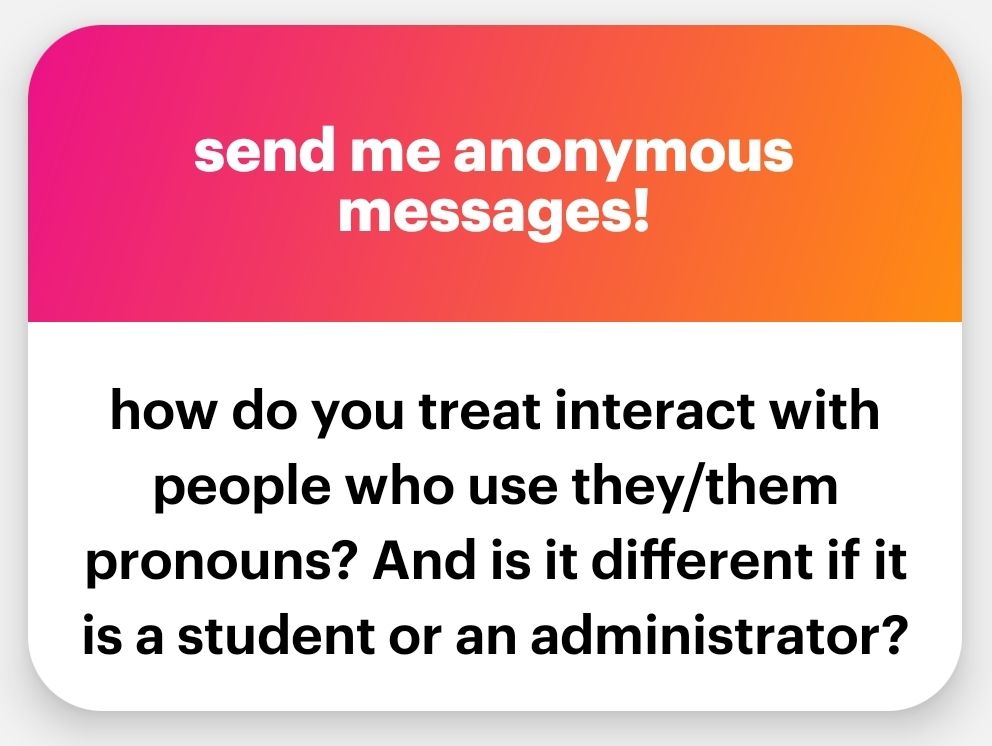
Pronouns are stupid because nobody addresses people in the third person. So it makes no practical difference whether you announce “pronouns” or not. People who are at least marginally polite and integrated into society refer to others in their presence by their name. I’d be taken aback if an administrator referred to me in my presence as “she” not because I want to be called “he” but because it’s rude.
With students, I speak in Spanish, and it’s a language that drops personal pronouns almost always anyway.
If, on the other hand, you are asking about transgender students, I use the name they provide. In language courses, half of the people present use assumed names because they want to sound Spanish.

 Clarissa's Blog
The pronoun craze has always struck me as not only asinine and bizarre, but also as symptomatic of the fact that the idea originated among university intellectualoids with too much time on their hands suffering from attention-seeking mania.
This in a country, the USA – but probably the same would hold for the whole Anglosphere – where the vast majority of people, including many academics, would not be able to tell the difference between an adjective and an adverb, let alone know what a pronoun is except as a virtue-signalling shibboleth for the rising Woke class.
LikeLiked by 2 people
People get so worked up about pronouns in the classroom, and it is a total non-issue for me as an instructor. One of my colleagues was practically in panic mode because a student announced they were transitioning, and this colleague didn’t know what to do about the student’s pronouns. The student was changing names from a masculine name to a similar feminine name, something like Chris to Chrissy, and I think I had to explain like six times that all the colleague had to do was now call this person Chrissy and use ‘you’ like they did with every other student. The colleague had somehow convinced themselves that they had to do something really complicated and couldn’t accept that it was that simple.
LikeLiked by 2 people
“If, on the other hand, you are asking about transgender students, I use the name they provide.”
That’s one of the main components of DEI training–respect the student’s name. Congratulations, you’re DEI.
As for the “pronoun craze,” we might look back to Chaucer, Shakespeare, and the 1375 work “William and the Werewolf” for the ongoing search for the gender-neutral pronoun.
Now, if a student (since we’re talking about academics) identifies as fluid or something other than their assigned sex, we as teachers aren’t generally qualified to determine whether or not the student will indeed be happier with their chosen gender identity or if they are acting based on gender dysmorphia or other issues. If a student comes to us in distress, we can suggest talking to someone, but that’s about it. Most of us in academia are trying to find the right way to accept, accommodate, welcome, and suggest assistance when appropriate–certainly not seeking attention.
As for “rising Woke class…” Ah, screw it. Just read this. It’s merely common sense:
https://www.edweek.org/teaching-learning/opinion-the-case-for-woke-education/2023/07
LikeLike
I don’t know, I always called them whatever they wished. Once I had a student whose name was William bit he went as Jack. So I called him Jack. I call my own daughter Q or QQ, so I’m down with unusual nicknames.
LikeLike
Tried to read the article but dude. It’s cruel to inflict this on me during my lunch break. I already spend more time than I ever wanted reading and hearing this kind of twaddle.
LikeLiked by 2 people
“Ah, screw it. Just read this. It’s merely common sense“
No, thank you, I’m not into victimology.
From the suggested reading: I contend that teachers should be woke, meaning that they should have a critical disposition… But being woke is exactly the opposite of having a critical disposition. On the contrary, it indicates that you are on board with the whole ideological charade of anti-racism, BLM, LGBTQ bullshit nonsense that so many readers of this blog have been constantly denouncing and which Clarissa has repeatedly drawn attention to.
How can anyone, let alone an academic, seriously suggest that a publication which recites such stale mantras as be brave and confront the power that exists due to whiteness is worth of intellectual consideration is beyond me. This is just Paulo Freire’s pedagogy of the oppressed neo-marxist cant. If this is what you go in for, fine, just say so, instead of pushing it as merely common sense, because common sense it is not.
So here’s the deal: I’ve read the article – a vomitation of trite marxist platitudes laced in educationalists’ jargon – now you read some New Discourses by James Lindsay https://newdiscourses.com/
You will find intellectually stimulating and in-depth discussions of subjects like The Queering of the American Child, and a very useful glossary of the new and current Holy Writ of Wokerism (Translations from the Wokish). For the case in point I suggest The Marxification of Education, which demystifies precisely the unintelligent and often unintelligible gibberish that passes for enlightening in Col. Potter’s suggestion that we read such despicable and anti-intellectual publications as EducationWeek.
LikeLiked by 3 people
There’s an overproduction of PhDs in North America. A large percentage are people who want to lead the life of the intellect but they were never taught the discipline and the habits of the mind to make it possible. So they grab on this lefty jargon and the attendant sense of self-righteousness and use it in place of an actual life of thinking and reflection. It never really leads anywhere. They go unnoticed, uncelebrated, not promoted or valued. Their resentment seethes because they aren’t stupid. They know something is wrong. But they are not very smart either, so they don’t know what.
LikeLike
Col. Potter is a bit like an LDS missionary trying to evangelize monasteries.
LikeLiked by 2 people
(ever optimistic, no idea what he’s up against… but will doggedly finish out the 2 years to claim the religious credential)
LikeLiked by 1 person
Haven’t had much time to respond—eldest daughter is in Western Psych and that’s just the beginning. That would be my biggest problem at the moment. Second biggest would be the other two special needs kids. And the third biggest problem… well, it’s not the seething rage of how my career is going, we’ll put it that way. I sometimes think my wife and I have enough support and spirit, and I have hope. I sometimes think we don’t, and I despair.
As for my career and research, well, I’ll admit I’ve never been reduced to such a weirdly specific cultural stereotype. It is true that Marx and Zinn are strong supporting players in my dissertation and later first book (Broadway and Corporate Capitalism:The Rose of the Professional-Managerial Class 1900-1920)—the key threads are by way of Bourdieu and habitus—but I don’t see how going toward the right would prove greater discipline of some kind.
As for my career, I’m incredibly lucky to have a job. I remember some old post of Clarissa’s where it was part of her daily reality that the university was lucky to have her, and when she overheard people saying great things about a teacher, obviously they were talking about her. Now, this isn’t about what I think of that kind of self-opinion, but I tried saying it to myself—This university is lucky to have me.”
Couldn’t finish the sentence—I was laughing too hard. I’m practically lottery-winning level lucky to have this job, and I only hope I can hang in there till at least 65, preferably 68, which would be 20 years. But here’s the thing. I did get this job after 5 years of searching. And I received tenure. I am also a full professor. So… I don’t really need more notice, thanks. Hell, I never thought I’d make 1,000 dollars times my age—not ever. I am now—and it would still be true if I taught to age 107. I did that. And I take some pride.
I’ll go more into woke-land another time, but I’ve listened to Mr. Lindsay on why woke is evil, translating woke terms, and how DEI is speaking bitterness, and, well, like I’ve said before, he’s a gormless git. Now that I’ve heard the latest round of gormless gitticsicms, I’ll just say that he tends to go on at length about a communist subject (CCP, Mao, Marx, etc.), tell how bad it is, and then say something like, “Clearly, DEI is just like this.” Well, no, Chuckles, it isn’t. Kneejerk hatred and anti-intellectualism will burn through, no matter how logical and erudite you try to sound—a good lesson for everyone, courtesy of Uncle Colonel.
Finally, that whole LDS missionary thing? Sorry, I guess that was a 4D insult, and I’m only scraping by in 3D. I’m sure if I had greater intellectual acumen, I would appreciate the smackdown and be sufficiently broken of spirit, which seems to have been the intention. I’ll be 61 on the 18th. I’m an old man. I’ve been on this earth a really, really long time. I won’t rush the end or seek it out before it’s meant to happen, but the end will be warmly welcome.
LikeLike
When I first began teaching here and the first student evaluations came in, the chair of the personnel committee said she’d never seen anything like this in her entire career. I don’t need to listen to what people say in the hallways. It’s in the SETs every semester. Every administrator who read my CV says the same, “How did we end up having you here? What are you even doing at this university?” So it’s not like I have to prowl around, listening in on people’s conversations and assuming everybody’s talking about me.
As for making money, I don’t believe I’m underpaid. I made excellent money in Ukraine in the 1990s. That was a real achievement in terms of money-making because that was a really brutal, completely neoliberal economy. Nothing I can make in North America looks particularly impressive to me after that.
In what concerns DEI, if you know and like Marxist theory, I’m sure you know that Marx would say DEI is part of the ideological apparatus that ensures compliance with the existing economic system. It lures the dispossessed to collaborate in their own dispossession by giving them pronouns and slogans while robbing them of wealth. I talked very recently about a glaring example of this when we were given “equitable budgets” which is simply a way to introduce budget cuts and name them in a way that precludes dissent. “Equity”, as you know, is right there in the DEI acronym. Two weeks ago, the unionized janitorial staff tried to protest against budget cuts. They are definition of the proletariat but they were told that their demands for a fair wage were racist because the administrator in $3,000 shoes who announced the budget cuts is black. You must have been reading some other Marx if you think Marx would have been on the DEI side.
LikeLike
“he’s a gormless git”
How so? He seems quite gormful to me.
LikeLike
@cliff arroyo
“How so? He seems…”
See here: “I’ll just say that he tends to go on at length about a communist subject (CCP, Mao, Marx, etc.), tell how bad it is, and then say something like, “Clearly, DEI is just like this.” Well, no, Chuckles, it isn’t. Kneejerk hatred and anti-intellectualism will burn through, no matter how logical and erudite you try to sound—a good lesson for everyone, courtesy of Uncle Colonel.”
And also here:
“James Lindsay in his own element and in his own words:
https://www.splcenter.org/fighting-hate/extremist-files/individual/james-lindsay
There’s just one thing left to say about him:
Bigot, bigot, bigot, bigot, I said big-big-biggety-bigot
Bigot, bigot, bigot, bigot, I said big-big-biggety-bigot
Bigot, bigot, bigot, bigot, I said big-big-biggety-bigot.”
LikeLike
“in his own words”
provocative but… I can’t argue with the substance…
Repeating ‘bigot’ over and over is not an argument.
I’ve listened to his broadcasts on the destructive influence of Paolo Freire’s lunatic ideas about education and other topics.
He’s repetitive and not an… exciting speaker but he knows what’s up, see his participation in the Grievance studies affair (pointing out how intellectually bankrupt and morally questionable ‘cultural’ and ‘gender’ studies often were.
Summary: Far from being gormless, Lindsay has gorm coming out of his ears.
LikeLike
“Repeating ‘bigot’ over and over is not an argument.”
But apparently being a bigot and spreading bigotry is an argument.
Let’s review the definition: “a person who is obstinately or unreasonably attached to a belief, opinion, or faction, especially one who is prejudiced against or antagonistic toward a person or people on the basis of their membership of a particular group.”
Now let’s look at Lindsay making George Floyd/Ukraine jokes:
“So, boys and girls, that’s why we have to be good and send Ukraine another $100B to be laundered a year every year: so George Floyd will fly around and visit all the little Russian kids and take their toys and redistribute them to the poor Ukrainian oligarchs on January 6th-mas.”
And here he is on the gay community:
“When I look at what’s going on with the Queer activist cult and children, I really, really hope that millstones part of the Gospel is true.”
And on drag queens (throwing in an outdated complaint about male buffoonery into the bargain):
“There should be male role models, should be female role models in people’s lives. They have to see what these models look like, and when we don’t have men that can act as men, and I don’t mean this alpha crap all over the internet like this exaggeration this, this …this pastiche of masculinity, but I mean, actual men doing what they’re supposed to do, you know, taking responsibility showing what it means to be masculine, to be real, to be present, to be responsible and to work with young people in a model that in their lives. You’re going to have young people who don’t understand that dimension of life and reality. And so it’s just crucial that we start nourishing that again, we start trying to overcome these narratives that have boxed men out or lead men to be treated like as buffoons like, you know, Homer Simpson, or whatever, but also as creepers, and if it’s a male who wants to be a role model, and so we have this vacuum of male role models and what do we have now? We have drag queens filling in the role. We have men pretending to be women, so they can be role models or groomers for kids. It’s a problem.”
Summary: Perhaps gorm once existed in this man, but it has been twisted into seething, vicious hatred. There are good things in this world. But neither Lindsay nor his ideas are among them. In other words:
Bigot, bigot, bigot, bigot, I said big-big-biggety-bigot
Bigot, bigot, bigot, bigot, I said big-big-biggety-bigot
Bigot, bigot, bigot, bigot, I said big-big-biggety-bigot.
(Also, this is not merely repetition; it is chanting. Respect the nuance, dude.)
LikeLike
The thoughtful and respectful argument I posted remains unanswered because it’s clearly easier to copy-paste “bigot” and “hatred” about some dude who’s not participating in the conversation.
So who exactly in this thread is unreasonably attached, prejudiced and antagonistic? I don’t think it’s me because I tried to engage in a sincere discussion. And all I got in response is “bigot, bigot, bigot.”
LikeLike
This replying business can be confusing. To sum up:
The Bigot Chant (I will make this a Thing) was directed first at avi, who sent me the stuff on Lindsay and strongly suggested I read it. Then toward cliff arroyo, who queried me regarding my response to Lindsay.
As for your “thoughtful and respectful argument”? I agreed with it. You’re right. DEI and Marx don’t go together. I’m completely on board.
Unless that ISN’T your argument, in which case, I too am lost.
LikeLike
Then there’s a contradiction in what you are saying. First, you explained how you used Marxist theory in research, which is interesting to me because I use it, too. But then you say you are in favor of DEI. As the old Soviet joke goes, “Rabinovich, either take off the cross or pull up your underpants.” Because both at once don’t make much sense.
LikeLike
Yes, indeed! This is what I’ve been saying! I’m not the one linking Marx and DEI, it’s this guy Lindsay. This is more @avi : James Lindsay in his own element and in his own words:
https://www.splcenter.org/fighting-hate/extremist-files/individual/james-lindsay
There’s just one thing left to say about him:
Bigot, bigot, bigot, bigot, I said big-big-biggety-bigot
Bigot, bigot, bigot, bigot, I said big-big-biggety-bigot
Bigot, bigot, bigot, bigot, I said big-big-biggety-bigot.
And @avi:
The next time you wish to send me some James Lindsay, I will just have to say,
No thanks. I am an educator. And I still believe in empathy and compassion.
LikeLike
I’m completely lost at this point. Compassion for whom?
LikeLike
My students. My family. Humankind.
LikeLike
How is this remotely related to what we are discussing?
I have absolutely no idea what’s so disturbing about what I posted that it can’t be addressed without first discussing how you feel sorry for humanity.
LikeLike
“How is this remotely related…”
Well, you asked for whom I have compassion. I can rearrange the order of importance, I suppose, but that’s the general idea.
I think what is happening is that my responses to avi and cliff are cluttering the whole Marx/DEI thing. Avi and cliff have indeed been in on what I’m looking at as one big conversation (argument?), but to address specifically your post–yes, I agree. Marx would not have been on the DEI side. Perhaps there’s a bit of a time delay with responses, or perhaps they don’t just line up the way they do on my screen. But the abridged version–I agree with you.
I hope this clears things up.
LikeLike
I, for one, have great compassion for the janitors who are being ill-treated in the name of DEI. And the NTT workers, and the staff. DEI helped nobody that I’m aware of and it hurt many people. This is why I ask who is the object of your compassion. It’s either the disenfranchised workers or the smug administrators who are robbing them and using DEI to stifle protest. I don’t believe you can be compassionate towards both because these are antagonistic forces.
LikeLike
“I, for one, have great compassion…”
Well, at least we’re having the same discussion now. Or argument.
I see DEI on a spectrum–good, problematic, and evil. I mean, we’re really talking about the people who use or misuse a particular tool or way of looking at things. But let’s start with good: my DEI training, which has helped me and some of my colleagues, is about teachers getting together and figuring out what best practices are in making sure that students are, well, included. No shaming, no making each other feel like failures, no ratting someone out for not being DEI enough.
Now we try to put this stuff to use in the classroom. Still good, but there can be problems. A misguided teacher could reduce a lesson to “airing grievances” without putting it in the context of “let’s try, ourselves, together, not to be that way.”
Next, we have one of the most problematic attempts to use a DEI strategy–businesses where peers are working together and getting what Dreidel remembers as Sensitivity Training. Yes, that can absolutely turn everyone anxious and insecure with each other, even in an environment where no one had to worry about such problems before. And DEI leaders are aware of this problem–there’s an article in the Chronicle of. Higher Ed somewhere that addresses leaders realizing that stomping into an environment being very sure that you’re right and everyone else is wrong is going to cause problems.
And finally, the situation you’re describing–evil, exploitative higher-ups taking advantage and padding their pockets using DEI structures and jargon. Hucksters are everywhere, and that sucks. (And except in a very broad sense, they aren’t worthy of much compassion.) And as you said, Marx would absolutely (and correctly) identify that behavior as the oppressors doing what they do best: oppress.
So… Marx. Well, he really wouldn’t go along with any of this, right, because he didn’t believe in the idea (or the possibility) of an oppressor class saying to the oppressed, “Hey, we’re going to work on not oppressing you any more.” Marx was more of a throw-off-your-shackles-and-overthrow-the-oppressors kind of guy.
I do like elements of Marxian theory, for sure. He’s observant about oppressors and oppressed–nothing new, even in his time, of course; after all, we see this in Aeschylus’ conclusion to his Oresteia, where Orestes is judged not guilty for killing his mother, because he did the more important thing, which was avenging his father (and the father is the true parent and therefore the most important figure). Aeschylus illustrated that in the creation of democracy, someone had to be oppressed. And Marx can clear the air with regard to what causes conflicts–it’s very often (thought not quite always) economic in nature. But getting him involved with a discussion of DEI isn’t especially productive.
LikeLike
I’m very interested in these best practices you are talking about. You say the goal is to make students included. But what does that mean? They are all in the classroom, all following the syllabus, all doing homework and writing the same tests. What were they previously excluded from and what are you including them into?
These are completely bona fide questions. I’d really like to hear about your experience.
LikeLike
Potter:
What makes you think DEI is not about economic conflict?
LikeLike
“i’m very interested in these best practices…”
I respect the question and want to get into it in more detail, but for now I’ll give a fairly quick example. A lot of what I teach is theatre history and literature, so I’m experimenting with tackling the “canon” from a different perspective. In my tragedy course, we have, not surprisingly, Oedipus the King. So we look at Sophocles, we examine how all of the characters’ moves to avoid fate lead them to fulfill it, how Freud uses the story, and so on (if there’s anyone on the blog who hasn’t read Oedipus, it doesn’t end well for him).
Then we read another Oedipus story, Oedipus el Rey by Luis Alfaro, set in 21st century California–Oedipus leaves prison and eventually becomes “king” of a Mexican crime family, which includes getting together with Jocasta in ways that are onstage and sexually explicit. So the class talks about the same story but through a different lens. And as the play is also largely concerned with the prison system and recidivism, we get to talk about why it is difficult for a former prisoner to make a constructive contribution to society. And generally, more students find they have strong opinions about what this Oedipus goes through.
There’s more, but I think you can see a picture emerging.
LikeLike
The question was how do you include students and what were they previously excluded from.
That I include both translation and interpretation activities in my syllabus, for example, doesn’t show that I’m being inclusive and is not a DEI effort.
LikeLike
“The question was…”
Actually, translation and interpretation is indeed DEI. See, about 80% of DEI, when looked at logically, is stuff you’re already doing as a teacher who cares about the students, or even just doing your job. Same goes for “woke,” by the way. Any teacher going through DEI training worth their salt will have several moments of “Yeah, I already do that.” The point there is validation (hey, I’m not a failure). And then there’s the extra we can do on top of that. For example…
Kids might not want to get into their pronouns, even if it’s important to them. So say “Hi, my pronouns are whatever and whosits.” And we start to develop a classroom culture, with the students. Sometimes the plays we look at deal with disturbing topics–Aphra Behn’s The Rover is just a hotbed of sexual trauma waiting to happen. So you talk about guidelines. Ground rules. And someone is going to make a mistake, maybe the teacher, maybe another student. So we decide, as a class, what the best things to do are in those situations. Because we all want a good class, and we all want to learn. And we’re all making the decisions, so we’re all… wait for it… included. (Yes, I’m a little snarky by nature–don’t mistake it for insincerity.)
You know all that “[fill in the blank] of the oppressed” stuff? The stuff that gets some of your readers just really hopping mad? Students feel it. Sure, we say, here’s our class, here are our assignments, you all are doing them. And we think that’s inclusion.
But power doesn’t go away, although it might get redistributed. There’s the culture that’s already been determined for them. There’s the power ladder and their place on it. They know this stuff. They can’t always express it or put their fingers on it, but they appreciate it, just as they can appreciate art and beauty, as you once noted (although I still kinda like that wacky poem from the Democratic convention). They look at ancient Greece and the white kids say, “This shit’s old,” and the kids of color say, “This shit’s old and white.” But when we add some modernity and some voices and perspectives of color–son of a gun. Inclusion. And you see it. You hear it in the students’ responses, you see the life in the eyes. I’ve seen it, as have many colleagues.
Now let’s talk about putting the Black, Latin, and Asian students into the next theatre department’s production of “Pride and Prejudice.” Well, maybe that’s another post.
LikeLike
“So say “Hi, my pronouns are whatever and whosits.” And we start to develop a classroom culture, with the students.”
“So you talk about guidelines. Ground rules. And someone is going to make a mistake, maybe the teacher, maybe another student. So we decide, as a class, what the best things to do are in those situations.”
“But power doesn’t go away, although it might get redistributed. There’s the culture that’s already been determined for them. There’s the power ladder and their place on it. ”
“They look at ancient Greece and the white kids say, “This shit’s old,” and the kids of color say, “This shit’s old and white.””
“But when we add some modernity and some voices and perspectives of color–son of a gun. Inclusion. And you see it. You hear it in the students’ responses, you see the life in the eyes. I’ve seen it, as have many colleagues.”
It looks like you believe that being “inclusive” is adding texts to the curriculum that students are supposed to “relate to.” I know this was popular back in 1982 but I had no idea people were still trying to drive engagement this way. I believe that every professor should have the academic freedom to teach whatever texts they want and no reading list is more virtuous than another. It looks like our main difference lies in the fact that I don’t believe that my choice of readings for a course should stem from my assumptions about students’ feelings and psychological hangups. I’m not a psychiatrist and I’m not qualified to heal emotional wounds. I do know that when I was a student, I would have been humiliated by the idea that a professor considered me so inept that he would specifically include books about Ukrainian immigrants to get me to participate in the course.
LikeLiked by 1 person
“Why would I say…”
Lots to think about, as usual. And I especially want to rethink anything that might imply that I believe any of my students to be inept.
But it’s time to take a break–oldest daughter comes home tomorrow, and I’ll need to concentrate on the whole family-rebuilding thing. And I realize this blog is getting a little too much in my head–feels like I’m always yelling in my responses, or else I’m getting yelled at.
I’ll probably lurk every now and then, especially after the election to check out the brave new world we’ll be starting. Best of luck to everybody.
LikeLike
On the subject of pronouns, specifically, if I put everybody through this exercise on the off chance that one person might find it helpful, how is that inclusive? It’s exclusive of everyone except that one person who probably doesn’t exist.
LikeLike
Of course it is. If I were getting humiliated like this, I’d take a break too.
LikeLiked by 1 person
“What makes you think DEI is not about economic conflict?”
It can be, sure. It’s on my spectrum above. I suppose I would say it’s a misunderstanding of Marxism (and DEI) to call DEI a Marxist idea, but you could definitely examine DEI strategies through an economic, or Marxist, lens. I don’t know that it’s solely, or even primarily, about economic conflict, however–race, ethnicity, culture all enter into the mix.
LikeLike
“pronouns, even if it’s important to them”
Why would they be important? Third person pronouns in all languages are decided by others, not the speaker. (Some languages like Japanese and Vietnamese do give the speaker leeway to choose how to refer to themselves but that’s a different tissue).
Facultative pronouns sound like a nice thing to people who haven’t looked into the issue much but the more I looked into it the worse of an idea it seems. Especially ‘they’, which is fine as an indefinite or generic but lousy as a definite single reference. If how other people refer to them is important that’s a sign that something is off (and maybe they should be in therapy rather than forcing their preferences on others).
There’s also a kind of subtle verbal abuse behind ‘inclusive’ curricula…. “Don’t worry dear, no one expects _you_ to be able to understand or relate to this. You are sooooo lucky to have an understanding person like me who can take your deficiencies into account. You should worship me in return.”
““This shit’s old,” and the kids of color say, “This shit’s old and white.””
How is it good teaching practice to cater to student prejudices?
LikeLike
Far more important than “pronouns” for 100% of students is having a high GPA. Yet we still fail them regularly if they don’t do the work. So if we completely disregard this far more crucial preference that all students have, why should we selectively cater to some other preference, especially one that is of interest to a miniscule percentage of them?
LikeLike
“putting the Black, Latin, and Asian students into the next theatre department’s production of “Pride and Prejudice.””
I’m an opera fan… I’m fine with colorblind casting in the theater. On film things are maybe a bit more complicated.
LikeLiked by 1 person
It’s really interesting to me that there are people who see this kind of 1980s stuff as edgy. Every student theater has done this since before I learned to walk. This has done absolutely nothing for graduation rates which remain stagnant for every one of these groups.
LikeLike
“who see this kind of 1980s stuff as edgy”
Exactly! Colorblind casting in theater should in no way be seen as edgy but rather normal practice.
“nothing for graduation rates”
Well…. the purpose of the system is what it does.
LikeLike