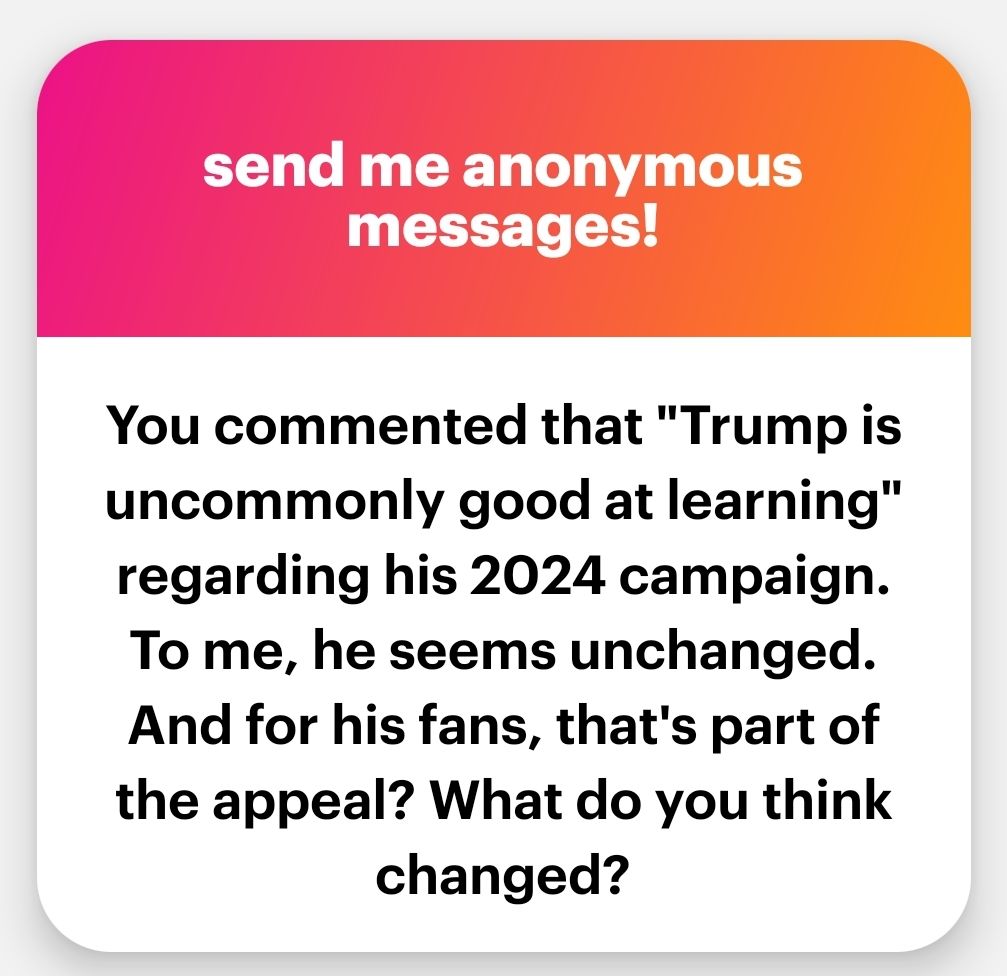
Trump is definitely the same person. It would be disturbing if he experienced a major personality change at his age. But he’s running a completely different campaign. If people were capable of leaving partisanship aside, Trump’s campaign of 2024 would be an object lesson in taking stock of your mistakes and correcting course. Everybody is too emotional and I’m not even sure it makes sense to post because once you say “Trump”, all reason flies out of the window.
The question was asked, though, so I’ll answer.
The Trump campaign of 2020 made three catastrophic mistakes:
- No legal challenges were presented before the election to prevent the shenanigans with ballot harvesting.
- The fantasy of winning the black vote was pursued to the detriment of courting the very winnable white male vote. As a result, this was the demographic Trump went down with in comparison with 2016. It was actually the only demographic where he decreased.
- Hiring absolute morons and incompetents, which is a problem that has dogged Trump since 2016.
This time around, we see a complete turnaround on all 3 issues.
- Legal challenges are presented swiftly and effectively before Election Day.
- The courting of Elon Musk, the Joe Rogan podcast, and the garbage truck photo op are only the most recent of the very successful efforts to speak to the demographic that can put Trump over. There are many others, and that’s a major difference from 2020.
- The people who carry out the day-to-day operations for the campaign are very organized, disciplined, effective people. Trump told, for example, about how fast the garbage truck photo op was organized, with the truck being covered with the campaign signage in a very short period of time and everything being ready lightning fast.
People have such an intense reaction to Trump – both good and bad – that it’s impossible to find anybody interested in discussing this. So thanks for the question, I appreciate.

 Clarissa's Blog
I haven’t paid active attention to the campaign– just the bits that are unavoidable. But I was most impressed by Tulsi Gabbard (whom I respect) and RFKJ (who is kind of weird and off-putting, but who gets a couple of key things right, and I appreciate his harping on them continually) jumping ship in his favor.
LikeLike
Tangential: hilarious campaign oddments:
https://x.com/Mostofsky/status/1853213600627708343
LikeLiked by 1 person
That’s seriously cute. Thank you, this made me smile!
LikeLike
Didn’t Trump do worse with white voters in 2020?
Funny thing about that whole point: I won’t say anything definite before the election, but Trump seems to actually be doing better with black voters this time in the way he hoped he would in 2020. My anecdotal evidence backs up the polling trends. But of course, polling is iffy.
LikeLike
Trump realizes now after the ’20 election fraud that, theft of an election can easily occur.
LikeLike
Why do you think Biden handlers feed that poor old man ice cream? Answer it raises his Type III diabetes blood sugar.
LikeLike
The garbage truck photo-op was actually a net negative. Who’d have thought?
https://x.com/MattBinder/status/1853159252359020722?t=_7tQF6uHYyPJg2CDtVAqjA&s=19
LikeLike
Well, if Puerto Rican near a supermarket said it, that’s all the political analysis we need.
LikeLike
We’ll find out tomorrow then, won’t we?
LikeLike
As we used to say in the USSR, it doesn’t matter how you vote. It only matters how the votes are counted. 😆😆😆
LikeLiked by 1 person
A Israeli perspective the day before Trump wins all 50 States
I had made aliya to Israel about 5 years previous to this history. As a young student in the Yeshiva started to make my connections with Rabbi Shalom Elyashiv through my Rav Aaron Nemuraskii. The left wing “peace process” by this time had shown itself as a complete failure and fraud. Remember seeing: מרץ שרץ in Mea Shearim. The 2nd Intifada remained yet into the future.
Recall the Israeli international politics as utterly chaotic during the Clinton Administration. Clinton similar to the British & French in the 1956 Suez imperialism tended to view Israel as a low power chess piece that could be sacrificed if it bettered Clinton’s narrow political agenda that rotated upon the glorification of himself as President.
Yitzhak Rabin and the First Lebanon War – YouTube
France had significant historical ties to Lebanon dating back to the French Mandate after World War I. This historical relationship fostered cultural and political connections that France sought to maintain and strengthen under Chirac. Lebanon stood at the center of Frances’ “backyard” Francophone domination of the Middle East. President Chirac viewed post ’67 Israel with hostility and great suspicion. France pompeously assumed that Paris merited a dominant role in the “Middle East Peace Process”.
Rafic Hariri, PM 1992-98, and a personal friend of Chirac, established the Taif Agreement which brough an end to the 15 year Lebanese Civil War. Some argue that Chirac dominated Hariri. During his 2nd term as PM (’00-04) Israel withdrew from Southern Lebanon in 2000, which terminated the first Lebanese Israeli war. Hezbollah opposes French domination of Lebanese politics. Hence the influence of Paris on Lebanese politics has shrivelled to almost non existence today.
France’s strategic engagement in Lebanon under President Jacques Chirac and the complex interplay of regional forces during the late 1990s and early 2000s: President Jacques Chirac viewed these ties as essential to maintaining France’s position as a stabilizing power in the Middle East, contrasting with the more military-oriented approaches of the rival super-powers.
The presence of a large Francophone population and historical French cultural ties provided a foundation for Paris to assert its influence. Chirac worked to sustain and expand these ties, seeing them as part of France’s broader ambition to exert a stabilizing and influential presence in the Middle East.
President Chirac viewed post-1967 Israel with significant suspicion and believed that France, with its historical knowledge and connections, deserved a central role in mediating peace in the region. France’s emphasis on dialogue and negotiation often put it at odds with both Israeli and U.S. policies, as well as with groups like Hezbollah that rejected Western intervention.
Hariri’s personal relationship with Chirac strengthened bilateral ties. Some analysts suggest that Chirac’s exerted a substantial influence upon Hariri; potentially shaping policies that aligned with French interests. Hezbollah, a powerful political and military organization in Lebanon, strongly opposed Western, specifically French, involvement in Lebanese politics. The group’s ideology and objectives often conflicted with France’s attempts to play a prominent role in Lebanese statecraft and peace processes.
The Israeli withdrawal from southern Lebanon in 2000, this significant event radically shifted power dynamics in the region. While Chirac likely viewed the end of direct Israeli occupation as a potential opening for greater French involvement, it also empowered Hezbollah, which opposed foreign dominance, thereby complicating French political ambitions.
Greater Lebanon emerged in 1920, it remained a French protectorate until 1943. That period left an indelible impact on Lebanese culture, economy, and politics which greatly contributed to the outbreak of the Lebanese Civil War, consequent to the French divide and rule strategies which pitted religious sects one against another. Jacques Chirac, with his Gallic flair: je ne sais quoi, enjoyed close relations not only with Lebanon’s Christian community but also with Shia and Sunni Muslims. This approach supported the notion that French foreign policy projected an inclusive and comprehensive influence, rather than focusing solely on one faction.
French political scholars have pointed out that Chirac’s relationship with Hariri provided Paris with a channel to exert soft power in the region, crucial for the French interest of maintaining influence without direct military involvement. The reconstruction projects, for instance, sometimes came with the backing of French financial and technical expertise.
The legacy of the French Mandate left a cultural and institutional mark on Lebanon that Chirac used to reinforce diplomatic and economic ties. This included promoting the French language, educational exchanges, and business partnerships that made Lebanon a bridge for French interests in the Arab world.
Books worthy of interest: “Old Interests, New Purpose: French Foreign Policy in the Middle East”. It explores the balance France strikes between cultural diplomacy and political objectives, often reflecting on its colonial past and ongoing partnerships in the region. Journals relevant to this discussion: French Politics, Culture & Society, or Middle Eastern Studies.
“French Foreign Policy in Libya and Syria (2003–2017)”. This book provides an analysis of France’s involvement in Libya and Syria, particularly how it has sought to promote democratic regimes in line with its strategic interests. It discusses the complexities of intervening in these conflicts while maintaining alliances with local actors and navigating international dynamics. An excellent source for understanding this topic is The Journal of North African Studies, which often features articles on French interventions and policies in North Africa and the Middle East.
“France’s Foreign Policy in the Middle East”. This course examines the evolution of France’s foreign policy from Chirac’s administration onwards, emphasizing its approach to peace processes, bilateral relations, and regional stability. France’s role in the Arab Spring and its relationship with Lebanon.
“Strategic Interests in the Middle East: Opposition and Support for US Foreign Policy”. Daniel W. Kuthy’s chapter delves into the nuances of French foreign policy during Chirac’s rule, particularly in how it has sometimes aligned with or opposed U.S. interests. This examination provides context for France’s strategies in a rapidly changing geopolitical landscape. This chapter is likely found in edited volumes or academic works on transatlantic relations or Middle Eastern politics. Journals like The Middle East Journal and International Security could have related articles discussing these themes.
LikeLike
This scares me more than anything that Harris ever said. Trump is not winning the 50 states. This is delusional thinking. What is the purpose of this strange, baseless fantasy other than to become perennial losers who refuse to see reality?
LikeLike
LikeLike
It gets worse, dude. I spoke with two mega-MAGA friends and they have this new narrative that I can’t fully transmit because it’s too convoluted but it has to do with the army having covertly taken power already and carrying out extra-judicial executions on behalf of Trump, and if Trump wins it’s actually a bad sign because it means that the executions are unsuccessful.
I kid you not, I almost started screaming when that theory was imparted to me.
LikeLike
OK you don’t like my election cheer. Bottom line: Israelis want a strong Trump mandate to rule the White House.
LikeLike
Trump wins the electorial college and the popular vote. Whooooooooooooooooooop so happy for America & Israel.
LikeLike
OT: Some good news from Moldova. The second round of presidential elections was marked by all manner of dirty tricks from russia… from phone death threats to journalists, attempts to fly/bus in russians to Moldovan embassies in Belarus, the Baltics and Istanbul to cyber attacks…. and all for nothing as the pro-European, pro-Ukrainian candidate beat the pro-russian stooge.
https://x.com/EuropeElects/status/1853420430561796589
Trăiască Moldova!
Here’s a russian taking it about as well as you’d expect….
https://x.com/punclizme/status/1853384572207317315
LikeLiked by 2 people
Moldova is complicated, and it’s stunning that they managed to withstand the Russian propagandistic assault. Pretty incredible.
LikeLike
https://blog.exitgroup.us/p/what-it-would-mean-to-lose
I agree with the above.
LikeLiked by 2 people