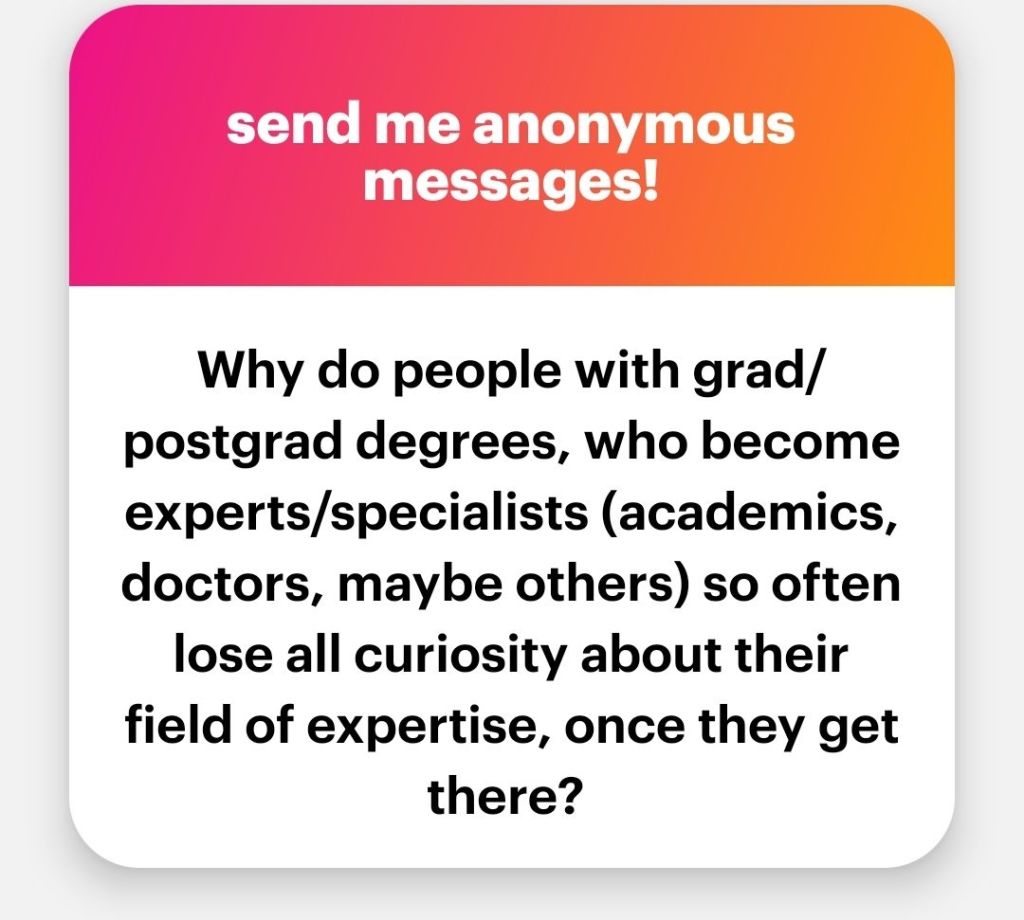
This is an excellent, excellent question, and I’ve been thinking about exactly this in the past few days. I’ll be on a show tomorrow to talk about this, actually, but since it’s not in English, I’ll explain my thinking here.
People ask, “how do I choose a profession? How do I decide what to become?” This is an outdated approach that worked in 1953 but causes pain and suffering in the reality we currently inhabit. Professions disappear. They get wiped out daily. If they don’t get wiped out, they get transformed beyond all recognition. What is my job, for example?
Is it a college professor? A scholar? A translator, an author, a university administrator?
No, no, and no.
My job is being Clarissa. I bring my skills, personality and way of being into different arenas, and since these skills and personality are good, I monetize them well in these different arenas. But these arenas aren’t me. I’m me.
When I describe the dismantling of my university, people assume I’m miserable. But I’m the opposite. Campus is where I come to practice my hobbies, pursue my projects of personal and intellectual growth, and use the resources available here to do that. It’s like when you are driving and you see police congregate around two vehicles that crashed. You feel compassion for the people involved but the crash isn’t really affecting you in any way. You are in your own car, going to your own destination. There might be a delay on the road because of the crash but you are still going towards your own goal.
I knew from very early in life that I need to arrange my existence in a way that will give me a lot of time to read, think, be by myself and live the life of contemplation. I’ve achieved that, I’m content, and everything else is other people’s car crash.
The disaffected, uninterested people from the original question went about choosing their profession in the opposite way of what actually works. They chose a field and then tried to squeeze themselves into it. That’s onerous and soon gets boring and heavy. The right way to do it is not to place yourself in a field but to place a job inside your way of being. Then, it becomes one of the many places where you enjoy the life that’s optimal to you. I love reading, so I organized my life around me reading. For others, it’s going to be something completely different but they should figure that out first and decide that this something will be their guiding light, so to speak.
Yes, what I’m saying is neoliberalism on steroids. I know that better than anybody but I look, for example, on the quit-lit academics who tied their entire sense of self to being an academic, and that’s not a fun place to be. I was a teenager when the USSR fell apart, and everybody simultaneously lost their professions. There were many people who were destroyed by it, and I knew even back then that I didn’t want this for myself.
In short, a job shouldn’t give you meaning. You have to find meaning and then bring it wherever you go, be it a job or a trip to the grocery store.

 Clarissa's Blog
Oh, gosh. This drives me batty.
It is said that the field of archaeology advances one funeral at a time. Every respected guy in the field came up with like, one groundbreaking (pun intended) discovery early-career, and then… they wrote a book on it, and now anybody who comes up with evidence that might disprove or modify any part of that… has to stuff that evidence under a bed until the first guy dies, or he gets his career assassinated by the previous guy because he’s got a whole reputation built on a theory that’s probably wrong. That’s not how science is supposed to work, but…
It is the same with every field of medicine. Ten years for new discoveries to make it into med school curricula, longer for word to reach practitioners, and established docs resistant to new information. Unless it’s new drugs with kickbacks attached.
I am shopping around for an orthodontist right now, and I’m ready to knock some heads together. I start asking about the more biomechanically-sane orthodontic methods available in Europe, Canada, other places, and… they don’t know what I’m talking about, and they don’t want to know.
It is like “I’m done with school, I’m an expert now, and I am unable and unwilling to take in any new information on my subject of expertise”
And I’m like… well dang. You want me to pay you $10k to do a bunch of stuff to my kids’ teeth that is unsupported by any evidence of long-term health benefit (you say it’s healthy, but evidence says maybe just cosmetic)… but you have zero curiosity about any developments in that field outside the US, or since you got your license?
I don’t trust people who aren’t curious. They’ve turned off the “what if I’m wrong?” function by isolating themselves from the possibility of evidence that contradicts their current model. I don’t want them anywhere near my kids’ teeth 😦
LikeLiked by 2 people
And that’s exactly the result. People went into medicine not because they are genuinely and sincerely into healing. They don’t even know what they are into. It all bores them. And this is what it looks like for the patients.
LikeLiked by 2 people
What were people doing that they suddenly lost their professions overnight? When the apartheid ended, a huge number of well-paid public sector workers lost their jobs, especially engineers, doctors, teachers, and police. Most of them were able to find better paid jobs in the private sector or by emigration. Their skills didn’t just suddenly become useless.
LikeLike
We were a fully socialist economy, so all we had was the public sector. Nobody really had any skills because in the USSR people weren’t really working. They came to their jobs, stayed there and received a small pittance in return. There wasn’t any private sector yet. People had to create it from the absolute zero but nobody knew how. People were having mental breakdowns when faced with the idea that they have to compete on the job market, actually look for jobs, think about what’s profitable and what isn’t. They couldn’t deal. They thought it was humiliating. Even people of my generation thought that applying for jobs was humiliating. My first husband was literally suicidal because he had to apply for jobs. He got hired at a fantastic salary on the first try but he still couldn’t get over the fact of having had to apply for years.
LikeLiked by 1 person
“people of my generation thought that applying for jobs was humiliating”
In communist Poland usually you were offered something when you finished schooling very roughly related to the level and contents of your education, often through parental or other connections (connections were _everything_ then…. and are still pretty important). If you didn’t completely suck then you had a job that most people treated as a kind of home base from which they carried out side hustles.
But even in communist times some people were able to leave and work in Germany or the UK (or even NAmerica) for a few months or years at a time. They weren’t that many but they were enough so that most people knew someone or knew someone who knew someone who had done that and so how things were done ‘in the west’ was a lot more familiar to them than to sheltered soviets.
In the 90’s I never came across the idea that it was humiliating to apply for jobs but there was a very…. specific approach that a lot of people had. Many would hunt around and once they found something they wanted they would treat the application as if proposing marriage and would be devastated if it didn’t work out.
LikeLike
In the USSR, people were told where to work. Usually, if they weren’t very well-connected, they’d be sent to work far away from where they grew up. It was called распределение (distribution), only it was people that got distributed to jobs.
You’d think people would be happy suddenly to get the freedom to search for jobs where their families and friends were but that was not how people felt b
LikeLike
“In the USSR, people were told where to work”
A few jobs worked like that, notably the police… excuse me, militia who were usually sent far from home to places that had historical emnity with their home regions or otherwise calculated to make them dislike their location (countryfolk sent to big cities that they found ovewhelming and unpleasant or cityfolk sent to ‘dziury’ (holes) in the countryside.
The idea was to maximize militia hostility toward the local population.
“In the USSR, people were told”
Is this why russians didn’t mind the USSR? They seem to have a great collective longing to be bossed around…. Polish people, and from what I can tell Ukrainians, can’t abide being told what to do and instinctively rebel.
LikeLike
I don’t complain because I’m a product of распределение. My parents were both sent to Voroshilivgrad to work and met there. N came into existence in the same way.
But yes, what a terrible practice aimed at severing people’s friendships and making them lonely and helpless.
LikeLike
…and no wonder y’all have such effed up families.
LikeLike
SA never had a fully socialist economy, although the communists are now claiming we’re in the NEP phase of the the revolution.
https://dailyfriend.co.za/2024/12/10/can-the-gnu-defeat-the-ndr/
LikeLike
“In short, a job shouldn’t give you meaning. You have to find meaning and then bring it wherever you go, be it a job or a trip to the grocery store.”
This is beautiful and profound. I will use it with my students. Thank you.
LikeLiked by 1 person