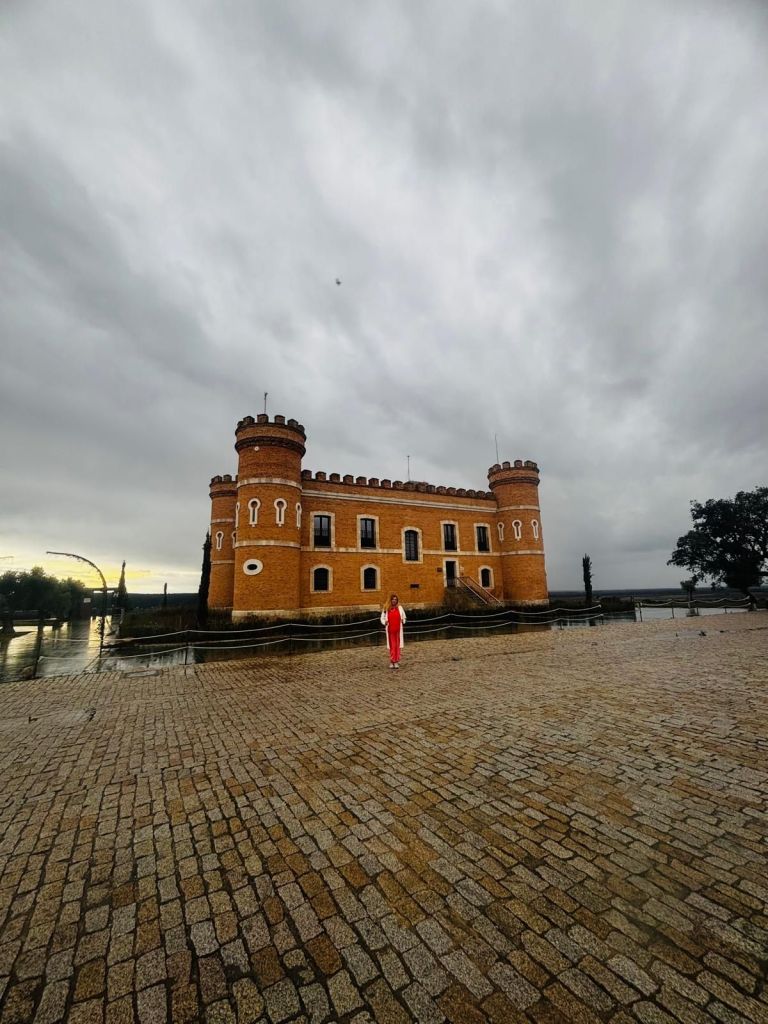
We are staying here on our way from Galicia:
I’m sorely saddened by Galicia, my friends. It offers a striking contrast with the Basque Country, Valencia, the parts of Portugal that are right across the border, and even the frequently upsetting Castilla León. It rains a lot in Galicia, which means that everything is covered in mold and smells like mold. But it also means fertile soils and lush greenery. The inhabitants, however, seem to have given up on maintaining the buildings, the streets, and the establishments in a passable state. Everything is blackened, falling apart, crumbling down, and looking sad and unloved.
This isn’t a failure of municipal or local authorities. The markings on the roads look extremely bright and fresh. The government is doing its job. It’s the people that have stopped trying. The number of extremely drunk people at noon on a Wednesday offers an explanation. We drew by a little town called Xinzo de Limia that has 1/3 of the population in my town back home. There’s nowhere to eat in Xinzo de Limia until 1 pm but there are more open and full bars in two little streets than we have in my entire home town.
There’s nothing like this wholesale devastation even in the most rural areas of the Spanish Basque Country. The French Basque Country is an absolute fairytale with its bright, freshly painted houses and clean, pretty front yards.
The people in Galicia are nice but helpless. The coffee is vastly inferior to everywhere else in Spain, let alone in Portugal. I’m not very knowledgeable about Galicia in particular but now I’m curious as to what is causing such a marked contrast with the rest of the country.
“people in Galicia are nice but helpless”
Haven’t gallegos always been a bunch of sad-sacks? I’m reminded of a former student working in Spain (edge of the Catalan area) who mentioned a Galician co-worker who would speak only to deliver bad news…..
LikeLiked by 1 person
Galician here (I’ve commented in in the blog very occasionally before, so I decided to resurface now that you’re there!). I would say that the reliance on the government here is even more extensive than in other regions of Spain. Why, I wouldn’t know. I have been reading on Galician history recently, and my sense is that the region was screwed up pretty badly by the desamortización, leaving tenants in the hands of disinterested small nobility who cashed up rents and lived in Madrid (hence lots of emigration etc.). But where people got the idea from that the government would be better, I don’t know, since it’s not as if the government at that time cared much either. My sense is also that before the Civil War there was greater community initiative (like mutual aid societies, private benefactors, etc.) but this died down at some point during the Franco regime and never recovered.
But just to give you an example – I live in the UK, and here there’s a culture of giving to charity and volunteering for charitable causes (probably not as much as the US but still quite important). When I share this bit of information with fellow Galicians, they are uniformly horrified: they say that why would you give to these charities if it’s the government’s obligation, and many of them will in fact argue that, by donating to charity, private citizens are encouraging government inaction so such donations should stop. So I wouldn’t be surprised if the people in the towns you’ve visited feel they aren’t getting enough government support to make their town look pretty.
LikeLiked by 1 person
Thank you for explaining, this is really enlightening.
That’s why I like this blog. Always well-informed, smart people come over to help one out.
LikeLike