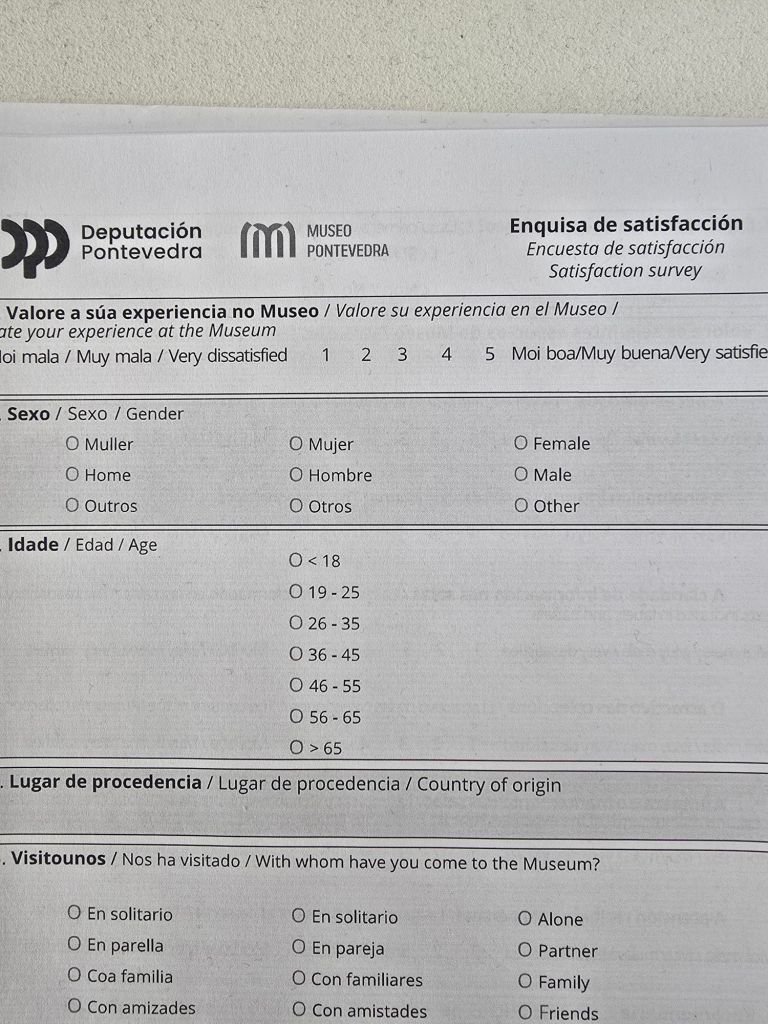
Spotted at a museum in Galicia. The tiresome “other gender” has infected the world, and it will take a while to get cured from it.
Opinions, art, debate
Spotted at a museum in Galicia. The tiresome “other gender” has infected the world, and it will take a while to get cured from it.

 Clarissa's Blog
In English, and presumably Spanish too, we do have a third gender: “it”.
We have three genders in our language, and two sexes in our species.
LikeLiked by 1 person
“Spanish too, we do have a third gender: “it””
English he, she and it are more about sex than gender (though traces of gender remain in English).
he – male
she – female
it – does not apply or unknown (animals or very very small children) but still the tendency in English is to use he and she as soon as the sex is known.
they – unknown or irrelevant (as in generic statements)
Referring to a baby or even a pet as ‘it’ after a person knows the sex is kind of…. unpleasant or rude sounding.
Spanish has strict grammatical gender with only male and female categories and all nouns have to fit into one of those two. Some say there’s a ‘neuter’ but it’s just a variant of the masculine form.
LikeLiked by 2 people
Thanks!
LikeLike
“Referring to a baby or even a pet as ‘it’ after a person knows the sex is kind of…. unpleasant or rude sounding.”
It is now. Read fiction from 1920 or so earlier, such as Nesbit
Two trends collided: early clownworld work to confuse the grammatical and scientific meanings, and the industrialization of education which pulled Latin and Greek from the curriculum.
A third, American mule-headed*ness about being distinctiveness contra the European, is also possible.
*Mules are great. And very American.
LikeLike
Exactly. Spanish is a gendered language, and the attempts to introduce the neutral “todes amiges” or “todxs amigxs” make me veritably rabid. I receive long emails from moron colleagues littered with Xs in search of “the third gender.” Of course, I always delete immediately.
LikeLike