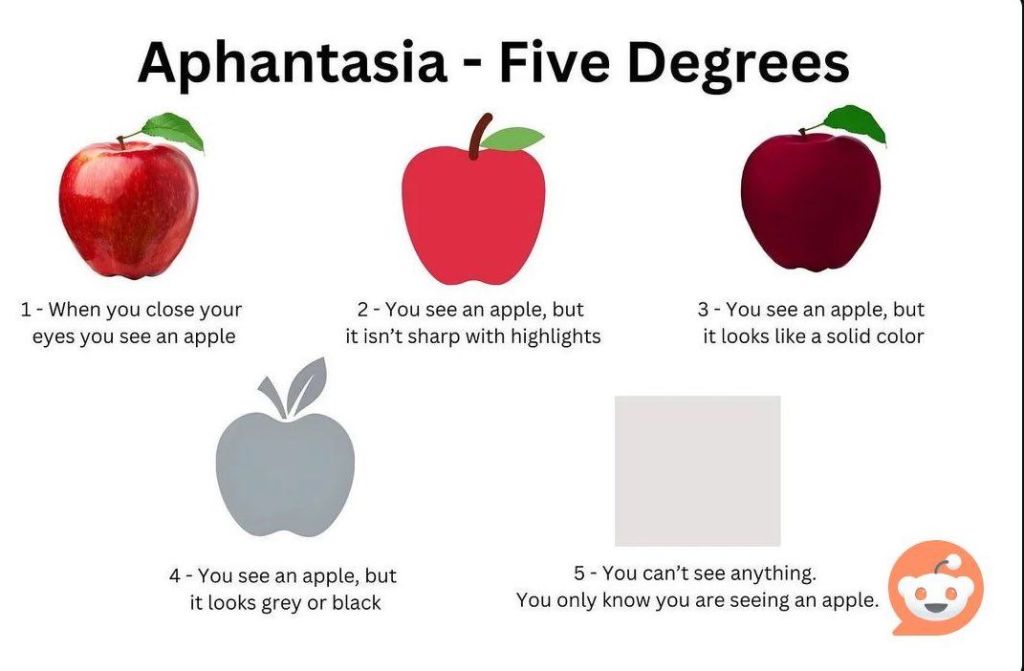
I don’t understand what people mean by “see.” When I close my eyes, I obviously don’t see anything. Because my eyes are closed. The only thing to see with my eyes closed is to fall asleep and have dreams.
Do they mean they can conjure a visual with their imagination? I can, kind of, but it’s not going to be isolated objects and I definitely need my eyes to be open.

 Clarissa's Blog
“don’t understand what people mean by “see.””
It’s called ‘the mind’s eye’…. it’s very, very hard to verbalize but if you think about a person or situation you visualize… not really but kind of…. really.
It’s a bit different from visualization in dreams.
Can you remember what your last apartment in Ukraine looked like? What the views from the windows were?
Do you remember what the supervisor of your phd looked like?
Can you picture what your car looks like?
LikeLiked by 1 person
This experiment brought back lots of memories of the Ukrainian apartments.
I can remember them but the moment I close my eyes, visuals switch off. I’m guessing there are people who are the other way round? And they need to close their eyes to remember?
LikeLike
“the moment I close my eyes, visuals switch off”
So your mind’s eye mostly/only works with your eyes open? Mine works whether or not my eyes are open….
What about dreams? Do you dream in color? Do you experience sensations? Do you ever convince yourself in dreams that you’re not dreaming?
Do you ever wake up from a dream and think ‘that was a weird dream!’ and then wake up again?
LikeLike
I do it better with my eyes open as well. Can do with eyes closed, but it takes effort.
This is because closing my eyes brings into sharp focus all the weird entopic phenomena, and they are distracting because I see them quite literally! Weirdly, in the right state of mind, I can make those assume definite forms, and in hypnogogic states they get very baroque on their own, but they never *look* like anything other than phosphenes–colorful glowy shapes on a black ground. That is not the same as imagination. It’s neurological.
LikeLike
What Cliff said: mental visualization is not like seeing with your eyes. It’s just, when you imagine a thing, how much detail can you imagine it with? Some people are visual thinkers and find it easy to imagine things in great visual detail– and in the case of talented artists, may be able to reproduce that detail in a drawing or painting later, without being able to see the original.
Some people are much more verbal, auditory, or even mechanical/kinetic thinkers, and can imagine things in great detail in *other* ways. Like, apparently being able to “hear” what a text sounds like, without reading it aloud, is a specialized ability not everyone has. I do it automatically, I read all texts, including musical scores, “aloud” in my head. I can imagine what it would sound like, if read aloud, without actually reading it aloud. This is partly acquired: when I first learned to read music for voice, I could not tell what the tune was, without vocalizing it or playing it on an instrument. Now that I’ve had years of practice at it, I can read the tune silently.
My youngest has a keen mental imagination for spatial relationships and mechanical actions– he describes things in great detail and enthusiasm, in terms of what goes where and how it moves in relation to the other bits. His communication would be crippled if he couldn’t use his hands, and the complicated high-speed gesturing any time he tries to explain something is… hilarious, adorable, and at times baffling. He’s trying to express complex things he hasn’t got a vocabulary for yet, and on the verge of inventing, out of whole cloth, a manual sign language for expressing 3D mechanical actions.
It is perplexing that aphantasia as a visual phenomenon gets so much press, when there are so many modes of imagining, and so much variance between people in which ones are expressed, to what degree.
LikeLiked by 3 people