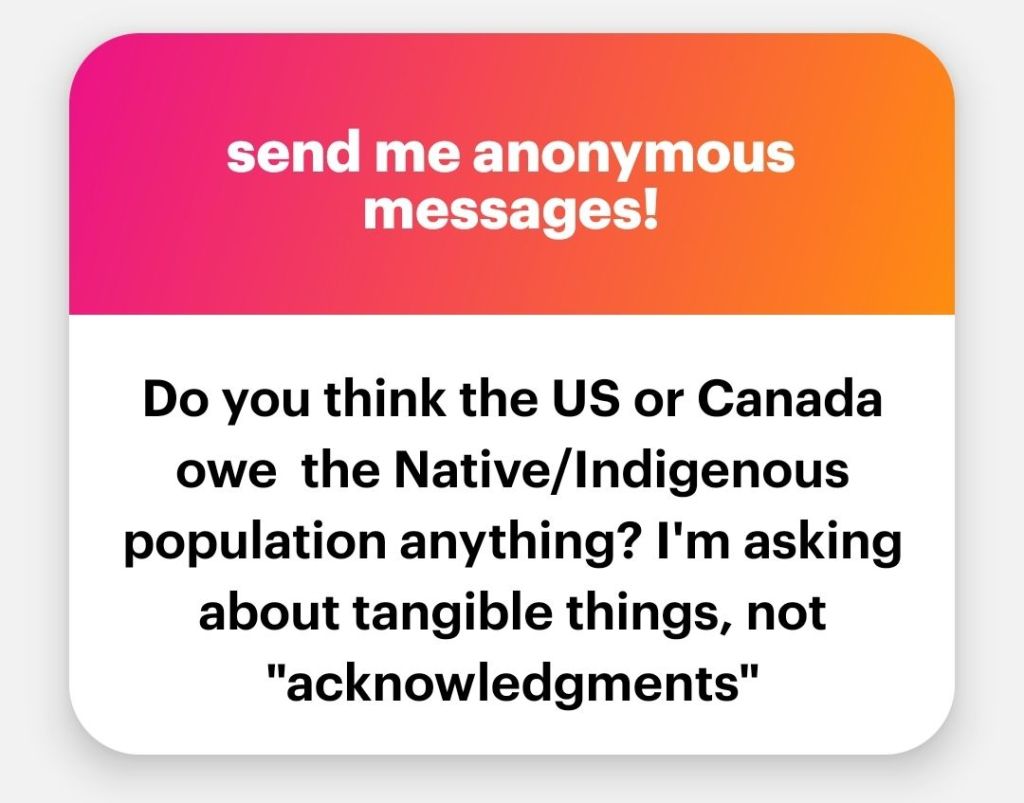
US and Canada have the same obligations to all their citizens and vice versa. It would be bizarre to assign any moral value to groups of citizens based on how their ancestors ended up in the area where the nation-state eventually formed.
So the answer is, if they are citizens and enjoy the rights of citizenship, then that’s it. Nothing else is due.
I’m kind of surprised by the question because it’s hard to imagine an alternative position.

 Clarissa's Blog
“it’s hard to imagine an alternative position“
And that’s precisely the problem. Apparently, the kind of logical reasoning that most reasonable people in Western countries have relied on for at least the last three centuries is deemed to be no longer valid and no longer applicable when it comes to this kind of scenarios involving so-called equity and social justice.
Mind-boggling and preposterous.
LikeLiked by 2 people
…plus whatever is stipulated by the current legal agreements the reservations operate under, which vary by state and tribe. At least in the US, this entails self-governance and semi-autonomy within particular well-defined geographic boundaries. Outside those boundaries, indians have the same rights and responsibilities as any other US citizen.
LikeLiked by 1 person
“current legal agreements the reservations operate under”
There is long-standing precedent for the US government to treat individual tribes as sovereign entities (why we have terms like ‘the Navajo Nation’) and they do have a very…. unique status and I’m okay with that.
Some years ago I was asked by someone to make sense of a TV show (crime procedural) where a crime may have been committed on a reservation and what that meant… I tried to explain some of the particulars but it was a hard slog.
There is also the question of federal recognition which is not a simple matter and some groups have that and some don’t. There have been some shady operators trying to create indigenous groups out of… not very much and some very real groups that don’t have recognition.
LikeLiked by 2 people
Exactly. It’s not quite as simple as “they’re citizens like everybody else”.
Alaskan natives have, I think, more legal sovereignty than most tribes, the result of Alaska being acquired later, and the population there having been evangelized by Russian Orthodox missionaries, which for various reasons put them in a better position to negotiate.
LikeLiked by 1 person
Cliff Arroyo: How do you think about/decide if you are okay with the unique status of individual tribes?
At the present moment, it feels like there are some groups pushing to give tribes more unique status and other groups that would like to take their unique status away. I imagine the specifics of what happens will depend on the situation, but also curious how you think about the topic in general.
LikeLike
OT, but this was the most interesting thing in my newsfeed this morning:
https://alwaysthehorizon.substack.com/p/they-were-lying-about-unemployment
Once they stopped manipulating the numbers, the real unemployment rate, that we were all seeing down here, and that helped elect Trump in spite of the MSM continually repeating “best economy ever” BS: 23%.
For comparison, unemployment during the Great Depression PEAKED at 25.6%.
But sure, we were supposed to believe that consumer confidence was high, economy was great, and vote for more of that. They must’ve been getting high on their own inventory.
LikeLiked by 1 person
“real unemployment rate”
The words “real” and “unemployment rate” need to be defined to have any meaning….
I remember a story in the Polish press some years ago when ‘unemployment’ was a big problem in Poland… It consisted of brief profiles of 100 different ‘unemployed’ people… a large majority of which had jobs. At the time, to be officially ’employed’ you needed a full time job which included social and health insurance payments and a bunch of other stuff. Not longer after that one of my best friends at the time was making well over the national average in terms of take home pay while being officially ‘unemployed’ (there was almost no social safety net then so he wasn’t getting anything from the government).
I agree the Biden economy was doubtless far worse than anything admitted by the MSM…
LikeLiked by 2 people
True.
According to the article, the 23% number was people actively looking for work, but I’m not at all sure the author verified that.
I have not worked in the formal economy for over a decade, but I am not unemployed.
What available metric would be a better gauge of the health of the economy, and wellbeing of the workforce? Percentage of people applying for state medical/food assistance? Household income/rent ratio? Percentage of residents renting vs. buying? I’d love to see all of those plotted together.
The interesting thing about the unemployment numbers is that they kept publishing them, crowing about how great they were, and then months later quietly and without any publicity, going back and saying “whoopsie, we missed a few!” and adjusting the numbers upward.
LikeLike
Delighted, btw, to see that I am leaving just one comment at a time today 🙂
LikeLike
Nature is healing! WP agreed to roll back the update that caused all this.
LikeLike
All that was caused by an *update*??
oi
LikeLike
They routinely do these updates and every single time something gets badly messed up. Why they can’t leave well enough alone is a mystery.
But that’s at the core of the neoliberal mentality. Change is always good. Stability is always bad. Change, change, change.
LikeLiked by 1 person
In the modern software ecosystem, a single software product by necessity depends on many others. The engineers running this product would need to eventually update the code even if no changes visible to the customer are made just to make sure their product can work with the updated versions of other components in the system.
Yes, you can keep using the older versions, but the dominant technology paradigm is everything is in the cloud, live, just-in-time, constantly updated, etc. It is simply not feasible for a company to survive for long and successfully compete with others unless it follows that or is sponsored by a billionaire, I guess.
This, in a nutshell, is why WordPress can’t leave well enough alone. You’re correctly attributing it to the big picture. I suppose I could say that the neoliberal mentality has produced the rot economy we are in.
I’ve logged into wordpress (via a browser on a laptop) and opened your site there, so I don’t get a textbox with all the formatting. Let me try a proper link – rot economy.
If that didn’t work, here’s the url: https://www.wheresyoured.at/the-rot-economy/
LikeLike
Clarissa
Yeah, sometimes you just have to laugh because otherwise you would weep. I have appended numbers to my name because they sometimes lose it and then refuse my password because somebody already has that password ;-D
LikeLike
I can answer this one, it is right up my alley.
Ok, so first off the question that was asked is not coming from good faith. It presupposes that the United States illegally claimed or stole the land, note the wording. “owe the Native/Indigenous population anything?”
This was not actually the case. The thing that most people fail to consider is that the concept of money was foreign in the Americas at that time. Instead the natives bartered for goods, land, women, slaves, etc. Just like was done in Europe till currency was created, same as Africa and Asia.
The second thing most people fail to consider is that while most people think of Indians as a singular group, or maybe a handful of tribes, but still as a singular mass. This was not the case. Instead there was hundreds to thousands, or more depending on how close you wanted to look. Of independent, or semi independent, mostly nomadic tribes roaming around taking and losing territory continuously.
These tribes were not one people, nor were they allied. Yes some had long term allies, some short term, some they were hostile to and others neutral too. However what they were was (Independent, as in not one nation.) This is a major sticking point, because a colony could negotiate in good faith with one local tribe, but then if a tribe from another area came in. They did not have peace treaties with them.
Now for the 3rd misconception. Free will. The colonists were accused of getting the Indians drunk on firewater (alcohol) during negotiations. This accusation is both true and at the same time unfair. It was not uncommon to have alcohol when making deals. It is also true that the Indians have a weakness to it, something that is still true to this day. (Note : I do not mean they get drunk. Everyone gets drunk. I mean they get drunk harder and faster than most races.)
I bring up Free Will, because no one forced the Indians to drink. They could choose not to. In today’s world, it is quite likely the drinks would be removed to remove the temptation, but the 1500s onward were not the 2000s. And as one is taught when learning history. One of the worst mistakes one can make, is to look a historical situation through the viewpoint of today. And at that point and time, having drinks there was seen as normal.
Now to the heart of the issue. I have brought all that up to address this. The European colonies were dealing with hundreds of tribes. Some they purchased land from. Some were raiders who took scalps and slaves. Some just traded for items they wanted but couldn’t produce, and left to go trade elsewhere. The Europeans however purchased land via trades and settled there. They also claimed land by killing or running out the tribes who were raiding them. Then there was war. There were several minor wars with the various Indian tribes. When they lost, they were run out of the land, and settlers sent in to settle them. If the colonists had lost they likely would have been massacred outright those who weren’t taken as slaves or managed to flee.
I am not a hypocrite, so I do have to acknowledge that there were reports at the time of settlers who were slipping past the borders into Indian lands. Sometimes they survived, sometimes they died. Either way they were idiots.
I can’t remember if this was during the French and Indian war, or before it. However there was one big event that very likely settled into the minds of the colonists that the Indians needed to go. I believe it was Pennsylvania, but I don’t remember for sure. Decided to do something utterly moronic. As a gesture to maintain the peace they gave their weapons to the strongest local Indian tribe.
That tribe later turned on them with their own guns. Note this was not a we will trade you guns, but we have guns too. No this was a we will voluntarily disarm and give you the guns and in exchange we have peace and you protect us.
The other colonies militia stopped the assault before it could go to far, but the fact that it happened at all was likely enough to get everyone on the same page. The savages needed to go. They could not be trusted, and if you tried to make peace they would scalp you.
The French and Indian war did not help. While some Indians fought for the British/Colonists, most fought on the side of the French, thus the name.
After the Revolutionary war, the States were still dealing with the various tribes. You see before President Washington, even thought the new states were colonies under Britain, they were semi independent in that each colony had its own treaties and wars with each Indian tribe. So for instance Georgia could be at war with the Creek, but Carolina could be neutral to the Creek.
President Washington decided to change that. He declared that any negotiations with the Indian Tribes would have to be with the new Federal government. Naturally no one was happy with this. Except it got worse. New forts were assembled up and down the frontier. These forts were supposed to keep the peace between the states and the tribes, and anyone could go to them for shelter to keep from being killed.
I can’t speak for the rest, but I can tell you the governor of Georgia came very close from declaring war against the newly created United States. There are records of raiding parties of Indians darting into Georgia and after being thrown back actually darting into the Federal fort and the federal troops refusing to give them up to Georgia Militia to be hung.
I’ll freely admit I don’t know much about the next few decades relations and negotiations. I do know that President Andrew Jackson had enough. He grew up in this era and decided to end it once and for all. He dispatched military personnel to round up all the remaining Indian tribes and drive them across the continent.
Naturally this didn’t magically fix everything. A lot of tribes continued to raid until they were put down. Those old Cowboy and Indian tales from the 1800s, those were real. The dangers of Indians attacking settlers heading to California was real. The Union sent military forces and built forts all over the West to deal with this threat because it was so prevalent.
Eventually they ran out of bodies, tribes, and space and were granted a deal. In exchange for not wiping them off the face of the planet, lands would be designated Reservations that would be theirs to rule over as they pleased. And in exchange there as to be no more raiding.
As all history is, there was no black and white. No good or bad. Both sides did good, both sides did bad. The difference is one side won and decided to let the other live. Extremely restricted, but alive, and retaining their independence.
Something else to take from this. There was a reason the word savage was used. Not noble savage, but savage. The Indians we know today are not the Indians of the past. Again not all of them acted savage, but enough did that it was seen as normal behavior.
Lastly to answer the original question. No the US does not owe them anything. The smallest potential claim died out when they were allowed not only to live, but granted territory that was theirs that they could rule as they wished. I highly suspect a large number of people of the time were very angry that the Indians had not been completely wiped out.
Even if one could successfully prove that despite being enemies the US owed them something. It would have been to those who had long sensed died. Not to however many generations later. By that logic Norway, Sweden, and Denmark owe most of Europe for their ancestors raiding it. Its foolishness at best, at thievery wrapped in pretty words at worst.
LikeLiked by 2 people
“These tribes were not one people, nor were they allied”
People also forget about differential development. All across the continent there were small scattered groups of foragers with minimal technology but also some groups that had developed a lot more, including proto-states like the Creek Confederacy (or other members of the Five Civilized Tribes that readily adopted European technology and/or social mores….. including slavery).
Even today, the idea of “American Indian” is mostly addressed to outsiders while most Native Americans primarily identify with their own group.
LikeLiked by 1 person
Thank you for this brilliant essay. I knew almost none of this and I’m grateful for the patient, detailed explanation.
LikeLike
“Ok, so first off the question that was asked is not coming from good faith. It presupposes that the United States illegally claimed or stole the land, note the wording. “owe the Native/Indigenous population anything?””
Well, land acknowledgements are pretty commonplace in North American universities these days. How could a student from a non-western country who is well-meaning, curious, but ignorant (and studying something like physics) phrase a good-faith question?
LikeLike
That is fair. …. I’ll be honest with you. I’m not sure. Typically when this question is asked in the US it is almost always asked in bad faith or from someone who either doesn’t know their own history, or is trying to use this as a gotcha question in yet another attempt at “colonists bad, this is why the US sucks.”
I really hate what I’m about to say next. Seriously hate it. It might be worth prefacing the question with something like, “I’m generally curious about….”
or something like, “I’m not from the West and am hoping someone can answer this for me.”
Like I said I really hate having to put stuff like that in, but things have gotten to the point where one almost has to put stuff like that in to prove its a genuine question.
Sorry I don’t have a better answer for you.
LikeLike
As we discovered later, the question about US and Canada natives was actually a lead up to some really inane analogy about Palestinians. It’s almost certain the question was asked by our resident “but do Palestinians have the right” lady.
LikeLike
Clarissa
My reply was an unromantic history of one group on the Canadian plains as the buffalo were extirpated, by the growing need for hides in the USA, and by the Metis pemmican industry in Canada. The Metis are currently desperately trying to get on the aboriginal gravy train, they were largely the offspring of various Cree sub tribes and French fur traders.
The other group were Blackfeet/Dene and Scottish fur traders. They not only fought over control of the fur trade but also over the two rebellions, however, both took scrip. The Scots may perhaps have taken their family responsibilties, at least education wise, more seriously.
LikeLike
Hi W, it is sad that that’s what it comes to. A lot of people don’t know their own history, through some combination of lack of curiosity and not being taught. It’s shameful, yes, but even if one is not a complete foreigner, how does one go about learning or even finding reliable sources? I grew up in an ex-soviet family in California in the 1990s and the only version of history I was ever taught in school was “colonists bad, Indians good because they were kind to nature”, which I think was part of some environmentalist/conservationist agenda at the time. I was a curious student and got good grades in history class, but I did not specialize in history after high school, and sometimes feel like I know less than nothing about the history of my country.
LikeLiked by 1 person
I really wish there was a good answer to this. There really isn’t one, but I’ll try to answer as best I can on this. Providing 2 completely different examples.
For the early days American history, I got lucky. I originally wanted to be a history teacher, which while it didn’t work out in the end, I managed to get taught by some of the last history professors in my college who were actually worth being called a professor.
Both the high-school and local college I went to first didn’t actually cover anything in depth, and early American history was more or less skipped over, or reduced to a bunch of names and dates.
In college, the first professor I had who was worth mentioning, started by telling us never to look at history with the viewpoint of today. If you were going to study history you needed to read and think like people would at the time. Their values and viewpoints are not our and ours are not theirs. So if we try to judge them based on our standards and morals today, it never ends well.
The other professor I had, was at my capstone project. It was unfortunate, but his wife was dying from cancer at the time, so he was kind of checked out, which was understandable. So my capstone project wasn’t reigned in like it probably should have been. (It was a history of a fort, one of those federal border forts I had mentioned earlier.) There wasn’t much left by that point, so it required a lot more digging and there was less to present than if I had been redirected to something else.
In that capstone project, I had to read an annoying amount of primary and secondary sources, including going to the Georgia Archives to pull from the primary source materials from the time. One of those was a record book? I don’t recall the actual name of it, but in it they recorded everything notable that happened in a nearby town. Including if I recall correctly the fort being set up and the trouble they had with the Indians raiding the area and vanishing into said border fort for safety from the local militia. (The garrison were Federal Troops, at the time each state view itself as its own country, so the Federal garrison and Ga militia were not exactly friendly with each other.)
During my time there, the history department wasn’t very large, so you really had to take what you could find, and even that was reduced because several of the professors were either concentrated in specific areas or were really obvious with their viewpoints and biases. For example of the former, one professor mostly taught a mix of Russian history and Russian Literature which was mislabeled as a history class which he forgot to mention until it was to late to change. Seriously he never taught anything outside of Eastern Europe and Russia.
The good professors I had were mostly concentrated on early American history, so that is what I learned. Their classes typically, (from what I recall,) used a mix of a main text book, and generally 5 or more primary or secondary materials. Sorry I can’t be more clear on this, it was a long time ago, and I have long sense forgotten the names.
Typically what I have found is that primary sources are annoying and definitely biased as they are typically journals or records from towns, but most of the events did in fact take place. The textbooks, generally shows more of the specifics, but you have to be careful of them, especially more modern ones from the 1960s forward as more and more anti American bias got mixed in.
The 2nd example comes from Nazi era Germany. This was is an interesting one to be sure, as it shows how one sided a view point can get. A few years ago a question popped into my head. What books did the Nazi’s burn. I mean we are told all the time how horrible they were burning books right? But no one actually states what books they burned outside of a couple of throw away “Jewish Books” statements.
So I started looking into it, and I found out that the Wiemar Republic was absolutely filled with trannies, lgbtq, prostitution, corruption, decay, inflation, bad policies, communism, and on and on and on. Berlin itself was seen as a hotbed of all of it, and there were entire streets where one could find any form of prostitution or degeneracy one wanted to look for.
It was even infecting the schools. I found out that the book burnings weren’t actually started by the Nazis. They were started by the schoolkids. I read translations of the speech that was given before the first books were put to the flames and I can’t say I disagreed with them. It basically boiled down to we are hear to learn and this filth has no place in schools, nor will we tolerate this any longer. The Nazis joined in and pushed this countrywide when they saw how much people supported the burning the those books. Granted they already supported getting rid of them so it was a small step, but they didn’t actually start it, they just helped spread it.
From there I started wondering what else I was misinformed about in Nazi Germany. After all really all we are ever taught is they were pure evil and murdered millions, started wars, and most important of all. Never look into their history unless you want to be arrested. (That would be Austria and Germany by the way.)
Thankfully the 2020s were not the 1970s so there were copies and translations of primary and secondary sources from inside Germany in the late 1920s and the 1930s. From there I ran into video lectures from an excellent historian. I understand a lot of people don’t particularly like David Irving, however even his enemies were forced to state publicly he was one of if not the most knowledgeable historian on WWII and pre-WWII Germany, and the surviving videos of his lectures are well worth a few hours of your time.
The point I’m trying to make is that while it should be easy to understand or know history its really not. Part of this is because people typically prefer short concise 15 words or less snapshots of the past. Part of it is because like with the WWII stuff in the 1970s at the time a lot of people were still alive and in power who would be highly embarrassed if some stuff that happened came out. And part is that there is always propaganda to make your enemies look bad and sometimes that isn’t removed when it should be.
So like I stated earlier there really isn’t a good or simple answer. Sometimes you can find quick ways like David Irving’s or those few college professors who whether you like them or not have studied the primary sources for years or decades and can do a good job or distilling it for anyone willing to listen. Sometimes you have to do the reading and digging yourself in the archives.
Again sorry there isn’t really a good answer for you, but I hope it does encourage you to dig around a bit as typically what’s taught generally isn’t everything that happened and rarely shows the way things happened the way they did.
LikeLiked by 1 person
Looking back at this, it clearly shows how distracted I was. I generally try to clean up my error from my comments before posting them, but we had an almost endless flood of clients walking in or calling yesterday morning when I was trying to write this, and it shows where I kept having to stop and restart.
LikeLiked by 1 person
Clarissa, you have the best readers!
LikeLiked by 1 person
That’s very true. We have an oasis in a sea of lunacy here. I’m glad people are back to being able to comment.
LikeLike
It is also complex in Canada: a mixture of agreement and treaties between the British and Canadian governments. And just to totally bugger it all up, Charles II had previously given all the land west and north of the lakehead as Rupert’s Land as a charter to the Hudson’s Bay Corporation; which Canada then purchased for $1.5 million in 1869.
Whereupon the mixed race Metis decided they really owned everything, murdered a few Scot pioneers, then an Orangeman, and were bought out with script. They took the money then set up a new village further west and tried the same horseshit; murdering some NWMP and HBC traders, and ambushing militia misled by British officers. Finally the militia ignored orders, charged Batoche and ended that particular wetdream. But the buffalo were gone, the Indians were starving and missionaries and the NWMP said do something quick or we will have another race war, so Canada issued some numbered treaties.
And I am sure everybody can imagine what overly compassionate academics and justices can do with that ;-D
LikeLike