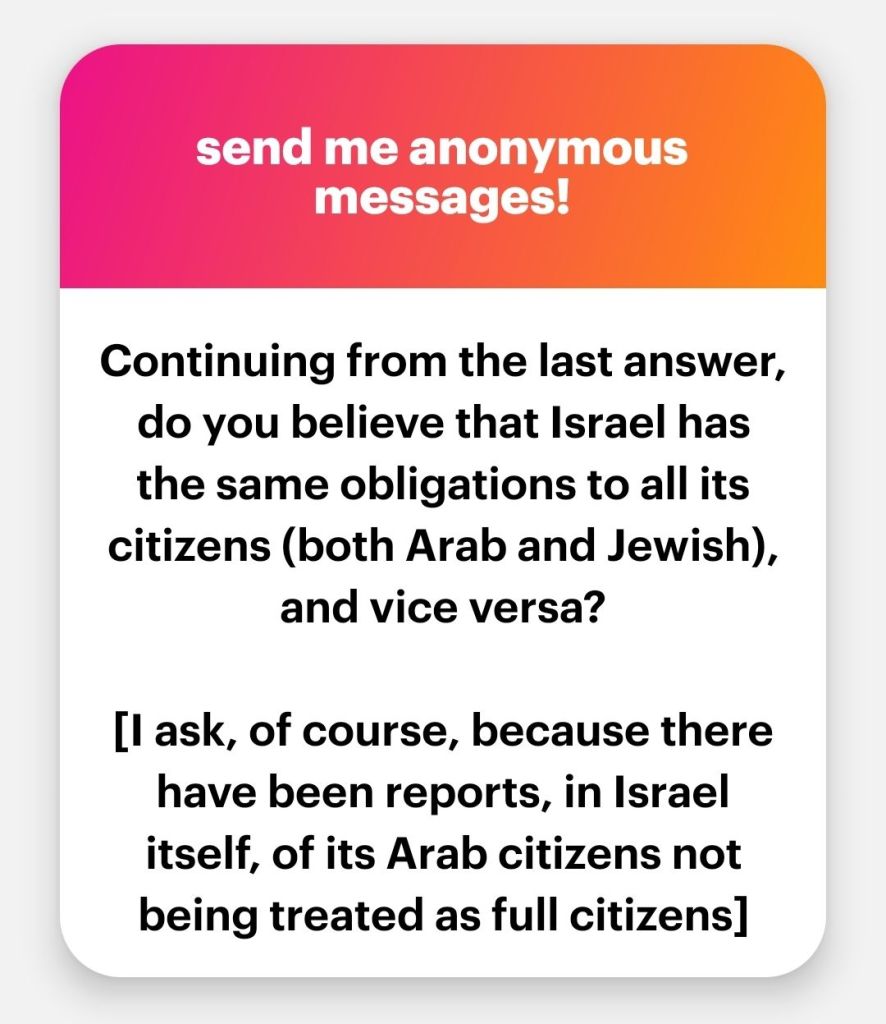
I recognize that I have not read the constitution of Israel. Or whatever foundational document they have. I don’t even know whether there is a constitution or what stands in its place. I became a citizen of Canada and then of the US, so obviously I had to get very familiar with the Charter and the US Constitution. Another country whose constitution I know almost by heart is Spain. And I know the history of all Spanish constitutions, how they were created, argued, destroyed, etc. All the other foundational documents of other countries are a mystery to me.
For instance, I wouldn’t be able to say what Germany or Poland have. I’m sure there’s a document but I never laid my eyes on it. In what concerns Israel, a reader shared that they even have a different system of legal rights for illegitimate children. I had no idea about that. So I wouldn’t venture to make any guesses about any documents I haven’t studied.

 Clarissa's Blog
Ok, I’ll preface this by saying the same thing as Clarissa in that I have not read the foundational documents of Israel, so I could be wrong in my opinion, also that the following is just my opinion. (And what horrible times we live in that we actually have to preface things with legal speak before giving an opinion.)
I tend to split this up into multiple parts as things tend not to be a singular issue, but rather complex ones that are woven from multiple times and actions in the past.
Current Day, Specifically current borders of Israel, including the Gaza Strip. In current day I think that a government is obligated to give the same rights to all its citizens, unless they are specifically excluded in the founding documents. I don’t think the Arab ones were in this case so they are or should be afforded the same. Now that being said, I think Israel has for the most part done a decent job about this, but I think we are being shown a false picture in the media about Israeli oppression of the Arabs.
1967 – End of the Six Days War, Borders expanded to include Gaza Strip. At this point in time, the Israeli government had obligations and a choice. They had obligations to all citizens inside their territory, (Not including the recently annexed territory.) The choice was what rights if any to give those in the land recently claimed. They were not Israeli people, and the Israeli government would have been completely in their right to exile all those living in the territory.
I do not know for sure, but judging by events in the present I believe they allowed the Arabs in the area to stay. I don’t know if they gave them citizenship or not. If they did then from the moment they did so they count as citizens and the government has obligations to them as they do to all their citizens. If they did not give them citizenship, then the government does not have obligations to them and should have cleared things up by either exiling them or granting citizenship. Failure to do either would be a failure of government.
1948 – Provisional Government of Israel and the claiming of the State of Israel. This one is much more complicated. Both sides present two diametrically different arguments about the land. On the one hand Israel says the land was a wasteland, few if anyone living on it, and they brought it back to life. The Arabs state they were living on it and run off.
I am inclined to believe Israel on this. I recall seeing some pictures of the region and it looked, bleak. Also major cities tend to stay major cities once established, even if they are raided and or burnt. So Jerusalem and the surrounding regions should have been a thriving metropolis and therefore outnumbered the Jews two or three thousand to one. Again I don’t know for sure, but I am inclined to believe Israel.
Either way, once they took charge of the area, the newly established government would have been offered the same choice as it was offered later in 1967. Grant citizenship to any Arabs in the land or exile them. They seemed to have allowed them to stay, so it is likely they gave them citizenship and all the rights and duties that come along with it.
Now for the part that people probably don’t want to hear.
70 AD – Siege of Jerusalem. At this point in time the land of Israel while under Roman control was in fact Israeli.
I believe there were records from other ancient civilizations about battles with Israeli forces, but I don’t particularly care to go searching for them at the moment.
Lastly we have Biblical records. The Bible is an interesting book. It is called the living word for a reason, but it is also a historical record. It records the timeline of mankind, when we first came about, where we settled, and gives a genealogy running from Adam to Jesus.
This is important for several reasons, first and while not pertinent to this particular question, does raise understanding of the originality of the troubles between the Jews and the Arabs. However what it does for this question, is that it answers the question of why Israel is so tied to this land in particular.
The short answer is that it was granted to them by God. Also the land they were granted is a fair sized bigger than what they own at the moment, so at some point that will change. God declared this land was theirs in perpetuity. Now that being said, when Israel turns away from him, the bible records shows that he is perfectly willing to allow foreign nations to occupy the land as object lessons, typically when they turn from him to false idols. Considering that when Jesus was there most of Israel turned away from him, yea losing the land for 2,000 years is completely understandable.
Going back to the actual question though, it depends on if the Arabs are considered citizens first, and also what the laws state about non Jews in Israel. For example in Islamic territory, by their own law, anyone who is not Islamic has to pay a special tax or they can be run out of the territory. So its really comes down to two questions. Are the Arabs being asked about citizens, and second what do the actual laws of Israel state about the rights and obligations of non Jews.
LikeLike
“wouldn’t be able to say what Germany or Poland have”
Of course there are also very big cultural/legal system differences regarding the meaning of constitutions….
(Gross simplifications follow).
The US Constitution is treated (metaphorically) as a Revealed Holy Text that requires exhaustive and repeated interpretation to understand fully… and is about 6 pages long. Countries whose legal systems are based on Common Law and Precedence don’t need long documents, just a statement of basic principles, the particular meaning of which is worked out in practice.
Poland (like almost all of Europe) uses Civil Law which means a lot has to be spelled out. The Polish Constitution is something like 10 times the length (at least) of the US Constitution and is completely irrelevant to most people most of the time. The constitution is simultaneously a declaration of principles and a reference for judges telling them how to rule in particular cases.
I have no idea what kind of system Israel uses…. but it would be an interesting to know of someone wants to enlighten us.
LikeLiked by 1 person
Israel doesn’t have a constitution. It has Declaration of Independence, which is very short and can be read in 3 minutes at this link. Among other things, it states the goal of Israel: “solving the problem of [the Jewish people‘s] homelessness by re-establishing in Eretz-Israel the Jewish State, which would open the gates of the homeland wide to every Jew and confer upon the Jewish people the status of a fully privileged member of the comity of nations.”
Instead of constitution, Israel has 14 Basic Laws, “quasi-constitutional laws … some of which can only be changed by a supermajority vote in the Knesset … dealing with government arrangements and with human rights.” Again, this wiki article is very short and informative.
I will mention three most important imo Basic Laws:
LikeLiked by 1 person
Arab Israeli citizens are treated as full citizens in ALL areas of civilian life: they have the right to vote in all elections, they may serve – and do – as members of the Knesset, the police, government and the judiciary, including on Israel’s Supreme Court.
There is only ONE area in which Israel’s Arab citizens enjoy positive discrimination: they are legally exempted from serving in the army (IDF), unlike EVERY other Jewish citizen, male or female.
They may serve though, if they so wish, as an increasing number of them are doing, especially after October 7, when they saw that their Palestinian “brothers” had no respect for any human being in Israel, be they Jewish, Christian Arab or Moslem, or Thai or Filipino.
LikeLike
Why nobody wants Palestinians:
(Via)
LikeLike
Few outsiders understand just how catastrophic African and Muslim “immigration” to Europe has been and is… especially for native women.
https://x.com/jonatanpallesen/status/1890191743544619050
LikeLike