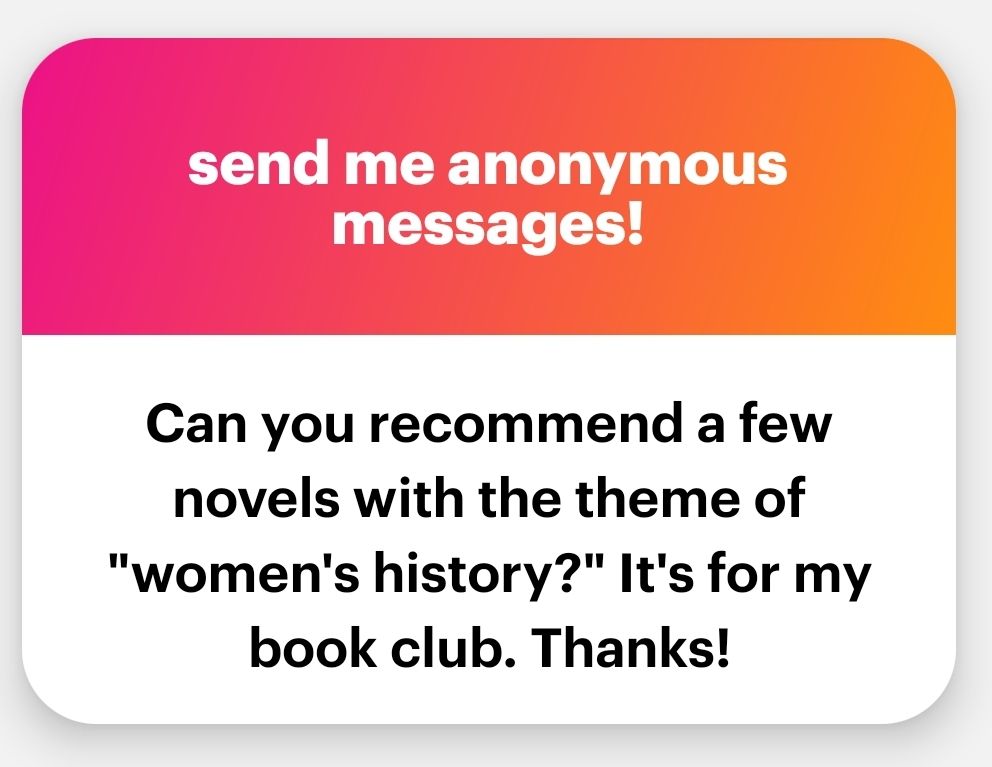
I’m not entirely sure what women’s history means. Is it historical novel with female characters? I don’t read much of that but if you are liberally disposed, you could go with The Time In Between by Maria Dueñas. I think it’s available on Kindle Unlimited.
The reason why I don’t read historical fiction is because authors invariably populate history with 21st-century characters who couldn’t have possibly existed in the past, and I don’t understand the point of this exercise. These writers fill the past with girl-bossing women and feminist men, and it’s all kind of embarrassing. But if people have recommendations, please share in the comments.

 Clarissa's Blog
Women’s history is men’s history, and men’s history is women’s history. I don’t really understand why people keep saying things like that. Of course we can talk about women, men, children, families and all sorts of themes, but they are never isolated. Everything is linked with everything.
LikeLiked by 1 person
I’d give better recommendations if people asked for gay history.
Giovanni’s Room for those who are literary minded. No Night Is Too Long and The Chimney Sweeper’s Boy by Ruth Rendell who want a good time. These are high-quality books that I loved.
I can also recommend more literary and hardcore gay literature. There’s a lot of phenomenal stuff about gay history.
LikeLike
I’m listening. I’ve read Giovanni’s Room but not the Rendell stuff
LikeLiked by 1 person
“…and it’s all kind of embarrassing.”
LOL, c’mon, you have to know that most guys would envisage projectile vomitting ;-D
LikeLiked by 1 person
Yes, it’s a genre that sums specifically at women. It’s supposed to be “empowering”, another word I despise.
LikeLiked by 1 person
Probably the last FOUR historical novels I’ve read with a female protagonist: they are all exceedingly well-versed in contraceptive methods available in their time. Complete with credibility-stretching backstory on how they acquired this intel.
What are the odds?
I mean, I’m sure hookers knew some of that stuff, but… *every female person over age 16, regardless of class and education?*
I get to this part in the book and keep… sigh. Again. This stupid thing.
LikeLiked by 1 person
Every single time. They talk like Zoomers, act like Zoomers, and one can imagine them pouting on Insta but not inhabiting any historical period before 15 minutes ago.
LikeLiked by 1 person
This is also why I tend not to like historical fiction. There are exceptions, but far and few between.
LikeLiked by 1 person
Vanity Fair by William Makepeace Thackery. Historical fiction, by a Victorian, about a woman, Becky Sharpe, set in the Napoleonic Era.
Excellent read.
LikeLiked by 1 person
Great idea. That’s a wonderful novel.
LikeLike
More to the sort of book they’re looking for, give them Amelia Peabody’s adventure by Elizabeth Peters: The Crocodile on the Sandbank. The Victorian era had some truly unusual British women, and Miss Peabody is one of them. Miss Peters, aka Barbara Michaels does her research, so Miss Peabody is unusual for her era in the way usual for it.
It’s also a vastly amusing romp, and a romance, if the ladies just want a bit of fun with their wine & cheese nibblies.
LikeLiked by 1 person
Desiree by Annemarie Selinko.
Madame Curie by Eve Curie – this one is not a novel, but a very well written biography of Marie Curie by her daughter, flows like a novel.
LikeLike