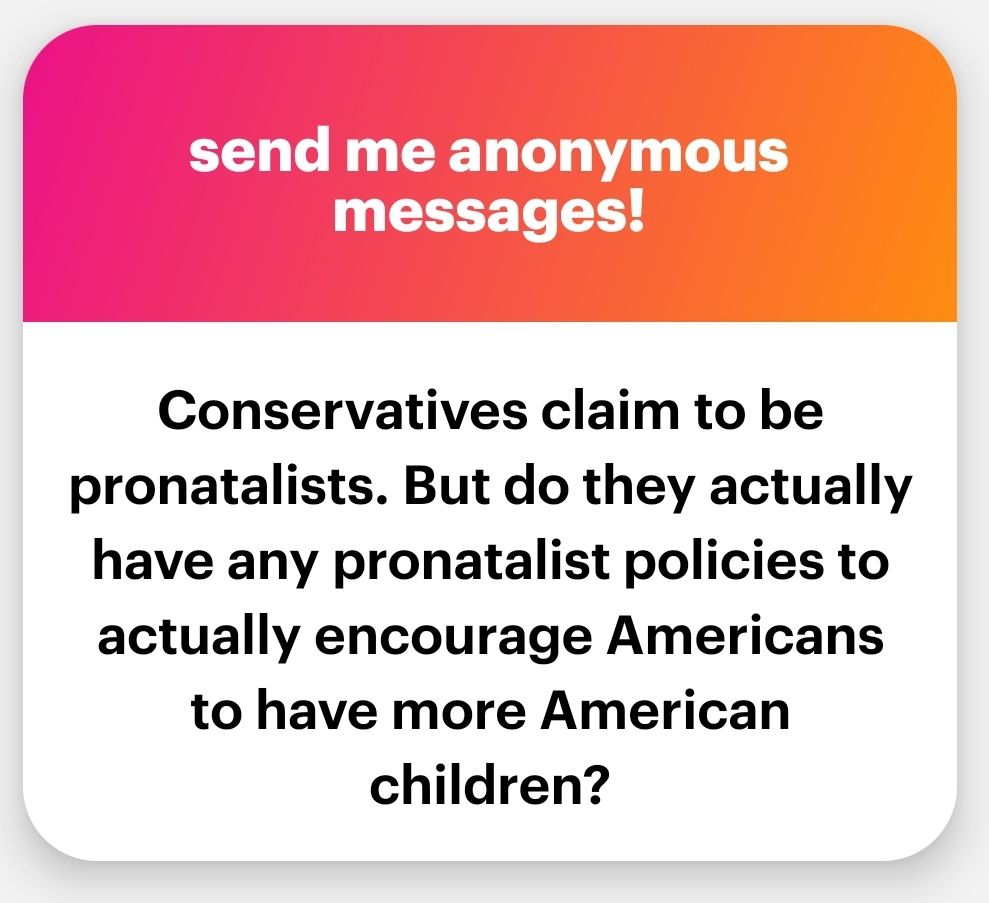
The problem is, nobody has those policies because they don’t exist. Africa is experiencing a population boom and Finland isn’t. That tells you all you need to know about the connection between policy and population growth. There’s policy to stop people from reproducing but no policy in reverse.
I have a friend from Benin who grew up with 11 siblings in a dirt-floor hut in Africa. Now she’s an American mother, and she says that she’s a mother in a completely different way than her own mom in Africa was. Her children are children in a completely different way. Our subjectivity is different in the West. We experience ourselves in the world in a radically different way. We are not a Fordist model of conveyor belt production of children. We are the artisanal model. The only way to go back to the subjectivity we left behind 200 years ago is through a cataclysm of extinction-level proportions. Obviously, we don’t want that. But what’s the problem, anyway? Why should we pursue quantity over quality at this point? Yes, it’s a good thing for people to have children. It’s normal and happy-making. But why does it need to be 10 children and not 2 or 3? Look at Elon Musk with his 14 kids that have to beg on social media for his attention. How is that better than having a real father, who’s there to play baseball with you, take you to the arcade, and make cringey but endearing Dad jokes? What is the purpose, to crunch out numbers or have an experience that brings together two different subjectivities (the parent’s and the child’s) in the most fulfilling, deep, pleasurable and enlightening manner possible? I know without a shadow of a doubt that N, for example, is enormously happier in his fatherhood than Musk because he has time and energy to build a nuanced, profound relationship with his child. Any man (but obviously almost no woman) can father a crowd of children all over the place and never care that they exist. But for what purpose? Yes, yes, I mean a man with money but you’ll notice that it’s usually the men with money who treat their fatherhood much more carefully than lazy layabouts.
So my conservative advice is let’s have children and concentrate on being good, attentive, loving parents to them. Or good, attentive, loving aunts and uncles if we don’t have kids of our own.

 Clarissa's Blog
But, if they’re serious, lots of people want to have more children, but are actively deterred by the horrific choice we give mothers of infants and preschoolers: leave them all week to be raised by strangers while you work, or stay home and be desperately isolated and overwhelmed all week, being the sole entertainment and support of high-maintenance small people.
Like, yeah, it’s God’s work. But in most cultures for most of history you’d have to be an absolutely epic arsehole to everybody you know, in order to be stuck doing that *alone*.
A great deal of what our culture considers normal– moving away from relatives for better jobs, not being part of a church, sneering at intelligent women who choose to raise kids over advancing a career, making housing unaffordable for families with kids living on a single income (for the benefit of boomers who already own theirs), vehicle restraint laws, car culture, safety culture, lax law enforcement in dense cities, urban desertification caused by failing to regulate road frontage– all of these things make having more than 2 or 3 kids unreasonably difficult, and all of them, to some extent or other, are amenable to change.
I see very few proposals, even among supposed pro-natalists, for anything resembling positive change in any of those sectors. It’s all maternity leave, free daycare, and tax bonuses, as if money were the main thing. What the hell good is that if you’re living 800 miles away from any family that might help, you don’t have any close community that might act like family, and it takes half an hour to load up your kids and all your kit to go to a park for 45 minutes before you have to pack it in and go home again because it’s naptime?
Meanwhile, my Catholic friends back in VN are still having four, five kids while materially much poorer. Not one of them owns a stroller, or a huge plastic car seat, or even a baby swing (they have a hammock, propped open with a palm stick). Most of them don’t bother with diapers– they just empty little kids into the nearest shrubbery while out, and they run around in cotton shorts at home. An accident on grandma’s tile floor is a 3-second cleanup, not 8 minutes, a fold-out changing pad, six wet wipes, a waterproof bag for the soiled diaper, a replacement diaper, and then pack it all back into your rucksack. They load the whole family onto the scoot or motorbike to go places too far to walk, and there’s a constant stream of inlaws, aunties, cousins, and neighbors in and out of the house, all of whom are prone to helping with the baby, sweeping floors, preparing food– all the stuff they do at home. It’s not really a case of more children = less attention, it’s that the attention is divided up among more people. Nobody packs a diaper bag to go out: where are you going? The moon? Auntie’s house has drinks and food same as yours. It’s just easier.
None of that is feasible in the US. We’re too rich and too independent. We like those things, but it might be helpful now and then to acknowledge the downsides.
LikeLiked by 1 person
“But, if they’re serious, lots of people want to have more children, but are actively deterred by the horrific choice we give mothers of infants and preschoolers: leave them all week to be raised by strangers while you work, or stay home and be desperately isolated and overwhelmed all week, being the sole entertainment and support of high-maintenance small people.”
Agree. There are people who would like to have children, but are smart enough to know they don’t have the resources to raise a child. May not totally reverse population decline, but could stem it somewhat, make it more manageable.
LikeLike
I really do think, if the “OMG population decline” people are serious, the gains are not in convincing more people to have kids: some people know they’d be lousy parents and they shouldn’t feel bad about opting out. But there are plenty of people out there with one or two kids, who’d totally go for more if their mental/emotional resources hadn’t been completely overwhelmed by the few kids they already had. I’ve polled it informally, and the responses I got from mothers divided up into two buckets:
I’d say, if you want to have a lot of grandkids, the winning formula is, have kids when you’re young and encourage your kids to do likewise so you are still spry enough to help out with grandkids, maintain a good relationship with your offspring, try to live close to them, and help (financial and practical-household help especially) all you can when they do have kids.
I honestly think the lack of family/community support is a huge, unexamined factor in postpartum depression. Bad enough that hormones are going bonkers. Spending all week alone at home with young kids *while* your hormones are going bonkers, for months, and you have no reality-check backstop in the form of other sane adult people around? The only surprising thing is that PPD isn’t far more common.
LikeLike
I’m not actually sure there are any pro-natalists policies that can be made. You shouldn’t go about forcing people to have children, that’s asking for disaster, and there are very good reasons why so few people are getting married and or having kids today.
That being said there are a few things that could be done that might help. To start the no fault divorce laws can be removed. Simply by doing this, it would likely increase the number of families. I’ve lost count of the number of men who refuse to have anything to do with women because of that one law. Simply removing it would likely increase the number of families, thus the number of kids.
You could also ban The Pill, as well as making abortion outside of the mother will die without it, a jail-able offense at the same level as murder. The removal of these two would first increase the number of kids as something like 50mil kids are murdered a year. Second The Pill very likely is doing unseen damage to women. Frankly it is something I have called to be banned for years. Think about it. You are ingesting a drug that is specifically designed to stop you from giving birth. That cannot be doing anything good to you.
Hungry issued something a few years ago, offering to pay women for every child. While a useful policy, I fear its too little too late here. Plus it was as far as I know a single payment, which is not enough to effect the cost of raising said child.
Another idea is banning magazines, newspapers, media, etc. From pushing a anti children message. Note I am somewhat uncomfortable with this idea, because once its used, a precedent has been set. That being said, a big issue is that young women are hearing a constant drumbeat discouraging them from having kids. Rather than being encouraged to have them. That drumbeat could be removed. It might help, but it will definitely hurt later on.
Honestly out of the three things preventing the number of children from going up. 1) The economy, 2) The media drumbeat to not have kids, 3) The medical murder machine of the abortion clinics and the pill. Of those three, the 1st nothing can be done about at the moment. The 2nd could be worked on, but it would take time. The 3rd would be the most effective immediately, and in terms of short term gains. That being said the left in particular and women in general will scream bloody murder at anyone touching the alters of Baal.
LikeLike
“Hungry issued something a few years ago”
Hungary tried a lot of things. One plan about paying women per child born caused a mini-baby boom among Gypsies… which is not something Hungary wanted or needed.
Then they tried fiddling with tax codes etc like lots of other European countries and they didn’t work. Poland tried monthly support payments for children and it didn’t work (it may have helped the economy in some ways but it didn’t really change the birth rate).
Legal and financial fiddling are foolproof answers to the wrong question.
Birthrate is not downstream of clever tax breaks or legislation regarding relationships or birth control.
Birthrates are downstream of culture. A society at the collective level either likes children or it doesn’t. When cultures like children people want to have children.
When cultures start thinking of birthrates in terms of economic incentives they’re already giving the game away that children are not liked or desired.
I don’t have an answer about making people want children because at the collective level populations decide unconsciously whether or not to have children.
And… as one person (can’t remember the source) pointed out, it’s natural for birthrates to fluctuate over time and can be seen in the European historical record several times – birth rates fall and then start increasing.
But modern societies are locked into a model where natural increases and decreases are seen as pathological because you need constant growth and the answer is large scale immigration which disrupts the natural cycle.
LikeLike
“When cultures like children people want to have children.”
This, totally.
LikeLiked by 1 person
I also want to add that older women, relatives and friends should stop telling graphic horror stories about the birthing process around little girls. No other physiological process is inflicted narratively on kids who aren’t equipped to understand it.
And it’s not only the birthing stories but also “right after I gave birth, the husband started to treat me like absolute garbage.” I understand the need to share but it should be done among adults.
LikeLiked by 1 person
I’ve spent some time in two countries where the birthrate holds steady right at replacement: Vietnam, and Peru.
In PE, abortion is illegal. In VN, it is available to anyone during first trimester, and the govt. pays for it: it’s free. Practically identical birthrates. So as much as I’m radically against abortion, I don’t think it’s the main factor here.
Things they do have going for them:
-intense extended-family culture. None of this American weirdness where people grow up, move away, and never talk to their siblings again.
-low priority on safetyism. Nobody expects you to bring a car seat to take your kid in a taxi.
-affordable housing.
-low personal-space and privacy expectations. Nobody thinks you have to provide a separate bedroom for every 1-2 kids. Traditional VN houses are two rooms: front and back. Men sleep in the front, women and children in the back, for security reasons.
LikeLike
and, I’ll add:
-people in both countries are more overtly religious than in US, in ways that are quite difficult to describe to Americans who’ve never seen it for themselves. Americans, even (perhaps especially) mainstream Christians, would likely describe it as superstitious.
LikeLike
I defer to everything that methylethyl has to say on the subject because all I do here as I read is shake my head in agreement to the point where I’m afraid it will fall off. If we were in person, I’d be yelling “WHAT SHE SAID!!!”
LikeLiked by 1 person
😀
I feel so validated.
LikeLiked by 1 person
….it’s hard to draw a direct line between that and having children, but I do think it’s connected.
LikeLiked by 1 person
LOL, you’ve already got four downvotes, ignore the shrieking, use measurement and reason to destroy Baal. Suggest joint spousal income taxation with each additional dependent yielding further tax reduction ;-D
LikeLike
Here in Italy – the land of the “bambinos” – we have one of the lowest birthrates in Europe, together with Spain, and in the world, after South Korea and Japan.
Italy is more religious – at least culturally – than France, where the birth rate has been hovering around 2.1-2.3 for the past 20 years.
The abortion rate is extremely low for Italian women (it’s significantly higher among immigrant women): abortion is legal in the first trimester and free, and basically on demand, even though in some areas of the country difficult to access due to high rates of conscientious objection among ob-gyns and obstetric nurses.
Even immigrant women start having fewer children once they’ve been in the country long enough.
The centre-right government now in power has tried introducing natalist policies such as increased child benefits, family credit, fiscal relief for parents, including unmarried couples but to no avail: fewer and fewer children are being born, even with higher rates of immigrants entering the country legally.
methylethyl is right in identifying societal elements such as extended family networks and religiosity as significant factors in higher birthrates but in the end it all comes down to one thing and one thing only: women.
Now, I’m no expert, so I don’t know exactly why so many Western women no longer want children and see child raising merely as a burden, but as a teacher at a high school which is preponderantly attended by girls (over 75% of students in all years), when I ask them (16 to 19-year-olds) if they envisage ever having children, the overwhelming majority says no.
I understand this is only anecdotal, but even in follow-up contacts (I’ve been teaching high school for close on 25 years), most students still report not having children.
A combination of individualism, loss of religion, the internalisation of societal norms which are overtly anti-family and in favour of professional careers, and probably many other factors that escape me are contributing to the idea that one doesn’t need children and a family to lead a fulfilled and fulfilling life. The spent force that is Europe’s youth of today spells the end of Western civilisation, even though it’s a slow agony.
LikeLike
That’s bleak.
If the parents of these girls had taken the artisanal approach I am suggesting, the girls wouldn’t want to erase their bloodlines by not procreating. We are looking to governments, policy, and all sorts of paternalistic societal structures but we are leaving out of the equation the people who actually did have children and did it in such a way that those children decided not to repeat the experience.
LikeLike
Exactly. This is why I feel giving financial incentives may not be ideal. The more important thing seems to be status. Once something in a culture is perceived as high status, people will be drawn to it. Right now, it’s high status for women to be non-monogamous girlbosses, have no children, and so on. It’s low status to be otherwise. That needs to change. Being a stay-at-home-mom, for example, needs to be cool and aspirational.
In-depth discussion here:
https://becomingnoble.substack.com/p/its-embarrassing-to-be-a-stay-at
LikeLike
“Being a stay-at-home-mom, for example, needs to be cool and aspirational.”
Why? A woman without family and/or at least strong social support networks couped up in a house with kids all day is _not_ what most women want. And not very many men can make enough on their own to support a house and family… so that’s a losing battle.
Being a mom should be recognized as cool and aspirationl, period.
LikeLiked by 1 person
This is, as mathematicians say, a necessary but not a sufficient condition (for increasing birthrates). As societies become more liberal, they stop having children. They just do. “You can have a fulfilling career now, get married later, and have children even later on in life etc.” doesn’t replicate at scale, as we are currently witnessing.
“You can have it all” is a losing battle too.
LikeLike
“As societies become more liberal”
There are a bunch of things that reduce birthrates regardless of anything else going on in the culture….
Urbanization,
Easier access to divorce,
Easier access to birth control,
Mobility.
Despite the real downsides these are also all things that can rightly be regarded as benefiting both men and women and dialing them back will just, especially in the short term, make life worse for many/most people with no guarantee it will work…
As I keep saying…. fluctuations in birthrates shouldn’t be a cause for alarm in and of themselves. It’s a normal part of human existence that is pathologized in a shark economy (where the idea is that anything but constant growth is death).
The challenge of the 21st century is figuring out how to get economies to work with fewer people. So far everybody’s still chasing constant growth (which is ultimately as destructive as constant choice).
LikeLiked by 1 person
It was cool and aspirational in the early post-Soviet years because it was so unheard of and nobody could afford it.
My mother quit the job she adored to pursue this cool and aspirational status. Then she drove all of us and herself absolute nuts because she was bored.
The problem is, also, that unless a woman has her children at age 40, they’ll start not needing her much while she’s still young and energetic. So what will she do with her cool and aspirational lifestyle that suddenly makes her unnecessary at, say, 35? Motherhood is a career with an extremely early retirement age. You get downsized way before you are actually ready to be a retiree. My mother was younger than I am now when her youngest child left the home. What is a woman supposed to do at that point? Wait for grandchildren to have something to do?
And this is a vicious circle because the daughter who will see this won’t be extremely excited to repeat that journey. My sisters and I are those daughters, and we had to work extremely hard to reconnect with our female energy because we saw the difference between our mother’s and our father’s path, and hers was just not appealing.
Look at Hickman’s wife Keturah. Massively religious, gave up on civilizational comforts, pregnant – and what is she doing? Building a career with the tenacity of a pitbull. This is a woman raised to be a wife and mother. This is her religious mission. And already it’s not enough.
LikeLiked by 2 people
Lawd.
I have seen *SO MANY* articles at this point, inevitably written by men, harping on: the reason birthrates are low is because it’s low-status to have babies, so we need to make it high-status to have babies…
(bang head on desk)
Look, I’m sure that factors into it *at least* as much as the expense of having to buy a minivan after your third: i.e. it is maybe one nudge among many, but not all that important.
There is a single economic factor we have personally encountered, that I have never seen mentioned, but which I think is far more relevant than either social status points or minivans:
More than half of families can’t afford to buy a house.
AND
That means they’re stuck renting. And at least around here, landlords are allowed to discriminate based on family size: fire safety = no more than 2 people per bedroom. That is *already* getting pretty sketchy when you’re at or below median income, and you somehow have to find an affordable 3-bedroom house to rent. As soon as you cross the magic threshold to five… forget it. You can be well below median household income and still not qualify for section 8. Have you *tried* finding an affordable 4br rental in an area that isn’t terrifying?
Just for funsies, that 2-per-br rule is not calculated by the square footage of the house, so it doesn’t matter how many rooms the house has, overall, just how many of them have doors and closets. So as a landlord, you can rent out an 1800sf house with three bedrooms, a home office, a craft room, a game room, and a dressing room off the master bedroom… and still legally refuse to rent to a family with six kids.
Back to the original point, though…
The status thing is silly.
We’ve seen high-status childbearing. It looks like hollywood stars buying children from surrogates and third-world countries, and toting them around like fashion accessories while they’re cared for by fulltime nannies.
The world does not need more of that.
LikeLiked by 1 person
Totally in on the comment about high-status child-bearing. It makes me think about those mommy influencers who are business sharks selling the idea that women shouldn’t be business sharks.
I don’t know Italy that was brought up in the discussion. But I know Spain. It’s at around age 40 when people can get out of the employment system where they spend 4-6 months in a year on benefits. It’s too late to have children by then. This is a life tragedy of many Spanish women. I talk about this iny scholarship, not as an economic phenomenon but as a personal tragedy of many women. The academics and graduate students in the audience are often in tears. They are shaken by my words, they come up after the talk, they say they’ve never heard such a brilliant analysis.
And it’s not a brilliant analysis. I simply say aloud what they know and we’re terrified to say aloud. That this lifestyle of crappy gig jobs, crappy short-term relationships, crappy rental apartments, and substituting “travel” and “freedom” for children and family absolutely sucks.
This isn’t about women swapping children for high-powered careers. For most women, that doesn’t happen. It isn’t money, fun, and status that these women get in return for never procreating but sad quickie hookups and €1,200 a month gigs.
LikeLiked by 1 person
Exactly. The percentage of women who have high-status careers is vanishingly small. Most of us who’ve been in the workforce have just had jobs– not particularly fulfilling ones. Given a real choice between “just jobs” and kids… for most of us it’s no contest. The kids are better, and the “just a job” isn’t even a close second.
Another thing we don’t talk enough about when this subject comes up is: C-section rates.
The studies have been done on this one, in US populations: there *is* an ideal C-section rate, for the best long-term health outcomes for mothers and babies, and it hovers around 13%. That appears to be the rate at which C-sections are actually necessary to avoid excess infant and maternal morbidity and mortality.
Last I checked, rates in the US still hover just over 30%.
That works out to 17-20% of births being unnecessary C-sections. My sister had one of those: her OB was going out of town, she was uncomfortably gravid, so they induced labor. After like 48 hours of no progress, they did a C-section. All that probably avoidable if they’d just waited till the baby was ready.
And the thing with C-sections is, after you’ve had one, most OBs will not *allow* you to have a baby in the usual way (VBAC). All subsequent pregnancies will just be scheduled C-sections. After you’ve had 2-3 sections, you’ll be advised to get a tubal ligation or hysterectomy, and never have another baby (rightly) because now your abdomen is a concretized mass of scar tissue, and every subsequent pregnancy comes with a hugely increased risk of really scary complications.
So… how many of those 17-20% of births that were unnecessary surgery, were primiparas? How many of those women wanted to have larger families and just got all that taken away because their OB had a vacation coming up, or the ultrasound tech overestimated the size of the baby and scared the crap out of them about it (this happens all the time) and they didn’t have sufficient information or resistance to medical authority to say no?
LikeLiked by 1 person
In what concerns C-sections, definitely, there’s a whole culture making them unavoidable. For one, you need to live a certain kind of life to be able to give birth naturally. You can’t be a sedentary, overweight 38-year-old habitual pot smoker and give birth naturally. It’s simply not happening.
Another problem is a complete ignorance about the actual process. I know several women who had to have emergency C-sections after starting to labor naturally. Obviously, emergency C-sections are worse than planned ones. But these women had no idea what the birth was going to look like. They had detailed birth plans, with outfits for different stages, music playlists, planned photo sessions for each stage of dilation. Then labor begins, and it turns out that the labor plan is out the window. The woman starts freaking out, and there’s no option but to do a C-section. A friend of mine went through this. I told her, “your mom gave birth to 4 kids. Have you shown your birth plan to her?” Because that birth plan was the length of a doctoral dissertation. But no, she didn’t listen. The result was an emergency C-section and 7 years of surgeries and fertility treatments to repair the damage. She finally had her second child through IVF number 3. Then it was too late for the third baby she always wanted.
LikeLiked by 1 person
Yeesh.
I grew up in the typical mixup of listening to moms tell childbirth horror stories. Didn’t want kids. Read Gaskin’s *Spiritual Midwifery* and cleared that right up: just wasn’t scary or mysterious anymore. She may be an old hippie, but she’s also had babies, delivered a lot of babies, and lays everything out– narrative and biological– in a clear, accessible, and not-frightening way there.
It’s kind of a shame that such books are so niche, and so few women read them before having kids.
LikeLiked by 1 person