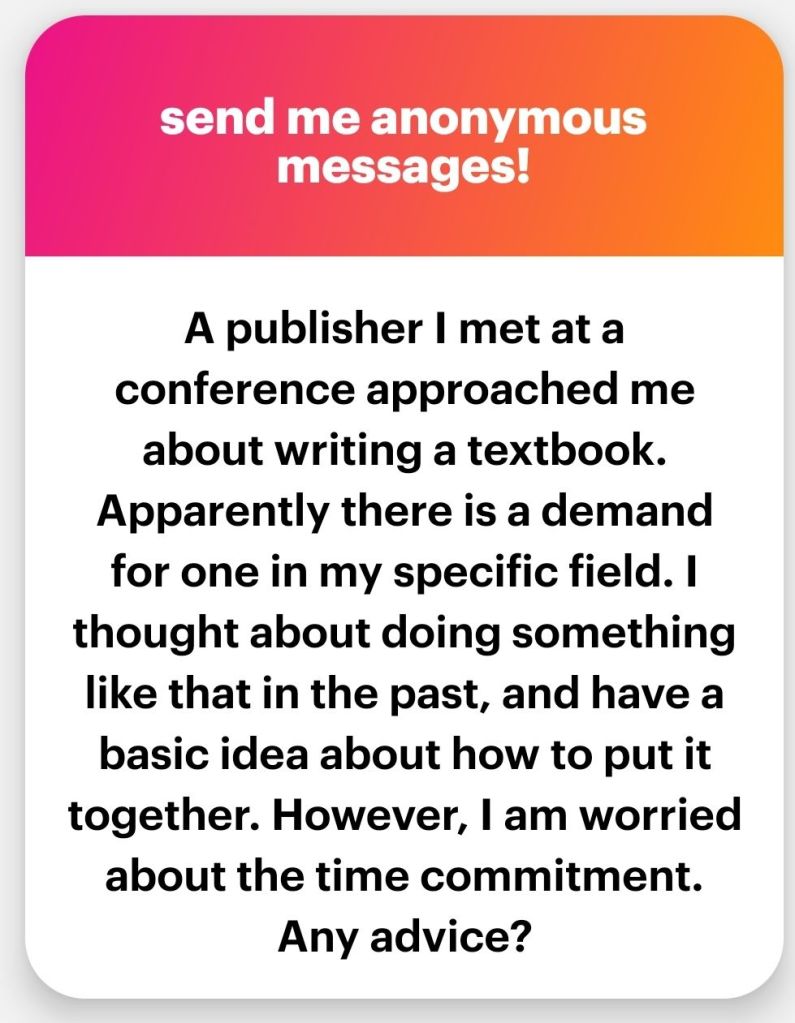
The answer really depends where you are in your academic career. If you don’t have tenure yet, please make sure you have fulfilled the tenure expectations in what concerns publications before you agree.
If you are tenured, I suggest making very certain that this is a highly respected publisher and not a vanity press or some obscure outfit. If it is reputable, then the answer should depend on how much this kind of work excites you. If you love it, then absolutely, go for it. But if you prefer a different kind of writing, then don’t torture yourself.
In terms of time commitment, I suggest creating a chapter plan, deciding how long each chapter will be, and calculating how many words you’d have to write per week to be done in a year, in 18 months, or however long you can dedicate to this plan. Is it viable? Will it coexist well with the rest of your responsibilities?
I highly recommend always starting a writing project with a specific date you will finish it. Put this date on your calendar, print out a banner with it and place it in your office, and return to thinking about that date often. Humongous, seemingly intractable writing projects slide in like a song if you know with certainty when you will write the last word.

 Clarissa's Blog
More suggestions, look at their contract terms carefully, and do not agree on uneven terms. Many publishers (even established one like Wiley and Springer-Nature) are predatory and will pay only 5-10% of royalty to writers while taking 90% or more for themselves. It is a buisness for them and they need constant supply for new books to stay sustainable in their business. Also, ask for substantial advance amount depending upon your time commitment. Read contract carefully and do not agree on any term that can put you in a bad position (f.e. choice of which state law will be used in case of a dispute). You have a lot of levarage (f.e. shop around for different publishers) if you are planning to do it.
LikeLiked by 1 person
Thank you both for advice. I am tenured, so no worries on that side. The publisher is a well established one (De Gruyter), although their entry into the STEM publishing is newer. From my brief conversation they offer 12% royalties to their authors, which appears to be on par with the other publishers. I have no idea though whether this is good or bad or how negotiable it is. I do have good contacts at Elsevier though and could talk to them about this as well.
I do not expect that this particular textbook will make anyone rich, it is more of an opportunity to put together my lecture notes and my thoughts on this topic and present it in an accessible way. I know there is a lot of hunger from non-experts to learn about this area as my classes on this topic are quite popular with students from various departments and I never struggle to fill them.
LikeLiked by 1 person
This sounds really good. I think you should go for it.
LikeLike
Thank you for the encouragement. I have decided to put together a proposal and see where it goes from there. It is inspiring to know that someone as busy as you can write and publish books alongside all her duties. It makes me think that perhaps I can do this too. If this thing goes forward and I can complete it, I will send you the book when ready.
LikeLiked by 1 person
Thank you, that’s so sweet!
Of course, you can do it. You clearly want to and there’s no reason not to give yourself permission to do it. I highly recommend saying things like “as an author of a textbook…” It doesn’t have to be aloud. Just say it to yourself.
That is, by the way, why I constantly mention my new book. I’m putting myself in the frame of mind of an author of books. If I don’t do it, a million other tasks will eat all my time. So I re-orient myself constantly towards the book.
LikeLike
Random reader: you know that the royalty is negotiable? Ask them to double (or more) and they will do it. They need authors as much as you need them. Stay firm. Don’t buy the notion that it is a industry standard. All terms are always negotiable.
LikeLike
Also, ask for advance payment to work on the book (you can calculate approx # of days/hours you will need and multiply with a reasonable rate), that should be your advance. They will add it in their contract, so don’t worry about it.
LikeLike
Great suggestions but I’m starting to feel jealous that we aren’t talking about my book. I have 2 chapters completely done and two half done. It’s 4 chapters total.
LikeLiked by 1 person
You know that the contracts are not written in stone and can be renegotiated if one of the party is not satisfies with the terms. The new terms (f.e. royalty terms from “xxx %” to “yyy %”) are put together in an amendment which both parties sign again. Alternateively, it can also be terminated (typical clause has 30 day notice). You are specially in a strong position because you have written 2 chapters already. Many publishers don’t give favorable terms or advance because they don’t know if the writer will deliver anything or not.
LikeLike
Textbooks are more negotiable since the publisher will recover the cost by selling many copies. If it is high school or intro college course text books, you will have more leverage. Again, depends upon the topic and level. It is less negotiable when it is edited book with advanced topic, but in the end, always return back asking more question and see how far they can go with their best rate. Don’t sign the contract on the first chance you get. Have your arguments ready that shows why it is an important book, your standing in the field, etc. In the end, it is a business deals for them as well as you.
LikeLike
Thank you, anonymous, for suggestions. I obviously have no idea how this works. In my field, we primarily publish papers, which, for the most part is free of charge (if you don’t count all the labor that went into collecting data/analyzing/writing). Recently, with the open access movement, there is starting to be a decent number of reputable journals that will even charge you to publish (I refuse to participate in that). I know very few people who actually wrote a book (not counting edited volumes). It’s good to know there is room to negotiate.
LikeLike
Good luck. Ask them to send their best conditions and then don’t show despration and calm try to improve the terms. You can also shop around and talk to a few different publishers. You already have a tenure so you are not in rush.
LikeLike