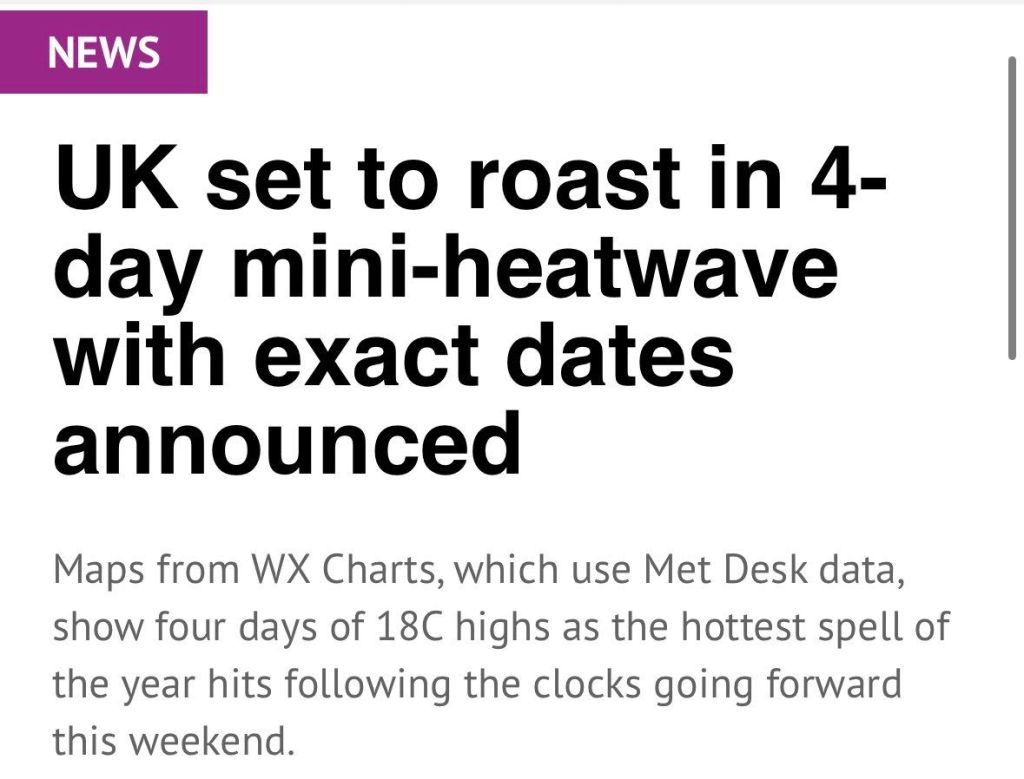
Is this why the Brits and the Germans went to war?

Rate this:
Share this:
- Share on Pinterest (Opens in new window) Pinterest
- Share on X (Opens in new window) X
- Share on Facebook (Opens in new window) Facebook
- Email a link to a friend (Opens in new window) Email
- Share on Reddit (Opens in new window) Reddit
- Share on Tumblr (Opens in new window) Tumblr
- Print (Opens in new window) Print
- Share on LinkedIn (Opens in new window) LinkedIn

 Clarissa's Blog
They roast at 65 degrees?
LikeLiked by 1 person
Something happened to the stoic, brave Brits and turned them into this mush.
LikeLike
Maybe all the heat-tolerant ones emigrated to the colonies already. Cream puffs are all that’s left.
LikeLike
“er war gestern kalt”
In order to be a pendantic twit (one of life’s great joys), shouldn’t that be “Es war kalt gestern”?
LikeLiked by 1 person
This is not pedantic at all. It should be “Es war kalt” if you are talking about the weather.
“Er war kalt.” implies that the (male) body had been dead long enough to cool to room temperature before it was found. If you want to say that someone male perceives the temperature as cold, it’s “Ihm war kalt.” This is usually taught as a personal dative construction or experiential dative construction.
Further evidence that Duolingo is a bit of a crap product.
LikeLike
It isn’t Duolingo that’s crap, it’s me making mistakes. In my justification, however, I have to say that I was overcome with confusion over the reference to the weather as being cold. 😁😁
LikeLike
I’m chuckling. Great response!
LikeLiked by 1 person
“This is not pedantic at all.”
Killjoy! Why won’t you value my lived experience?
LikeLike
Yes, the app corrected me. I’m still figuring out the German word order, which is lovely but not intuitive to me. I’m trying to make it intuitive, so I’m not looking up the foundational principles of how it’s done.
LikeLike
German word order follows very consistent rules, but it always takes learners forever to really absorb and apply them. It’s one of the things that I see as a clear proof that language learning is more complex than just learning the rules. People need tons of exposure and practice to master some rules that are really very straightforward.
LikeLike
On a positive side, yesterday I read a Wikipedia article in German about Eva Menasse and understood almost everything. 🎊🎉🎊🎉
LikeLike
I’m approaching grammar similarly. We’ll pretend it’s for high minded reasons like yours rather than just laziness 😛
LikeLike
“German word order, which is lovely but not intuitive to me”
I remember a conversation with an English speaker who was living between Germany and Poland (he preferred Germany but needed the two gigs to get by).Despite is strong affection for German he said he had trouble with extended speech because without warning he’d find himself in a word order trap that seemed to have no exit, even backing up didn’t help.
I sympathized…. For years German worder influenced my Polish and I had (among other things, a tendency to put the infinitive last) Muszę się na zajęcia przygotować (I have to for class get ready)…
LikeLiked by 1 person
Have you heard of TEKAMOLO? It’s a common mnemonic acronym for word order in German: TEmporal-KAusal-MOdal-LOkal (time-cause-mode-place).
It’s not infallible but it helps.
LikeLike
Strangely for a lifelong language teacher, I am very bad at language rules. I never learned all the cases of the Spanish subjunctive or preterite/ imperfect. Students tell me these rules and mnemonic devices that they learned with other teachers and I know nothing about them.
The way I learn and teach is by getting the feel of the language. I struggled a lot with the rules for the Spanish preterite and imperfect,for example, until a Mexican friend told me he can explain the entire thing in two words: interrupted action. The imperfect is interrupted action. Once I heard that, I never made another mistake.
Of course, many people learn through rules, exceptions, etc. But I have a piss-poor memory, so it doesn’t work for me. I need to get where it becomes intuitive.
LikeLike