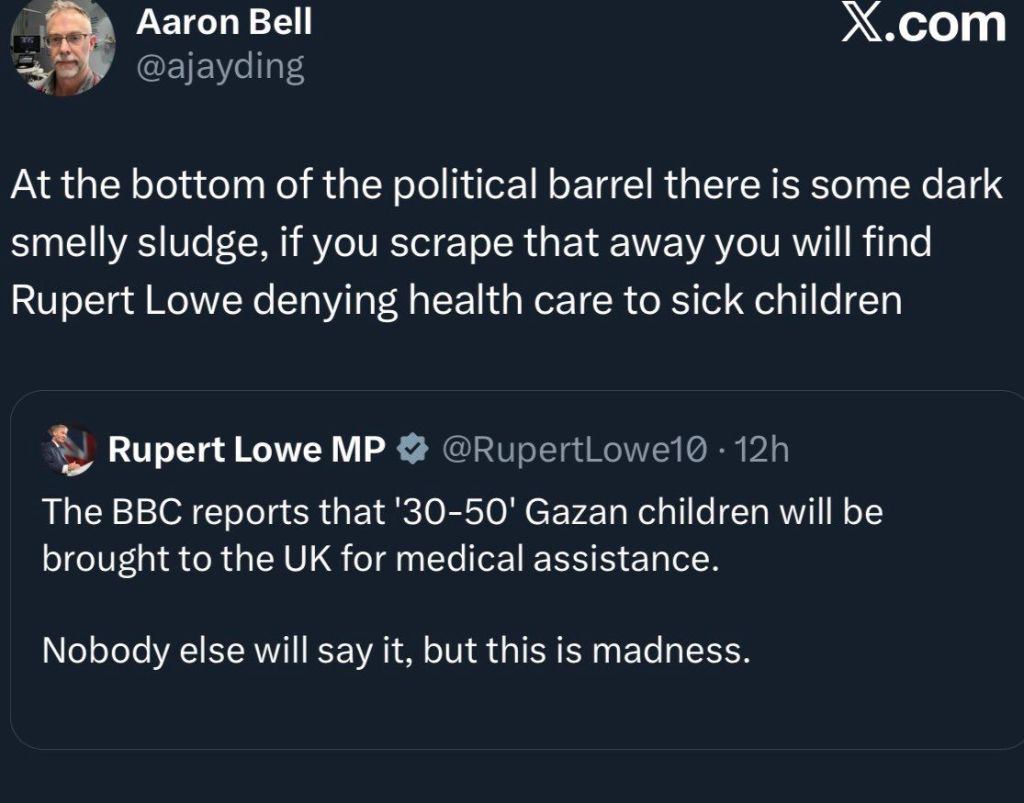
Nothing illustrates the difference in worldview around the nation-state than this exchange. There cannot be a national healthcare system that provides services to everybody on the planet. There cannot be a nation-state that guarantees rights and protections to everybody on the planet. The nation-state is by definition exclusionary.
But this exchange reveals much more than that.
Remember how I recently wrote that a healthy relationship is one that tolerates ambiguity? This is true not only for individuals but groups and countries. Aaron Bell, whoever he is, is incapable of tolerating the ambiguity of wanting to provide healthcare to British children but not to any others. His love is unhealthy because it will ultimately destroy healthcare for everybody except the wealthy who can pay out of pocket.
Aaron Bell doesn’t want to live in reality. He can’t accept that reality is imperfect. He will destroy the imperfect real in search for an impossible perfection. In interpersonal relationships, this kind of an individual will go to pieces if the object of his affections is not 100% attentive to him 100% of the time. The ambiguity of any love, profound as it might be, is that, unless you are an infant, the object of your love will not always be completely available and completely devoid of boundaries all the time. In a healthy loving relationship, you say to yourself, “today, I can see that he’s tired, distracted, needs some space. That is fine. I will respect his boundaries and step back.” In an unhealthy relationship, you throw a fit because you interpret the normal human ambiguity of “I love you to pieces but right now I want to be alone” as lack of love.
Love that doesn’t accept boundaries is not love at all. It’s a destructive, consumerist force that will eat everything in its way. If Aaron Bell really cared about the sick children of Gaza, he’d start a charitable campaign, donate, organize, find money and pay for it. I, for example, care deeply about the plight of the lonely elderly people in Ukraine. I found a group of volunteers who provide food packages and lamps to them. I donate, I help the group (@JuliaSubbotina1 on Twitter) get the cause known. I didn’t privatize the benefits while socializing the costs of my love for these elderly. I assumed the costs. That’s true, healthy love.
We live in a mentality where accepting any form of boundary is intolerable to people. Their self becomes so big that it squeezes out everything around them. There’s no space left for anything else. We need to rehabilitate such concepts as boundaries, borders, and ambiguity.


 Clarissa's Blog
Leave a comment