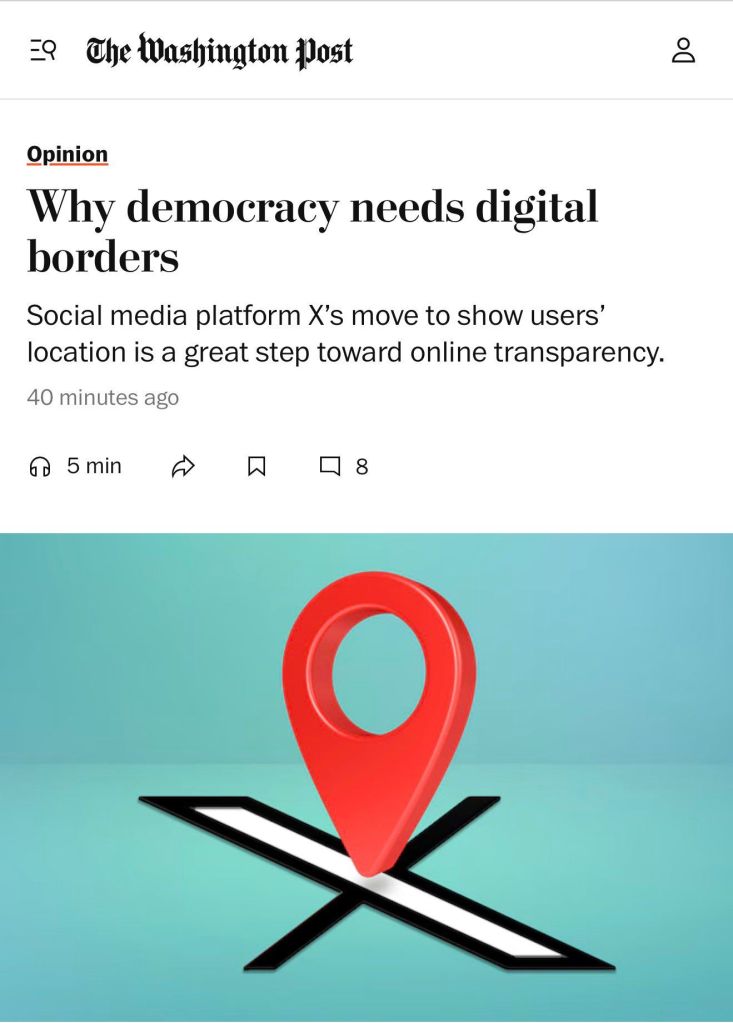
How come it doesn’t need actual borders between countries, then?
These people are full-on stupid. What’s the point of showing one’s country of origin on social media posts when “country” stops being a meaningful concept?
For days, we’ve been drowning in posts and articles about the dangers of people from other countries posting on social media. These are people who are in their countries. They aren’t committing autism fraud in Minnesota. They aren’t raping teenagers in Rome. They are in their countries. And they are the problem? Because they haven’t left?
Please observe how insistently we are led to believe that words are more important than actions. We are seriously discussing “digital borders” when the real ones, the ones that matter have been weakened into near insignificance.

 Clarissa's Blog
Yeah, I love how we instantly recognize that X accounts from India are a bad thing, but somehow infinite work visas from india are A-OK.
LikeLike
…hears Indian accent on telephone: instantly suspicious. Indian clerk at the motel or gas station: check for weird charges on credit card for 2 weeks after. etc.
I do know Indian immigrants who are great people and have assimilated well. Almost universally Christians from Goa, who are basically their own weird and not particularly respected caste back in India.
But I think we need to ask more often: if 90% of our experience with Indians (and Guyanians, and Somalis, etc) is *expectation of fraud*… why is that? Is it an accurate reflection of the originating culture? If so, do we want more of that in the US? If not, could we be more selective about who gets to immigrate?
LikeLike
The latest dispatch from the Vivek campaign: he has proposed lengthening the school day to 4 PM and eliminating summer vacation. His political instincts are so bad that many on the right thought it was an AI video made by the left to make Vivek look bad. But honestly, I couldn’t make Vivek look worse than he makes himself look even if it was my fulltime job.
LikeLiked by 1 person
It’s almost comical how out of touch he is with what Americans actually want.
LikeLike
“almost comical how out of touch he is”
He’s trying desperately to prove his tiger parents were right to deprive him of a normal, happy childhood.
LikeLike
That’s very insightful. And I mean, poor guy, I feel sorry for him but he’s tanking our chances in Ohio with his dysfunction.
LikeLike
You either do not understand what this is about or purposely move the focus to a false issue. This is about accounts pretending to be from one country but being operated from another country, e.g. MAGA accounts being operated from African, Asian or Eastern European countries, or about people pretending to be located in one country but living in another one, like some Ukrainian bloggers who push anti-Ukrainian narratives showing their country as “Europe”, or Spain.
LikeLike
Thank you for explaining the painfully obvious. The point I’m making – and please try to concentrate, hard as it might be – that people who pretend to be from another country do a lot less damage than waves of mass migration.
“Narratives”, as you call them, are not nearly as important as you think they are. Reality is important.
Please Google “Somali fraud Minnesota” before engaging in any further discussion of “narratives”.
LikeLiked by 1 person
Somalis can only dream of the fraud that orthodox jews commit.
LikeLike
Amazing.
LikeLike
While you’re at it, also google welfare fraud in orthodox jewish communities in new york. Makes somalis look like amateurs.
Also google kiryas joel.
LikeLike
Yes, the source of immigrants matter, a reality ignored in most Western countries. It is long past time to state the obvious: that charity begins at home; we cannot afford to import the world’s problems; and that we must select immigrants that strengthen our nations both financially and culturally.
These findings highlight systemic challenges in the Netherlands’ immigration policy and integration efforts, with significant fiscal and socio-economic implications. A Euro is currently worth ~$1.16 American. I apologize for the size, the 2024 source refused to copy — possibly because I am an incompetent old phart ;-D
LikeLike
“non western” covers a lot of ground. I think I saw a similar Dutch study that found Japanese immigrants were a net positive.
I’d love to see the breakdown on that for all the Asian countries: I’d guess that in addition to Japan, you might see break-even or net positive for Korean and Viet (with possibly a differential between the Catholics and everyone else) immigrants, possibly some of the others.
-ethyl
LikeLike
eyhyl
Yeah Kid, here’s Korean descendant that loves Britain and particular Scotland, because he realizes that the oatmeal savages largely invented the West — okay, that may be a tad hyperbolic ;-D
LikeLike