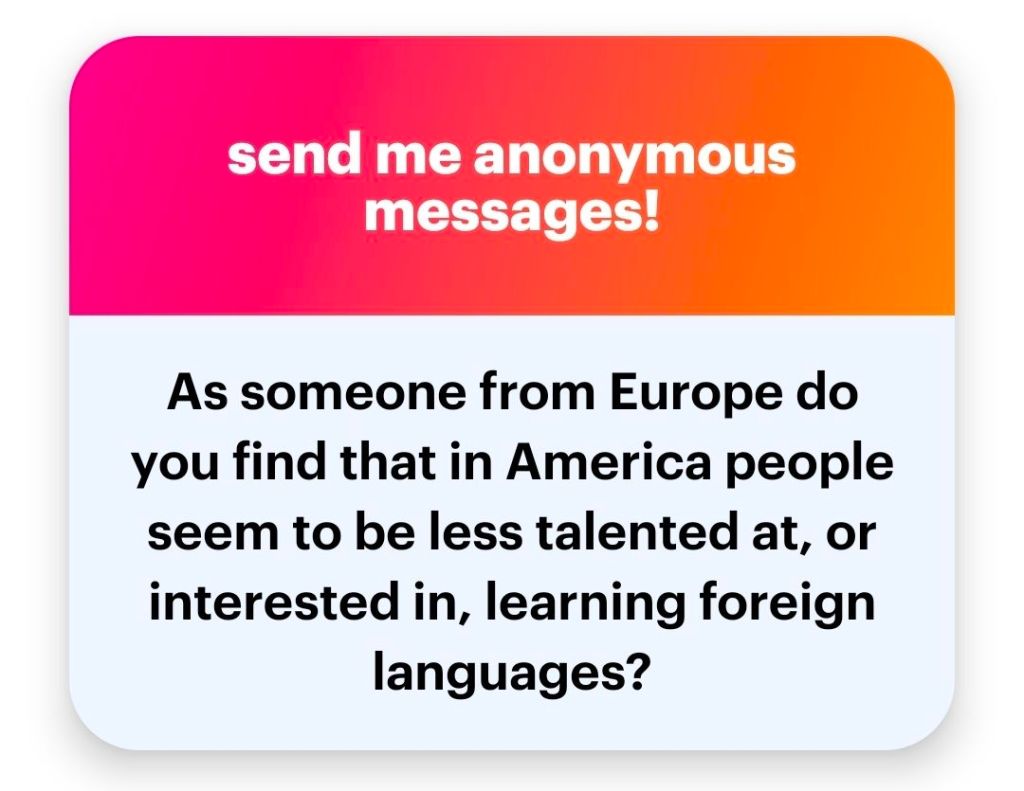
Americans are in awe of people who can speak more than one language. When my polyglottery comes up, everybody immediately begins to react like I walk on water. This makes me feel very shy. To me, moving between languages is normal. I’ve never lived in any other way. When others start treating me like some sort of royalty for something that I do as easily as breathing, I feel self-conscious.
Of course, it’s very endearing. Whenever somebody meets me for the first time and finds out about the languages, they start announcing me to other people like I’m the 7th wonder of the world. Like, they are so happy to have uncovered this wonderful phenomenon that they can’t wait to share with others. Embarrassing. Sweet, lovely, but embarrassing.
As for learning languages, I don’t see any differences in my American and my European students. Among colleagues, Germans speak amazing Spanish. Brits are downright terrible. I am talking about Hispanists, people whose profession is the study of Hispanic literature and culture. There are exceptions, of course. Here I’m speaking in generalities. The French are not as bad as the Brits, but pretty bad. Italians are, as a rule, very good, but not nearly as amazing at speaking Spanish as German colleagues. The German-speaking Swiss are also great. As I keep saying, there is an affinity here, the nature of which I do not fully understand.
What I said above, however, only has to do with the actual quality of speaking the language. In terms of producing interesting ideas in the field of Hispanic studies, British scholars are about a hundred light years ahead of the Germans.
Going back to what I was actually asked, I see no differences in teaching Americans or Europeans. They’re equally great.
The vast majority of native-born Americans NEVER travel outside of the United States, and NEVER meet, let alone interact, with anyone who doesn’t speak English — so there’s no practical need for them to learn a foreign language.
The only reason that I speak fluent German is because sixty years ago when I was a college student in Tennessee, all students getting a B..A. or B.S. degree (which I needed to get into medical school) had to take two years of a foreign language. For some reason I chose German, while most of my fellow pre-med student colleagues took Spanish (which was considered the easiest foreign language class to twiddle your thumbs through without learning or remember enough the language to ever be useful).
I don’t know exactly why, but I fell in love with German and ended up majoring in the language before moving on to get my M.D. degree.
Then six years after graduating from medical school, I joined the Air Force and spent over haff of my 21 years as a military officer overseas. (Most of the Germans I conversed with initially though I was British, because they’d never met a bilingual American,)
Dreidel
LikeLike
“majority of native-born Americans NEVER travel outside of the United States”
The idea that foreign language education is (or should be) mostly about the need to interact with speakers of said languages is fairly new.
Foreign languages have always been a bedrock of education not for dealing with foreign people but because the knock on effects of learning a foreign language (or 2 or 3) are primarily cognitive – brain skills that don’t seem to develop in any other way.
LikeLike
Exactly. The standard language to learn in school used to be Latin.
LikeLiked by 1 person
Our professor of Chinese retired last month, and on the eve of his retirement, he gave this beautiful speech about the true gains that students had from learning Chinese. Most of the students never became fluent because it’s a very difficult language. But the professor explained how important it was for the students to spend some time in the presence of true complexity and how their efforts to find the way towards even a sliver of understanding of this complexity were enriching to their lives.
Plus, you understand your own language so much better when you try to learn another one. You understand the culture that inspired your language. You understand how culture and language are profoundly linked and how extremely different the reality of people who speak another native language is.
LikeLike
Yes, if you were streamed to be aimed at university, you were expected to take both some Latin and French as well as English. But in SW Saskatchewan, low German, Gaelic, or Norwegian might have been more useful, at least the common profanity. Or maybe even some restaurant Chinese slang, a girlfriend’s mother always called me bai mi fan — white rice, an insult because removing the bran from the grain leads to B vitamin deficiency ;-D
LikeLike